Bosnia and Herzegovina has not been able to solve the issue of state property for three decades, mostly because of the maximalist and exclusive demands, the interpretation of the authorities of the Republika Srpska entity.
They believe that the property of the state of Bosnia and Herzegovina “belongs to the entities”, and their last attempt to appropriate it was canceled by the high representative in Bosnia and Herzegovina, Christian Schmidt. In February 2023, he issued a decision repealing the Law on Immovable Property of the RS. However, even since then, the law on the state property of Bosnia and Herzegovina has not been adopted, although the majority of domestic politicians and international “mediators” are trying to find a certain compromise solution. Nevertheless, it seems that the “Gordian knot” could finally be untied.
“Softer” attitude of the RS
Namely, the attitude of the authorities in RS recently, after the recent visit of their delegation to Washington, seems to have somewhat “softened”. Due to the sequence of events, it could be assumed that the issue of the state property of Bosnia and Herzegovina is part of the “settlement” package of the United States of America (USA) with Milorad Dodik, after the administration of President Donald Trump suddenly lifted sanctions on him and his associates in October of last year.
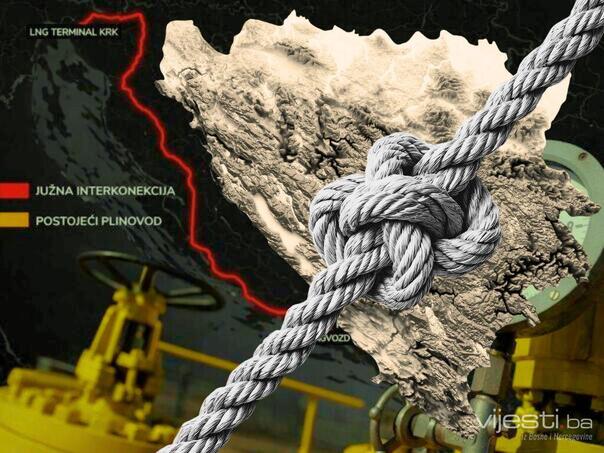
This is indicated by the statement of Željka Cvijanović, a member of the Presidency of Bosnia and Herzegovina from the RS, Dodik’s closest associate from the Alliance of Independent Social Democrats (SNSD), “that the RS through state institutions will not stand in the way of the construction of the Southern Interconnection”, by which Bosnia and Herzegovina will cease to be dependent exclusively on Russian gas.
And, in order to start the construction of the Southern Interconnection, the preparations of which are well under way, the issue of state property should receive clear outlines.
“The Southern Interconnection project will be a watershed that, after three decades of political discussions, will define the ways of dealing with state property,” said Muharem Cero, an expert on state property issues, in an interview with Radio Free Europe.
He emphasized that the solution is necessary to ensure the legal security of investors from the USA and to avoid potential arbitration processes that could cost Bosnia and Herzegovina millions.
He did not rule out the possibility of passing a special law that would offer a solution for the land through which the gas pipeline will pass. He also reminded that the judicial institutions have several cases related to the illegal sale or disposal of state property and that the new solution should not legalize the previous dismemberment.
What is and where is state property?
Bosnia and Herzegovina owns 1,000 units of state property, according to incomplete data submitted to the Office of the High Representative (OHR). 979 of them are in Bosnia and Herzegovina and 21 abroad, of which the most are in Croatia – 14.
There are 552 units of state property on the territory of the Federation of Bosnia and Herzegovina, 404 in the RS and 23 in the Brčko District. More than 30 percent are military property.
State property includes movable and immovable property, diplomatic and consular property, as well as financial claims and debts. For example, these are rivers, forests, military facilities, construction and other land, real estate and other facilities, works of art, manuscripts, books, scientific and other collections, as well as archives, they write Vijesti.ba