
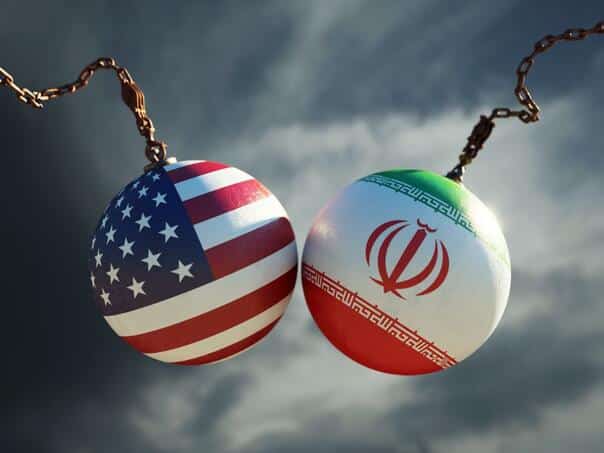
US officials, on the other hand, have repeatedly emphasized that Iran, not the US, is holding back progress in the protracted negotiations, writes the BBC.
Yesterday, US Secretary of State Marco Rubio said that President Donald Trump prefers an agreement, but that it is very difficult to achieve one with Iran. But in an interview with the BBC in Tehran, Iran’s Deputy Minister of Foreign Affairs, Majid Takht-Ravanchi, said that the United States is on the move and that they must prove that they want an agreement.
He added: “If they’re honest, I’m sure we’ll be on the way to a deal.”
Trump has threatened to attack Iran if a deal is not reached to limit its nuclear program, while the US is also building up its military presence in the region.
The escalation comes after Iran violently suppressed anti-government protests across the country last month, which rights groups say have killed thousands of people.
The US and Iran held indirect talks in Oman earlier in February. Takht-Ravanchi confirmed that the second round should take place on Tuesday in Geneva and assessed the talks so far as “more or less positive, but it is too early to judge”. Trump also described the talks as positive.
As proof of willingness to compromise, the deputy minister highlighted Tehran’s offer to dilute its enriched uranium to 60 percent.
That level, close to that needed to make weapons, has deepened suspicions that the Islamic Republic is moving towards developing nuclear weapons, which Tehran has always denied.
“We are ready to discuss this and other issues related to our program if they are ready to discuss sanctions,” Takht-Ravanchi said. He did not specify whether this means the lifting of all or only some sanctions.
Asked whether Iran would agree to ship its more than 400 kilograms of highly enriched uranium out of the country, as it did under the 2015 deal, he said it was “too early to say what will happen during the negotiations.”
Russia, which accepted 11,000 kilograms of low-enriched uranium as part of the 2015 deal — from which Trump withdrew three years later — has offered to take the material back.
One of Iran’s key demands was that the talks focus solely on the nuclear issue.
“Our understanding is that they have come to the conclusion that if a deal is to be reached, the focus should be on the nuclear issue,” Takht-Ravanchi said.
If confirmed, it would be a key step forward for Iran, which sees Washington’s demands – for a complete halt to enrichment – as an obstacle to any deal.
Iran considers this a red line and a violation of its rights under the Treaty on the Non-Proliferation of Nuclear Weapons.
Takht-Ravanchi told the BBC that “the issue of zero enrichment is no longer an issue and, as far as Iran is concerned, it is no longer on the table”.
That contrasted with comments Trump made to reporters on Friday, saying, “We don’t want any enrichment.”
The Iranian negotiator also reiterated that Tehran refuses to discuss its ballistic missile program, a key demand from Israel, the country where the missiles are aimed.
“When we were attacked by the Israelis and the Americans, our missiles came to our aid, so how can we accept to lose our defense capabilities,” he stressed.
An Iranian diplomat expressed concern over the contradictory messages of the US president.
“We hear that they are interested in negotiations. They said it publicly, they also said it in private talks through Oman,” he said.
However, in his latest remarks, Trump again focused on regime change, stating, “It seems like that would be the best thing that could happen.”
“We don’t hear that in private messages,” Takht-Ravanchi noted, referring to messages relayed through Omani Foreign Minister Sayyid Badr bin Hamad Al-Busaidi, who is now the chief Arab mediator.
Takht-Ravanchi also questioned the strengthening of the US military presence in the region, warning that another war would be “traumatic, bad for everyone … everyone will suffer, especially those who initiate that aggression”.
He added: “If we feel this is an existential threat, we will respond accordingly.”
Asked if Iran would consider a US military campaign a struggle for survival, he replied: “It is not wise to even think about such a dangerous scenario because the whole region will be in chaos.”
Iran has repeatedly made it clear that it would consider US military bases in the region as legitimate targets.
When asked about the more than 40,000 US troops now deployed in the region, Takht-Ravanchi said that would be a completely different situation.
Senior Iranian officials are holding intensive talks with counterparts across the region, who have in turn spoken to President Trump by phone about the urgency of avoiding war.
“We see that almost everyone in the region wants to avoid war,” Takht-Ravanchi said.
Iran has repeatedly accused Israel of trying to sabotage the negotiation process. The surprise Israeli attack last June, which triggered the so-called 12-day war, came just days before Iran was due to meet the US envoy, denting Tehran’s confidence.
Iran is known to have been disappointed by the lack of progress in last year’s talks, and Iranian officials have criticized that deals reached in one round are often changed by the next meeting.
The participation of US President Jared Kushner’s son-in-law in the last talks in early February was interpreted by Iran as a positive signal of greater US involvement.
Although many observers remain skeptical that a new agreement is within reach, Takht-Ravanchi said Iran will go to the next round of talks in Geneva with the hope that a deal can be reached.
“We will do our best, but the other side must also prove that it is sincere,” he concluded.
(Vijesti.ba)


