
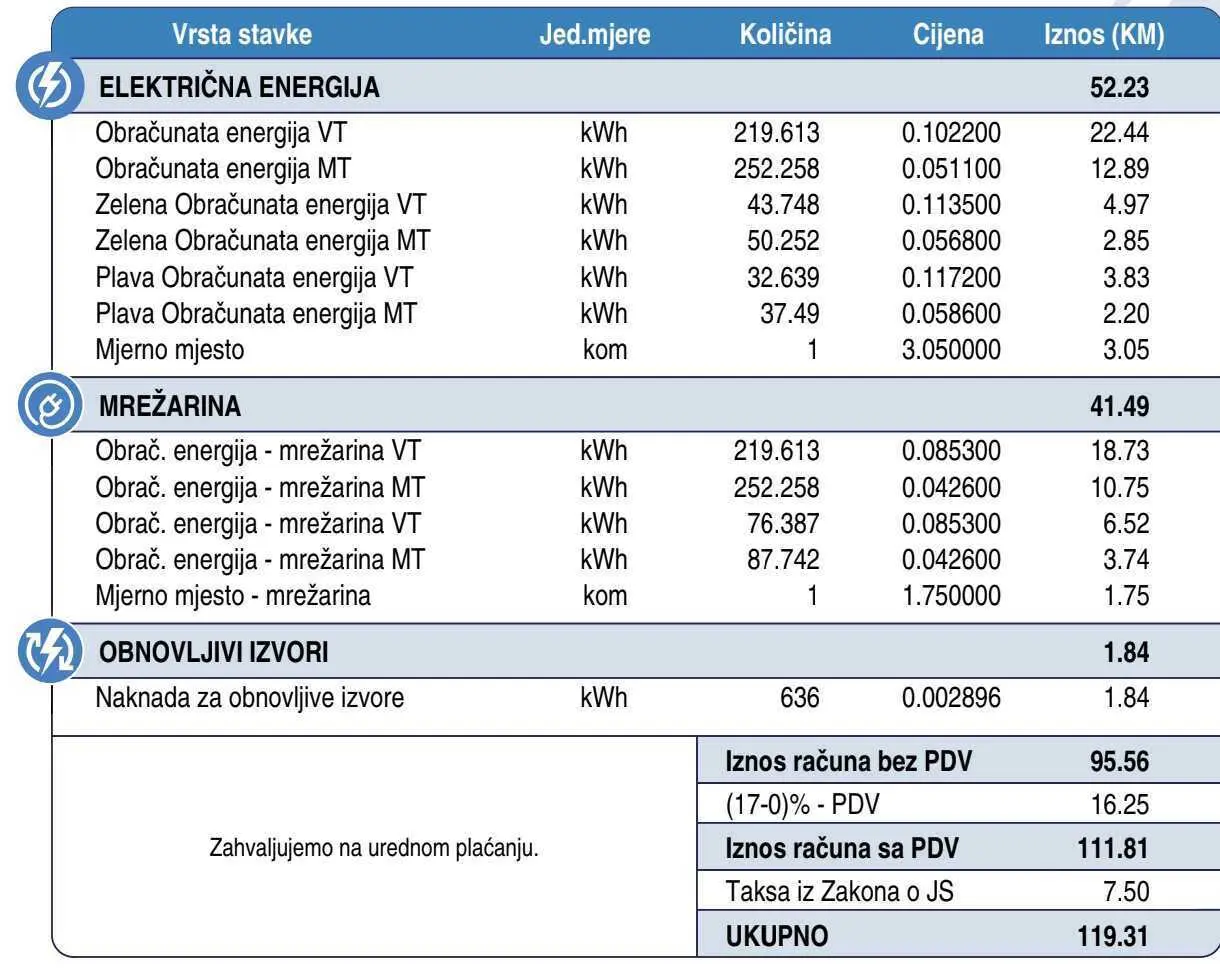
If you’ve ever opened an electricity bill and wondered why we pay a grid fee, apart from the electricity used, you’re not the only one.
Many citizens in the Federation of Bosnia and Herzegovina have the feeling that they are paying something extra that they did not notice before, or that they are paying for electricity twice. However, the network fee is not the same as the price of electricity, but a cost related to a completely different part of the system.
The network charge exists because electricity is not only a product that we buy, but also a service that must be enabled through a network that works every day, regardless of weather conditions, breakdowns or increased consumption.
What exactly is the net fee?
The network fee is a fee paid for the use of the electric power network, that is, the system of transmission lines, substations, cables and distribution infrastructure that brings electricity to households and companies.
In other words, it is not enough to generate electricity. It must be transferred and safely delivered to your meter. This is exactly what is paid through the network fee.
Citizens often perceive the network fee as a “hidden” cost, but it is essentially the cost of maintaining the system that allows electricity to reach the outlet in the first place.
Why is the network fee separated from the price of electricity?
In the Federation of Bosnia and Herzegovina, the electricity bill is separated so that the consumer can clearly see what he is paying for. One part of the bill refers to electricity as a product, that is, to the kilowatt hours you used, while the other part of the bill includes network costs.
That separation is not accidental. The electricity sector is organized so that the production and sale of electricity are separated from transmission and distribution. This ensures transparency and better cost control.
If everything were combined into one item, consumers would not be able to know how much they are paying for the energy itself, and how much for the infrastructure needed to deliver that energy.
What is financed through the network fee?
The network fee in practice finances the maintenance and functioning of the electricity distribution system. This includes the work of teams in the field, interventions after breakdowns, rehabilitation of damaged lines, maintenance of substations and regular technical inspections.
In addition, through the network fee, investments in the modernization of the network are financed, which is especially important at a time when more and more electricity is being consumed, the number of connections is increasing, and when the network has to bear greater loads.
In short, the network fee is a cost that enables supply stability.
Do we pay the network fee to Elektroprivreda?
The network fee does not apply to the electricity producer, but to the electricity distribution. In the Federation of Bosnia and Herzegovina, electricity distribution companies manage the network and are responsible for ensuring that electricity reaches every consumer.
That is why the network fee is not income from the sale of electricity, but income that serves to maintain, repair and improve the network.
This is one of the key reasons why the network fee is shown as a separate item on the bill.
Is the network fee the same for all citizens?
It’s not. The amount of the network fee depends on the tariff category of the consumer and the method of calculation, as well as on the consumption and power of the connection. In practice, the network charge may include multiple elements, such as distribution, metering and billing fees, and other regulated items.
That is why two households do not have to have exactly the same amount of network fee, even if they have similar consumption.
Who determines the price of the net fee in the Federation of Bosnia and Herzegovina?
In the Federation of Bosnia and Herzegovina, network fee prices are not arbitrary. They are determined by the Regulatory Commission for Energy in the Federation of Bosnia and Herzegovina, FERK, which makes decisions on tariffs and approves distribution prices.
FERK’s role is to regulate the sector and ensure a balance between the interests of consumers and the need for the electricity distribution system to have sufficient funds to maintain the network.
In other words, the network fee cannot be increased without the decisions of the regulator.
Do we pay the grid fee because we pay “twice for electricity”?
No. The network fee is not an additional price of electricity, but the price of the infrastructure.
Electricity is what you consume, and the grid fee is what allows that energy to reach you. Those two parts are different, but both are necessary.
The simplest explanation is that we pay for both the product and the delivery service through the invoice. Just as it is not the same to buy fuel and pay for the maintenance of the road you drive on, it is not the same to pay for electricity and pay for the network that transmits it, he writes RTV Slon.


