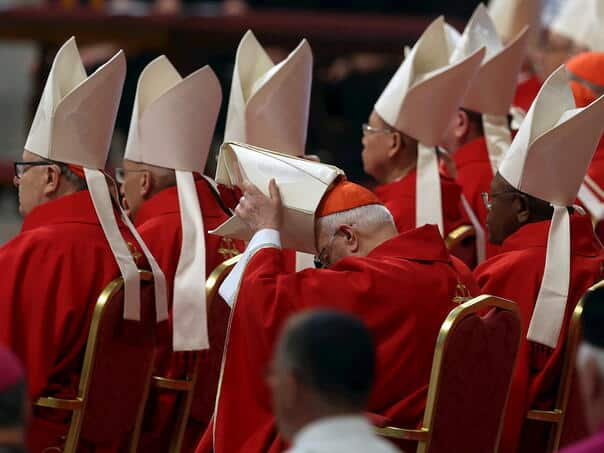
Cardinals participate in it – the highest members of the Catholic Church, also known as the “Princes of the Church”. Only cardinals under the age of 80 have the right to vote, and two apologized for health reasons. Cardinal Angelo Becciu, convicted of fraud and embezzlement in 2022, does not participate. The Vatican confirmed that all 133 menus arrived in Rome.
More than 50 menus come from Europe, with a large majority of Italians. The USA is 10, from Asia 23, from Latin America 21, and from Africa 18.
What does the beginning of a conclave look like?
Cardinals in red uniforms move from the home of St. March towards the Sistin Chapel, handing over cell phones, and the room has been previously checked on the wiretapping devices and signal interference. All menus take an oath of secrecy.
Then the ceremonium pronounced, “Extra Omnes!” – All except the menu and several officials and doctors must leave the chapel, and the door is locked. Then the Izolation of the cardinals beginning, which are completely cut off from the outside world and information from it, and they cannot even open windows. Failure to do the rules are risked from the church from the Church and Monsignor Paolo de Nicolo, who was at the head of the Papal Home for three decades, says no one dares to do so.
There is no discussion or speech in the Sicinean chapel. The first voting will most likely be held on Wednesday afternoon, followed by four votes per day – until one candidate gets a two-thirds majority.
The day of the cardinal begins with Mass, lunch break is around 12:30, and the voting continues in the afternoon. The day ends with a joint evening prayer and return to the Chamber of St. March to dinner. As this building has only 120 rooms, additional accommodation units are provided for the excess cardinal.
If no results can even after three days, cardinals can take a day of rest for prayer and consideration.
How is the vote?
Each cardinal gets a table, pencil and ballots with the inscription “Eligo in Summum Pontific” (“I choose to be the supreme chief”). The leaf writes the name of the candidate, folded paper and insert it in the bronze urn.
The three counter is randomly drawn randomly, three who collect votes from ill cardinals, and three controllers.
The leaves are counted, then break through the needle through the word “eligo” and tie into a bundle. They then burn in the furnace – if there is no selected pope, smoke is black; If it is, smoke is white. Through the chimney on the roof of the Sikstine Chapel smoke comes out to light, and the Vatican Firefighters are on standby.
When white smoke appears, the ads of the Holy Peter Basilica – a sign that “Habemus Papame”, “we have a Pope”.
What follows after the candidate gets a majority of votes
Dean of the cardinal choir raises the question: “Do you accept the canonical choice for the Supreme Chief?” If the candidate agrees, chooses a papal name. Other cardinals then expressed obedience.
The new Pope goes to the adjacent “room of tears”, where he changed from the red cardinal uniform in the White Papinsk. Usually, the three sizes of uniform is prepared in advance, and it is believed to be used this time the existing uniforms from previous conclaves.
Then he appears on the main balcony of the Holy Peter basilica and is addressed for the first time gathered.
How long can a conclave last?
Everything from a few hours to a few weeks. The longest conclave in history, in 13. century, lasted two years and nine months. At 20. and 21. century most of the conclaves lasted two to three days, and the longest conclave in the two centuries lasted five days.
If no winner is organized at this time, the second round of voting between the two with the most votes – but also need a two-thirds of 133. If no results are not yet clearly defined, it says index.hr.
Who are Favorites
As the main favorites before the conclave were mentioned by two cardinals – Pietro Parolin and Luis Antonio Tagle.
Italian Cardinal Pietro Parolin (70), long-term Secretary of the Vatican and the closest collaborative of Pope Franje, is considered an unprimceptant candidate. It is known for its diplomatic experience and moderate attitudes, and participated in key negotiations with China and the United States. He speaks more than more languages, but there is no pastoral experience, which some resent him.
Philippine Cardinal Luis Antonio Tagle (67), Former Archbishop Manila and the current Leader of the Dycaster for Evangelization, is often mentioned as a successor in Francis Spirit. It is known for the closeness to the people, advocating the church for the poor and open criticism of abuse within the church. Still, it was criticized due to poor control over Caritas management.
Prominent shadow candidates
There are also several of the appearance of the shadow candidates with them:
- Matteo Zuppi – President of the Italian Bishop Conference, close to Francis Social Science, active in peace diplomacy (eg Ukraine). It is very often cited as the most attractive compromise candidate.
- Jean-Claude Hollerich – the main reporter of the Synodal Process on the Future of the Church, close to Pope Francis, known for more open attitudes, especially about the role of women and LGBTQ + believers. It is regularly mentioned among serious candidates.
- Peter Turkson – Although 2013 was considered a favor from Africa, today less often mentioned, but it is still in combination, especially if the candidate outside Europe was requested. It is a moderate candidate.
- Marc Ouellet – once a leading conservative candidate from Canada. After he was faced with charges of sexually inappropriate behavior, which were later rejected. However, they disturbed his reputation, but it is still mentioned as a potential candidate in the event of a blockage between “left” and “right”.
It is important, however, emphasize that the conclave is unpredictable, and the real favorites are often not the most visible before the election itself.
(Vijesti.ba)