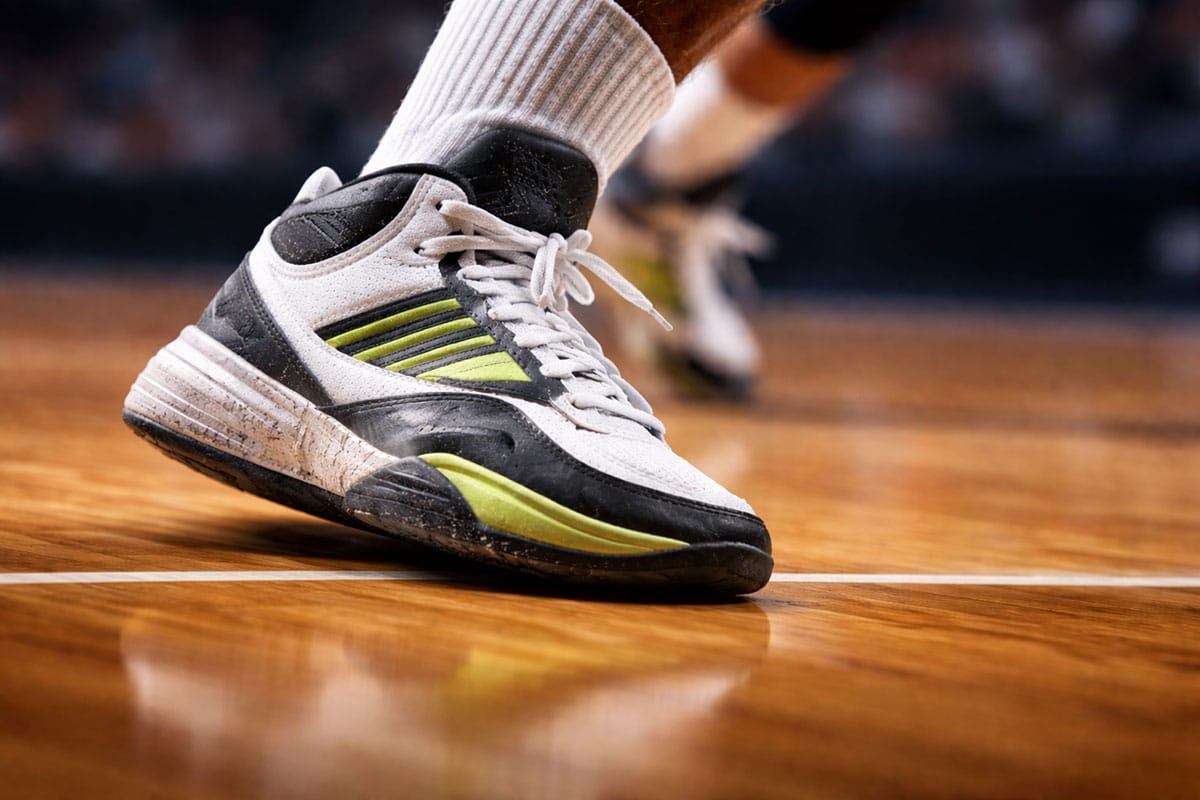
While watching the Boston Celtics NBA game from the stands of the TD Garden, one noise kept attracting Adel Djellouli’s attention.
This crunching sound as the players skate across the floor is everywhere. It’s always there, isn’t it? he wondered.
Squeaky tennis shoes it’s part of the symphony of a basketball game, when rubber soles scrape the floor as players take quick steps, cut lanes and turn, and defenders move their feet to stay in front of their player.
Driving home after the game, Djellouli wondered how does that sound come about?. And as a materials scientist at Harvard University, he had a way to examine it.
Djellouli and colleagues slid a tennis shoe over a smooth glass plate over and over again. They recorded the squeak with a microphone and recorded everything with a high-speed camera to see what was happening under the sole.
In a study published Wednesday in the journal Nature, they described what they found. While the sneaker “works” to maintain grip, small parts of the sole change shape while they momentarily lose and then re-establish contact with the ground thousands of times per second – at a frequency that corresponds to the pitch of the loud screeching sound we hear.
That squeak is basically your shoe ‘rippling’, i.e. creating creases that travel super fast. Those waves repeat at a high frequency and that’s why you get that screeching sound, Djellouli explains.
Why you shouldn’t wear the same sneakers all the time
Patterns on the soles can also play a role. When the researchers slid blocks of flat, perfectly smooth rubber over the glass, they saw a sequence “chaotic, disorganized waves”but they didn’t hear the screeching.
Ridged, channeled patterns on the bottom of the sneakers can organize those impulses to create a clean, high-pitched sound.
Other scientists have studied these impulses before, but this study with tennis shoes analyze the friction that occurs at much higher speeds. And for the first time, it connects those rapid pulses with the screeching sound they produce.
These insights are not just to satisfy the curiosity of a basketball fan. They can help answer important practical questions.
Friction is one of the oldest and most complex problems in physics, wrote physicist Bart Weber in an editorial accompanying the new research. However, despite its practical importance, he added, “it is difficult to manage and difficult to predict.”
A better understanding of friction could help scientists better understand how Earth’s tectonic plates move and rub during earthquakes, or to save energy by reducing friction and wear.
Do you know what the last hole on the sneakers is for?
It could also help eliminate moments off the field when squeaky shoes can be a bit awkward or uncomfortable, say in a quiet office hallway.
This research does not offer a direct solution, although the Internet does a bunch of tips that can be risky, including rubbing soap or dryer fabric softener on the sole. But some insights from the study could help design squeak-free sneakers in the future.
So, for example, one additional experiment showed that changing the thickness of the tire can make the screeching sound lower or higher in pitch. In the future, could we fine-tune sneakers to squeak at such a high frequency that we simply can’t hear them?
Now we can start designing with that in mind. We can start making contact surfaces that do if we want to hear this sound, or don’t if we don’t want to hear it, said Weber from the Advanced Research Center for Nanolithography and the University of Amsterdam.
(www.jabuka.tv)