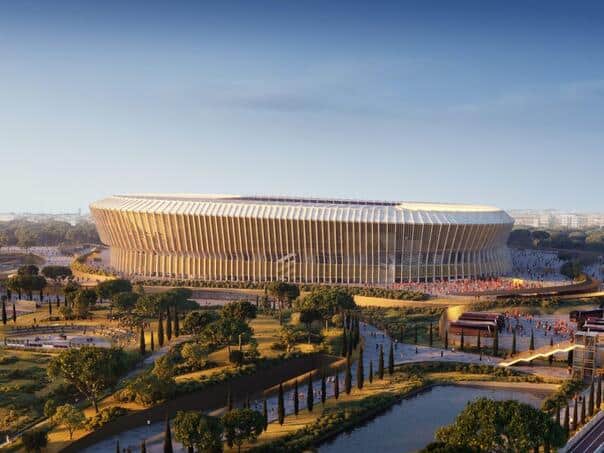
The plan also includes two parks, three new bridges and more parking zones, with an estimate that total indirect revenues will exceed 3.3 billion euros, writes Il Messaggero.
The project foresees 2,280 parking spaces for cars in the stadium area, additional parking spaces near the stadium, and 2,897 spaces in parking lots for transferring to public transport.
According to the confirmed economic and financial plan, the costs are broken down by item:
stadium 633 million euros,
two parks 27 million,
three stations for bikes and scooters, 773 thousand euros,
different parking lots almost 50 million,
three pedestrian-bicycle bridges almost 12 million,
adaptation of the metro station Quintiliani over 2 million euros.
The delivered project itself already cost more than 26 million euros, while the implementation project will cost 25.5 million.
When taxes, contributions, technical and unforeseen costs are included, the total amount reaches almost 1.048 billion euros, with an additional VAT of 204.5 million euros.
Financing is planned through a bank loan of 600 million euros during the construction period (2027-2030), special financing to cover VAT of 205.3 million euros, and the share capital of owners or future partners in the amount of 572.1 million euros.
Revenue projections start from 2031, when the stadium is expected to open: 153.6 million euros in the first year, 156 million in the next, and growth to 165 million euros in 2035.
Towards our new stadium
https://t.co/9deqJLs7UT#ASRoma pic.twitter.com/4lSxbq6yzO
— AS Roma English (@ASRomaEN) July 24, 2024
In the first year, the largest part of the income (118 million euros) is planned from tickets and subscriptions, followed by rights to the name of the stadium (7.7 million), food and drinks (4.5 million), sponsorships (7.8 million), management of parking lots (3.1 million), museum (3.5 million), sales of goods (1 million) and other events (6.5 million euros).
The expected net profit of the club after all expenses is estimated at 60 million euros.
Roma also submitted a draft contract that would tie the stadium to the Pietralata area for 90 years, through a building right model: The City of Rome remains the owner of the land, and Roma gets the right to build and manage the revenues.
The value of the assigned right is estimated at 13.75 million euros, and according to the draft contract, all works will be financed by Roma, which will manage parking lots in the stadium area and have the right to collect parking fees, while the City will receive 50% of the revenue from non-standard parking fees.
The club plans to establish a separate company for the management of the stadium, with the possibility of renting the stadium, parking lot and bars.
The final capacity of the stadium is predicted to be 60,605 seats, whereby the southern tribune (Curva Sud) would accommodate 22,769 fans and be nine meters higher than the northern one, and its 22 entrances would be inspired by the 22 historic city districts of Rome.
The northern stand should have 7,163 seats, in addition to the already mentioned 3,237 seats for away fans.
Three types of parking are planned (stadium zone, near the stadium and transfer hub), and the club estimates that 55% of fans will use public transport only, 15% will come by car to the transfer hub, 12% will come by car directly, 13% by motorcycle, 4% on foot or bicycle, and 1% by taxi.
In the stadium zone, 2,280 spaces for cars and 5,712 spaces for motorcycles are provided, while there would be a total of 2,897 spaces in the parking lots for transfers.
Three pedestrian-cycling bridges are also planned: near the Tiburtina station, on Livorno Street, and a new bridge on Monti di Pietralata Street (as a replacement for the previously planned one on Monti Tiburtini Street), while the construction of the originally planned bridge remains the responsibility of the City.
The total construction time is estimated at 37 months, the laying of the foundation stone is planned for 2027 (the club’s 100th anniversary), and the opening of the stadium is expected in 2031.
(Vijesti.ba)