
The goal is to quickly strengthen the German armed forces because it is estimated that Russia could be able to launch an attack on NATO members as early as 2029.
As part of its modernization, the Bundeswehr is ordering several thousand combat drones for the first time. The war in Ukraine showed that drones are a decisive factor, and young technology companies gained the upper hand: Stark Defense from Berlin and Helsing from Munich. Ordered “kamikaze” drones, so-called “loitering ammunition”, they fall on targets and in the process destroy themselves. The plan is to equip the Bundeswehr brigade in Lithuania with them, for stronger protection of NATO’s eastern wing.
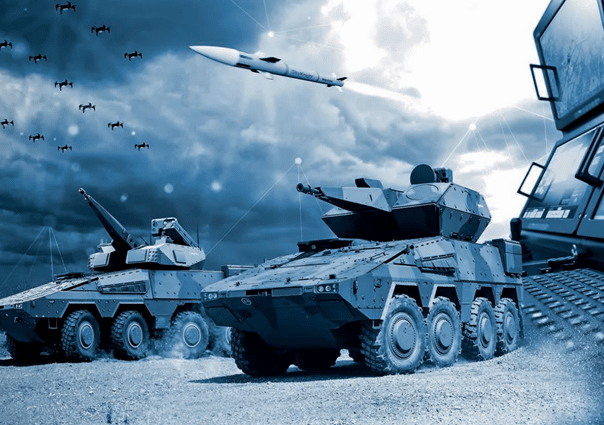
At the same time, the Bundeswehr is strengthening its anti-aircraft defense. In addition to electronic jamming and the Skyranger 30 anti-aircraft armored vehicle, which can suppress swarms of drones, laser weapons are also planned for the Navy. The Skyranger, manufactured by Rheinmetall, is due to arrive in 2028 and become a key system of the newly formed anti-aircraft unit of the Army.
Procurement also includes large international contracts. Germany has ordered 35 F-35A stealth fighter jets from Lockheed Martin for almost ten billion euros. These planes can carry American nuclear bombs, thus taking over the role of the Tornado-planes of the Bundeswehr. In addition, 60 CH-47 Chinook heavy transport helicopters (€7.3 billion) and the P-8A Poseidon maritime reconnaissance aircraft were purchased, whose advanced sensor technology enables the surveillance of large sea areas and the detection of submarines.
Artificial intelligence is becoming an indispensable part of armed systems. The Uranos KI project should help the Bundeswehr brigade in Lithuania analyze large amounts of data from sensors, for example to detect enemy drones. Details of the project are kept strictly confidential.
However, modernization is not without problems. The F126 frigate encountered major technical and financial challenges, so the Dutch contractor Damen Naval abandoned part of the project. The German company Naval Vessels Lürssen takes over the completion, while MEKO A-200 type frigates are being procured from TKMS (7.8 billion euros) for urgent needs.
For uniforms and personal equipment, the Bundestag approved funds for all 460,000 soldiers, which includes the reserve. Currently, the Bundeswehr has around 184,000 members, but the plan is to increase the number significantly. Defense Minister Boris Pistorius points out that the new soldiers will not be dressed in “tracksuits”, but in an adequate uniform ready for combat tasks.
With these investments, Germany wants to ensure a rapid and strategically effective strengthening of its armed forces, from drones and artificial intelligence to aircraft and ships, thereby strengthening NATO’s eastern flank and its own ability to deter threats.
(Vijesti.ba)


