
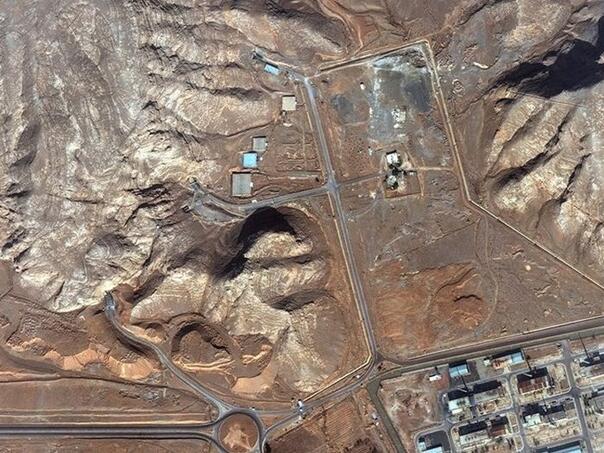
The activities are taking place at a time of heightened tensions, while negotiations between Iranian and American officials continue. US President Donald Trump has threatened new military actions against Iran if Tehran does not agree to a new deal on its nuclear program.
Renewal of the nuclear program
The footage, first analyzed by the US think tank Institute for Science and International Security (ISIS), shows the reinforcement of tunnel entrances on Kolang Gaz La Mountain, also known as Pickaxe Mountain.
Experts say that the facility could be intended to protect Iran’s uranium enrichment activities or key equipment, but its exact purpose, as well as whether it is already operational, remains unclear.
Iran maintains that its nuclear program is purely peaceful and rejects accusations that it is trying to develop nuclear weapons. However, Trump declared in June 2025 that Iran was only one month away from having nuclear weapons. Then, during the 12-day war between Israel and Iran last year, he ordered attacks on three underground nuclear facilities where centrifuges were used to produce highly enriched uranium.
Trump asserted that the strikes had “destroyed” Iran’s enrichment facilities, but added that Iranian officials were “thinking about starting a new site.”
Plant protection
Pickaxe Mountain was not among the sites hit in the June 2025 US-Israeli airstrikes, but the Natanz nuclear facility, located about two kilometers to the north, was targeted.
Satellite imagery from February 10 shows freshly poured concrete above one of the entrances to the compound on Pickaxe Mountain. A concrete pump is also visible at the site, as confirmed by ISIS analysts and the British intelligence analysis company Maiar.
At the second entrance to the tunnel, the alignment of rocks and soil is visible, as well as a new concrete-reinforced structure nearby. ISIS experts estimate that these changes are aimed at strengthening the protection of the entrance from a possible air attack.
According to their assessment, the constant presence of heavy construction machinery and materials suggests that the facility is not yet ready for operational use.
“Iran previously claimed that the construction was related to the renovation of a facility to assemble advanced centrifuges, but the size of the facility and the protection provided by the high mountain immediately raised concerns that other sensitive activities, such as uranium enrichment, could be planned,” according to ISIS.
Plant rehabilitation works
Satellite images also show remediation and defense strengthening work at the nearby Natanz facility and at the nuclear complex in Isfahan, 125 kilometers to the north.
In Isfahan, according to ISIS analysis, all the entrances to the tunnel complex are now filled with earth. Such burial, according to experts, can mitigate the effects of an air attack, but also make it difficult for ground operations aimed at taking over or destroying highly enriched uranium that could be inside the facility.
At the location in Isfahan, a new roof was built on a building believed to have been used in the production of centrifuges, which was damaged in an Israeli attack last year.
The work is also visible above ground in Natanz, a site damaged by Israeli and US airstrikes last June. Between early December and January, a roof was built over the damaged drone protection system at the enrichment facility. ISIS estimates that the roof was installed to prevent observation of the activities taking place below it.
Is Iran expecting an attack?
Professor Sina Azodi, director of the Middle East Studies Program at George Washington University in the US, believes that Iran “acts under the assumption that attacks will happen and must protect the facilities as much as possible.”
“Iran’s nuclear program has not been destroyed,” he added. “Once you have the knowledge, capacity and technology to rebuild a program, you can always rebuild it.”
The head of the International Atomic Energy Agency (IAEA), Rafael Grossi, told the BBC that a new nuclear deal between Iran and the US is possible and urgently needed.
“My impression, after talking to everyone involved, is that we have a window of opportunity, but such windows can close suddenly, so I think we have to seize the moment,” Grossi said in an interview at the Munich Security Conference.
He added that he believes that an estimated 400 kilograms of highly enriched uranium, which is technically only a step away from the level needed to make weapons, is still in the underground tunnels and chambers where the US dropped bunker busting bombs last June.
(Vijesti.ba)


