
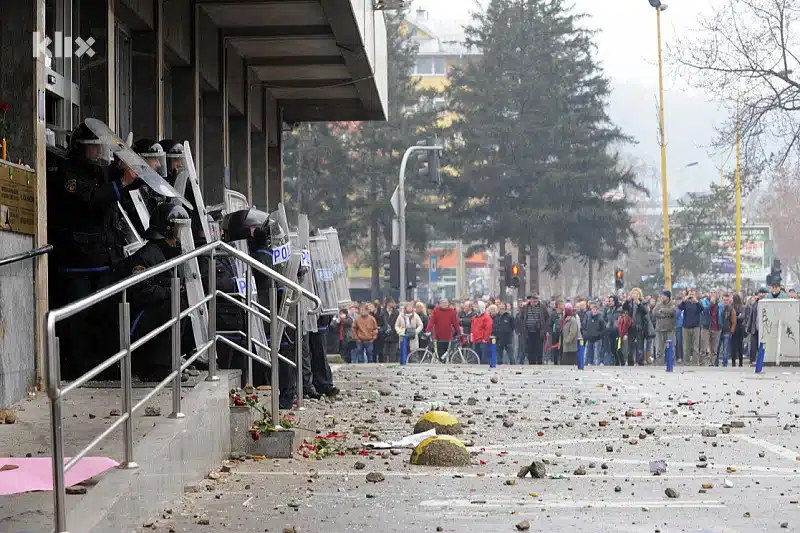
The mass protests that shook Bosnia and Herzegovina in February 2014 are now a distant historical memory. The wave of worker and citizen discontent, which briefly raised hopes for social change, died down over time, leaving behind silence and deep mistrust.
It all started in Tuzla, on February 5, 2014, in a city of industrial tradition and worker resistance that became the epicenter of the rebellion against systemic injustice, privatization robberies and political irresponsibility.
Two days later, the Tuzla Canton Government building was set on fire, and the resignation of then Prime Minister Sead Čaušević symbolically marked the climax of that moment. The protests soon spread to other cities, and Bosnia and Herzegovina witnessed massive civil resistance.
Today, the only tangible reminder of those days remains the former SodaSo building in Tuzla, which is currently under reconstruction.
Once a symbol of industrial power, then the epicenter of a rebellion, and today only a silent witness of a short period when citizens believed that change was not an illusion.
In the immediate vicinity of the building today, only a small group of citizens gathered, members of the Tuzla Canton Solidarity Union, recalling all the events of 12 years ago. Among them is the president of the trade union Sakib Kopić.
“I remember those days. My heart was big when I saw how many people came out against the government of that time. But later everything was diluted because the politicians inserted their players among the protesters. As the years pass, there are significantly more reasons for protests, but the citizens are simply killed in the concept. They no longer trust anyone, especially young people who have one goal, which is to finish high school or college and go to the West,” Kopić told Klix.ba.
Kopić believes that the unions have sold out and betrayed the working class.
“We have 26 branch unions in which everyone wants to be the president. We speak out against the high salaries of our ministers, representatives and parliamentarians, and we have in our ranks union members who have a salary of three thousand convertible marks each,” emphasizes Kopić.
Citizen voice today has moved mainly to social networks. Reactions to the arrogance of political elites are mostly reduced to statuses, comments and content sharing, without any real pressure on decision-makers.
In the vacuum created by the withdrawal of citizens, political structures continued to operate unhindered, often more brazenly than before.
“We did not express our rebellion on the Internet. We have been on strike since 2002, when most workers lost their jobs. From Šićki Brod to Slavinović, we were on the streets day and night, in the end, through a strong struggle, we still managed to get part of what belonged to us. Today, workers fight differently, especially young people, which I consider wrong,” says Enes Tanović, a member of the TK Solidarity Union.
However, the protests have not completely disappeared because they are still present, but fragmented and marginalized. They are worn by the workers of certain failed companies or those that are about to be closed, people who are looking for unpaid wages, the binding of seniority or the basic right to a dignified life.
Unfortunately, their demonstrations often end in front of the closed doors of institutions, without broader social support and without concrete results, he writes Klix.


