
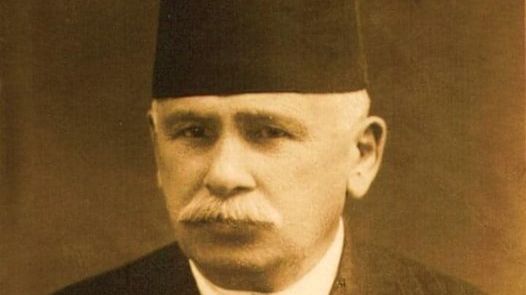
On this day in 1954, Bosnian writer and educator Edhem Mulabdić passed away. Today, four elementary and one high school in Bosnia and Herzegovina, as well as streets in Tuzla, Bihać, Sarajevo, Brčko and Tešnje bear his name. In his native Maglaj, the traditional event “Mulabdić Days of Culture” is held every year in January.
Edhem Mulabdić was born in Maglaj in 1862, where he finished high school and high school. Mulabdić’s father, Selim, was a tax official, and his mother, Nur-hanuma, was killed by robbers after the Austro-Hungarian occupation of Maglaj. Edhem’s older brother Mehmed was also killed in those battles, and his younger brother Đulaga was wounded.
Writer and editor
In 1887, Mulabdić enrolled in the Teachers’ School in Sarajevo, and after obtaining his diploma he got his first job in Brčko, and in 1892 he was transferred to Sarajevo at Darul-muallimin, where he taught Bosnian language, history and geography for eight years. At that time, he also started cooperation with Mehmed-beg Kapetanović, starting the political weekly “Bošnjak”, of which he was the editor-in-chief from 1892 to 1894. He was also the editor of the Muslim calendars “Bajraktar” and “Mearif”, the secretary of the Sarajevo Kiratana, and then, together with Bašagić and Hadžić, the initiator of the Muslim magazine “Behar”, of which he was the first editor, from 1900 to 1906.
Together with Reisu-l-ulema Džemaludin Effendi Čaušević, Safvet-beg Bašagić, Husein Đoga Dubrović and others, in 1927, Mulabdić started the cultural magazine of the Muslims of Bosnia and Herzegovina “Novi Behar”, writing a proclamation about the importance and role of that magazine: “We are obliged and all of you are obliged to bequeath to our posterity everything that is valuable, that ennobles and elevates, that it builds complete people and good Muslims.”
Bequest to posterity
In 1893, Mulabdić published his first book, a collection of short stories “Rukovjet Šale”, and his most famous work “Green Bush” was published by Matica Hrvatska in 1898. Although many literary critics and analysts declare the novel “Zeleno busenje” to be the first BH novel. novel, it should be said that it is, after all, the novel “Hopeless” by Osman Nuri Hadžić and Ivan Milićević (Osman-Aziz), which was published three years before Mulabdić’s. Both novels treat the Austro-Hungarian theme in our literature, but the fact is that, unlike “Hopeless”, the novel “Zeleno busenje” has moved much further from the documentary to the literary-artistic style.
Mulabdić’s novel “New Times” is of lesser importance, but still a valuable document for the study of that period of BiH history. He published the collection of short stories “On the Coast of Bosnia” in 1910, marking himself as the first Bosniak novelist.
End of life in poverty
Aware that he would not be able to do much for his people by writing alone, Mulabdić also became politically active, and as a candidate on the list of the Yugoslav Muslim Organization (JMO) he was elected three times to the National Assembly of the Kingdom of SHS, in 1923, 1925 and 1927. In parallel with politics, he initiated the establishment of the Cultural and Educational Society “Narodna Uzdanica”, at whose annual assembly, in 1929, he was unanimously elected president. From 1933 to 1945, “Narodna Uzdanica” published a calendar whose contributions were edited by Mulabdić. In that period, he experienced a great family tragedy, when his only son Ešref died in Bihać.
Mulabdić was arrested and detained on charges of a verbal offense during the Second World War with the NDH (Independent State of Croatia), and was released at the end of March 1946. As another BiH wrote. Alija Nametak, a great man of words, after his release from prison, Mulabdić was left with nothing, no pension, no job and no income. Until his death, he lived in poverty, depending on the alms of a few friends, and he was helped the most by our prominent historian and another prominent Bosniak, Hamdija Kreševljaković.
Everyone must leave the mosque moved
Knowing the power of publicly spoken words, Mulabdić advised imams that their sermons should be of high quality, instructive and useful to the people:
– That there is as much opportunity as possible for the people to be taught, what the doctrine is, to make them aware, to call them to themselves. Therefore, this lesson is of great and inestimable significance for the nation, for its intellectual, ethical, national and religious development… A good vase can do more than anyone else in terms of national development. Vaiz addresses all ages, children as well as adults. On the contrary, a weak preacher can have a harmful effect on his environment, and then he realizes that he is guilty, he is guilty that he cannot express himself. It is not the same to say a vase just to say, when time and effort are already spent, and the object of the vase itself is so sublime, everyone must leave the mosque moved and touched by the sweet words of the vase, writes avaz


