
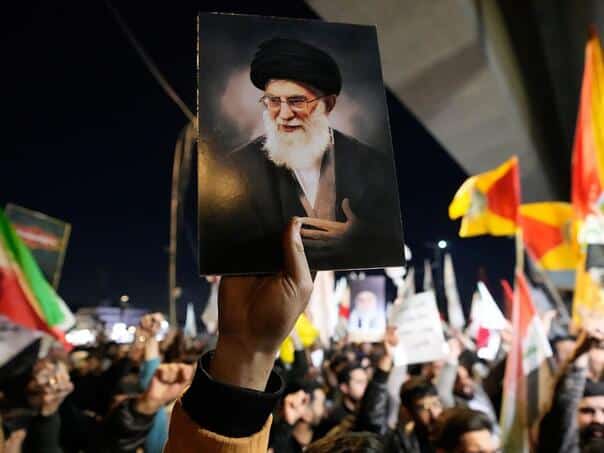
Khamenei was only the second Supreme Leader since the 1979 Islamic Revolution. He took office in June 1989, after the death of the founder of the regime, Ayatollah Ruhollah Khomeini.
Given that the Supreme Leader has the final say on all key state issues, his death raises a crucial question – who will succeed him?
Which high officials were killed?
Apart from Khamenei, several senior Iranian officials were also killed in the attacks. Among them are the Chief of General Staff of the Iranian Army, General Abdol Rahim Mousavi, and the Minister of Defense, General Aziz Nasirzadeh.
Major General Mohammad Pakpour, who took command of the Revolutionary Guard after Israel killed his predecessor last June, was also killed, as was Ali Shamkhani, Khamenei’s chief security adviser.
Iranian media say that among the dead are members of Khamenei’s family – his daughter, grandson, son-in-law and daughter-in-law.
The Israel Defense Forces also announced that Saleh Asadi, the head of the Intelligence Directorate of the Khatam al-Anbiya Emergency Situations Command, Mohammad Shirazi, the head of the military office, Hossein Jabal Amelian, the head of the Organization for Defense Innovation and Research (SPND), and Reza Mozaffari-Nia, the former head of the SPND and former deputy minister of defense, were killed.
What’s next?
In accordance with the constitution of the Islamic Republic, a three-member temporary council was formed to govern the country until a new supreme leader is elected.
The Council consists of the President of Iran Masoud Pezeshkian, the President of the Supreme Court Gholamhossein Mohseni Ejei and the lawyer Alireza Arafi, a member of the Guardian Council and the leader of the Basij paramilitary formation. Iranian official Ali Larijani confirmed that the council would be established on Sunday.
Speaker of Parliament Mohammad Bagher Qalibaf said that the country is ready for such a scenario.
“We have prepared for such moments and have plans for all scenarios, including the one after the martyrdom of the respected Imam Khamenei,” said Qalibaf.
Who chooses the new leader?
The new supreme leader is chosen by the Assembly of Experts, a body made up of 88 Shiite clerics. According to Iranian law, the election must be held as soon as possible.
Members of the Assembly are elected every eight years, and their candidacies are approved by the Guardian Council, a constitutional oversight body known for disqualifying candidates.
In March 2024, the council banned former president Hasan Rouhani from running for the Assembly of Experts. In 2015, Rouhani signed the nuclear agreement (JCPOA) with world powers, from which the United States later withdrew during the tenure of Donald Trump.
Who could be the successor?
According to Iran’s system of “vilayat-e faqih” – the guardianship of an Islamic jurist – the supreme leader must be a senior cleric with political and religious authority.
His 56-year-old son, Mojtaba Khamenei, has often been mentioned as a possible successor, although he has never held public office. He is considered a conservative close to the Revolutionary Guard.
Former president Ebrahim Raisi was also considered a serious contender, but died in a helicopter crash in May 2024.
Calls for the overthrow of the regime
US President Donald Trump called on Iranians to seize the moment to overthrow the Islamic Republic, calling Khamenei’s death “the greatest opportunity yet for the Iranian people to take back their country.”
A similar message was sent by Reza Pahlavi, the son of the last Shah of Iran who was deposed in 1979, who lives in the USA. He said that the Islamic Republic “has reached its end” and called on the security forces to join the people.
However, the final word on Iran’s future will be given to the Assembly of Experts, whose decision may determine the country’s political course in the coming decades.
(Vijesti.ba)


