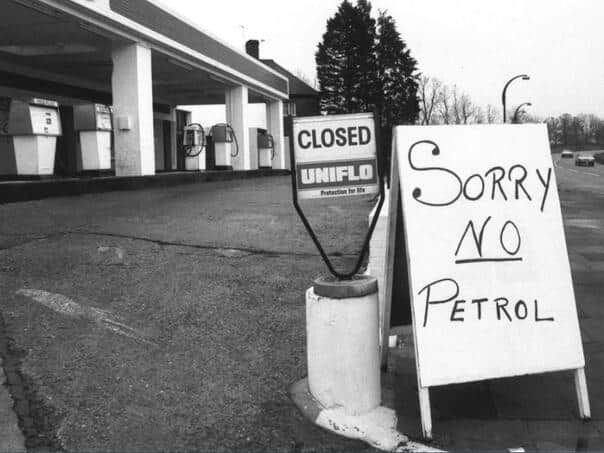
Germany then, for example, introduced four weeks without cars, writes DW.
We are facing “the biggest threat to energy security in the history of mankind,” Fatih Birol, director of the International Energy Agency, said earlier this week. Speaking at the National Press Club in Australia, he pointed out that the current crisis in the Middle East is more serious than the oil shocks of 1973 and 1979 combined.
“At that time there was a shortage of about five million barrels of oil per day. Today it is eleven million barrels per day, which is more than during both major oil shocks combined,” said Birol.
He assessed the situation on the gas market as equally worrying, stressing that, compared to the period after the Russian attack on Ukraine in 2022, the global gas shortage has doubled.
In the 1970s, reduced supply led to an increase in the price of oil, and thus other goods, which caused inflation. At the same time, industrial production and economic growth in developed countries declined. Germany then fell into stagflation, a state in which the economy stagnates and prices rise at the same time.
Prices are not rising today like they were then
Due to the current war with Iran, the global supply of oil has decreased by about eight percent due to the closure of the Strait of Hormuz. “Previously, the drop in global supply was around five percent. In this sense, today’s shock is more pronounced than in 1973 and 1974,” believes Klaus Jürgen Gern from the Institute for the World Economy in Kiel.
However, the key difference is that prices then rose dramatically. “From 1973 to 1974, the price of oil quadrupled, and in 1979 it tripled again,” Gern points out. Although the embargo was lifted in early 1974, OPEC kept prices high until the end of the decade, which had serious consequences for the global economy.
Today the situation is different. “Oil prices have exceeded $100 before, the last time after the Russian invasion of Ukraine, but also in 2007, 2008 and after 2011,” says Gern.
He adds that this is not an entirely new situation, unlike the 1970s when countries were first faced with such high prices without a clear estimate of how long they would last.
In addition, the current rise in prices is the result of a reduction in supply due to the blockade of the Strait of Hormuz and the closure of facilities, not the permanent destruction of production capacity. Therefore, it is expected that after the end of the conflict, the situation could be normalized. Deutsche Bank researchers also believe that markets are not yet counting on a prolonged oil shock.
Damaged energy infrastructure
However, the damage is already there. More than 40 energy plants in nine countries of the Middle East were seriously damaged in the Iranian attacks, warned Birol.
Even if the war ends soon and navigation through the Strait of Hormuz is restored, it will take a long time to restore the damaged facilities.
“For some it will take six months, for others much longer,” said Birol.
Qatar said the attacks could cut liquefied natural gas supplies by 17 percent over a period of three to five years.
On the other hand, Christoph Rühl from Columbia University believes that a serious crisis will only occur if the blockade lasts longer and if more plants are destroyed. He adds that Qatar participates with about 20 percent in the global gas supply, so any damage would have a limited impact on the overall market.
Market more resilient today
Today’s oil market is much more diverse than in the 1970s. While the OPEC countries then covered more than half of world production, today their share is slightly more than 36 percent. Meanwhile, the United States of America has further increased production and in the last ten years has ensured almost 90 percent of the growth in global supply.
Despite the crises, the demand for oil continued to grow. While in 1973 the world produced less than 60 million barrels per day, by 2022 that figure has risen to nearly 94 million.
To mitigate disruptions, states have increased strategic reserves. According to the International Energy Agency, at the beginning of this year global stocks reached 8.2 billion barrels, which is the highest level since 2021.
Thanks to those reserves, part of the shortfall has already been compensated, so the shortfall has been reduced from 11 to eight million barrels per day. In addition, the US has temporarily eased sanctions on Russian and Iranian oil already at sea.
It all depends on the duration of the conflict
According to the estimates of Commerzbank analysts, existing stocks could make up for the interruption of deliveries through the Strait of Hormuz for about nine months. China, on the other hand, has reserves sufficient for approximately seven months of imports from the region.
However, the duration of the war with Iran remains unknown. Although US President Donald Trump has spoken of “productive” talks, Iran has denied this, adding to the uncertainty.
Economists warn that the consequences will already be visible. “Inflation will increase in the short term, while production will decrease as oil consumption will be tried to be limited wherever possible,” concludes Gern.
And while traffic in some countries continues to flow without major restrictions, others have already introduced austerity measures.
Pakistan, for example, invited citizens to follow sports events from home in order to reduce fuel consumption, so this year the Pakistan Super League will mostly be held in a virtual format, writes DW, reports Indeh.hr and Vijesti.ba.
(Vijesti.ba)