
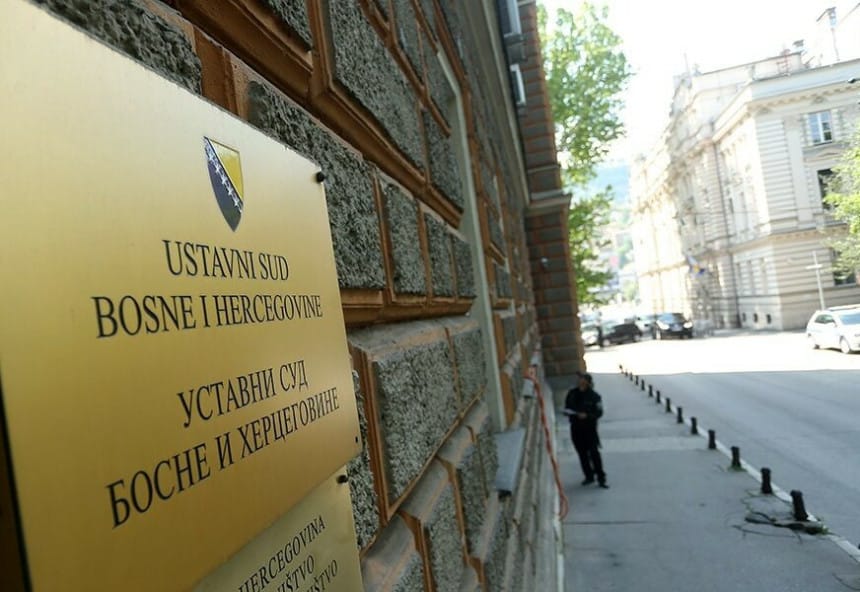
The Constitutional Court of Bosnia and Herzegovina annulled several decisions and parts of laws passed in Republika Srpska, and declared some decisions of state institutions invalid, which in practice means that certain measures can no longer be applied.
At the two-day session, the court considered a number of disputes between different levels of government and made several important decisions.
One of the most important decisions refers to the draft of the new Constitution of the Republic of Srpska. The court concluded that the draft was not in accordance with the Constitution of Bosnia and Herzegovina and ordered the immediate suspension of all activities related to it. This practically means that the RS cannot proceed with changes to the constitution in the way it planned.
The court also decided on the law on the police in Republika Srpska. Part of that law was annulled because the RS tried to take over the competences already held by the Agency for Identification Documents at the state level. In a simplified sense, the entity cannot independently manage systems such as personal documents and digital signatures, because these are already regulated state competences.
At the same time, one part of the law remained in force, so the Ministry of Internal Affairs of the RS can still perform certain administrative tasks related to personal documents, but not those that are exclusively under the jurisdiction of the state.
In another case, the Constitutional Court overturned the law abolishing budget funding of political parties in the Republic of Srpska. The court considers that such a decision violates the equality of parties and political pluralism, that is, some parties would be put in a disadvantageous position.
The decision regarding the appointment of Bosnia and Herzegovina’s negotiator for the European Union also attracted great attention. The court found that the decision was not made according to the rules, because it did not pass both chambers of the BiH Parliamentary Assembly. Because of this, it was declared null and void, which means that it was never legally valid. Parliament has been given a period of six months to regulate this process in the correct way.
In the field of education, the court challenged parts of the law in the Zenica-Doboj Canton that allowed excessive control over universities. In particular, it was assessed that the rules for replacing the rector were too broad and imprecise, which could lead to political influence on the universities.
On the other hand, the court did not accept the request related to the election of the Government of Republika Srpska, with the explanation that it is not a question for the state Constitutional Court, but for the entity’s.
Ultimately, these decisions mean that certain moves by the authorities in the Republika Srpska and at other levels have been declared unconstitutional and must be stopped or changed, while state institutions have been reaffirmed as key in issues affecting the entire country, he writes. RTV Slon.


