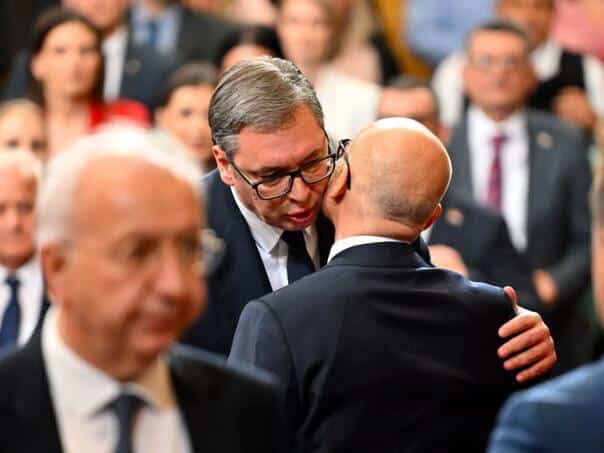
The so-called “doctrine of four pillars”, which arose after the shock over the declaration of Kosovo’s independence, is now falling apart, at a time when the thirteen-year-old regime of President Aleksandar Vučić is facing unprecedented pressures inside the country from protesters and civil society, writes Andreas Ernst for the Swiss newspaper Neue Züricher Zeitung (NZZ).
Vučić’s great hope that Donald Trump’s return to the White House at the beginning of last year would open a new chapter in relations with the USA quickly turned out to be unrealistic. Trump strictly adhered to Joe Biden’s sanctions against the oil industry in Serbia, which is mostly in Russian hands, and insisted on its sale.
Under American pressure, refineries no longer receive crude oil, and if an agreement is not reached soon with potential buyers from Hungary or the United Arab Emirates, Belgrade could be forced to nationalize Russian shares.
At the same time, relations with Moscow are strained. Although Serbia, along with Belarus, is the only European country that has not imposed sanctions on Russia, the Kremlin is unhappy because Belgrade supplies artillery ammunition to the Ukrainian army through third countries.
Moscow accuses Vučić of duplicity and uses Serbia’s dependence on Russian gas as a means of pressure, constantly delaying the signing of the long-awaited supply contract.
And Serbia’s most patient partner, the European Union, is slowly turning its back. Accession negotiations have been proceeding very slowly for years, and there has been no significant progress since 2021, especially due to setbacks in the areas of the rule of law and media freedom.
The appearance of mutual interest in membership was further damaged when Vučić, after criticism from Brussels for his treatment of civil protests, demonstratively canceled his arrival at the Balkan summit.
The “four pillars” policy, which is now falling apart, was created as a reaction to the declaration of Kosovo’s independence in 2008. That event, supported by the US and key European countries, ended Serbia’s cautious rapprochement with the West after the fall of Milosevic. In Russia and China, Belgrade found allies who challenged Kosovo’s statehood in the UN Security Council.
The Serbian leadership, before many in the West, understood that the “multipolar world order” is not just propaganda, but a strategy that changes the geopolitical balance. For a long time, it worked.
Seventeen years later, Kosovo is recognized by between 50 and 60 percent of the world’s countries. However, critics warned that the energy invested in the fight for “renegade territory” could be better used for the development of the country.
The proximity of Russia and China enabled Belgrade to create political capital towards the West, which wanted to keep Serbia in its sphere of influence.
However, the balancing policy was primarily intended for the domestic audience. Analysis of the map and trade statistics reveals the real picture: Serbia is deeply integrated into the EU economic space and surrounded by NATO members. With three of the four pillars collapsing, the question is whether only China will remain in the end, concludes Ernst.
(Vijesti.ba)