

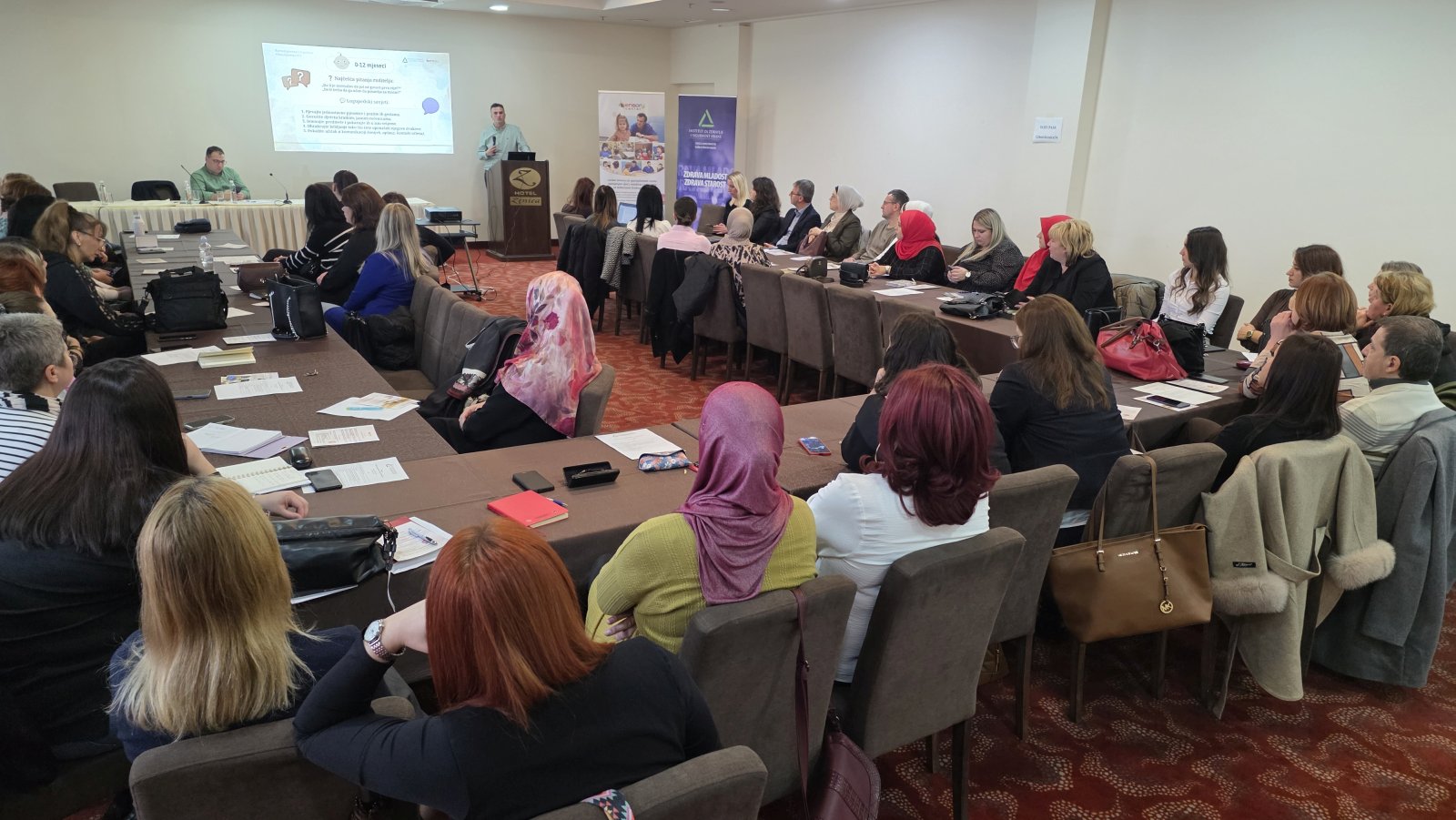
The Institute for Health and Food Safety Zenica gathered today about forty representatives of public and private preschool educational institutions from the entire Zenica-Doboj Canton, centers for early growth and development from Zenica, Visoko, Maglaj and Tešnj, representatives of the Center for Children and Adults with Special Needs, the Ministry of Education and the Sensory Center.
A word from an expert
The lecturers at the round table were the head of the School Hygiene Service, Nino Hasanica, with the topic “Are problems in speech development a public health problem”, Nedim Patković, master of speech therapy, with the topic “Speech development 0-6 years” and Muhamed Karčić, master of psychology, with the topic “Challenges and negative patterns of behavior in the context of emotional development of children”.
The round table brought together experts with the aim of creating common, sustainable solutions in the field of speech development in children and young people.
– Every child grows at his own pace, but there are signs that we need to react to. What we notice is that many children show signs of delays in speech development, changes in behavior, to which we must respond, says Dr. Elma Kuduzović, head of the Institute for Public Health within the INZ.
dr. Kuduzović states that “data from clinical practice and school systems show that 10 to 15 percent of children show a delay in the development of the speech system, while almost every fifth child experiences certain difficulties in behavior, attention or emotional development during their growing up”.
– Today, the Institute for Health and Food Safety Zenica, recognizing the importance of this topic, gathered experts from the field of education and health sector, in order to exchange experiences, open a dialogue on this topic, and go in the direction of recommendations and concrete steps in the next year to solve this problem, said Kuduzović.
Nedim Patković, master of speech therapy, was one of the lecturers.
– A very important topic for us, because difficulties in the development of speech and language in children are increasingly present. every day we witness, especially kindergarten teachers, how the number of children with speech and language difficulties, as well as other difficulties, is increasing, says Patković.
Experts believe that it is high time that all the indicators of potential problems are shared with colleagues who work directly with children on a daily basis, and that work is done on solving them at the earliest stage, while they leave no or minimal consequences for the growth and development of children.
Optimal time for intervention
Patković pointed out that the period from birth to the age of six is an intensive period of development of children’s ability to speak properly.
– During this period, children often fall behind in their speech and language development, so the intervention of a speech therapist is necessary. in order to know what needs to be done, they must first look at what proper speech and language development is, so that they can properly prepare treatments for these children, he added.
Ildana Fazlić, coordinator of the Center for Early Growth and Development of the Zenica Health Center, says that four employees at the center, a registered nurse, an occupational therapist, a speech therapist and a psychologist, have been working full time for five years.
– This year, 3,237 children entered, of which 2,174 are in “early intervention”, and the rest as an incentive to work at home. We are connected with 13 centers in FBiH, she said.
She also recommended when parents should call and ask for expert help.
– The best “alarm” is when the child is between two and three years old, when the brain is developing rapidly and when the child’s brain is at its strongest. You don’t have to wait three or four years, as they say in our people, “he will speak”. Some 24 months of the child is the optimal period to start early intervention. Disruption is one thing, delay is another. In the second year, children should have at least 50 words in their vocabulary. If they then notice that some items, some simple commands and words are missing, the path is – a pediatrician. The pediatrician makes a detection, assessment and then moves towards early intervention, she said.
Today’s event is a platform for exchanging ideas and defining strategic directions of action in the interest of the health and proper growth and development of our children.


