Transparency International’s latest report (CPI 2025) shows that corruption remains a serious threat in every part of the world.
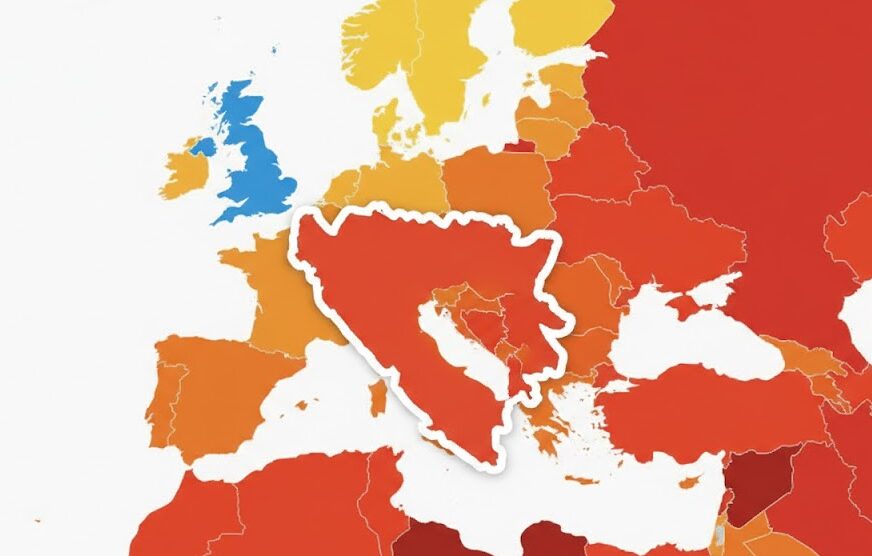
ok the global average drops to a new low, Bosnia and Herzegovina with a score of 34 remains far below the average, occupying 109th place on the world list.
The 2025 Corruption Perceptions Index (CPI) ranks 182 countries and territories on a scale of 0 (highly corrupt) to 100 (very clean).
The results show that more than two-thirds of the world’s countries score below 50, indicating serious problems in the public sector that directly affect citizens’ quality of life, from hospital financing to infrastructure security.
The situation in BiH and the region
Bosnia and Herzegovina, with a score of 34, takes a disappointing 109th place. This result places BiH in the group of countries where corruption systematically undermines institutions. This result confirms the stagnation and lack of courageous leadership in the implementation of reforms. According to the report, low ratings like this are usually the result of abuse of power, weak judicial systems and pressures on independent institutions. For the sake of comparison, the global average is 42, which means that BiH is significantly below the world standard. The worst ranked in the region is Serbia, which is in 116th place with an index of 33.
The analysis of the results in our region shows a deep gap between the countries that are part of the European Union and those that are still struggling with basic reforms of the judiciary and public administration. Slovenia stands out as the absolute leader of the region this year, taking 41st place in the world with an index of 58. Although it is far ahead of its neighbors, Slovenia is the only country in the region that is above the global average, which indicates that the rest of the Western Balkans is in serious trouble.
Croatia and Montenegro form the middle of the regional list and are relatively close to each other. Croatia is in 63rd place with a corruption index of 47, while Montenegro is only two places below, in 65th position with a score of 46. These two countries show some stability, but their results, which are still below 50, suggest that the fight against corruption in these societies has not yet produced the desired results in key institutions.
At the bottom of the scale are North Macedonia, Bosnia and Herzegovina and Serbia, which are perceived as countries with the most pronounced systemic problems. North Macedonia ranks 84th with an index of 40, while the situation in Bosnia and Herzegovina is significantly worse. With an index of 34, BiH is in 109th place on the global list, which is a clear indicator of the deep corrosion of institutions and the lack of political will for change. At the very back of the region is Serbia, which ranked 116th with the lowest regional index of 33.
The leadership gap and the stifling of civil liberties
The report warns of a worrying long-term decline in leadership in the fight against corruption. Even established democracies, such as the US and Great Britain, are in decline. The absence of bold leadership leads to weaker standards, while many states simultaneously increase restrictions on civic space.
By making it difficult for NGOs and journalists to work, the authorities reduce transparency, which allows corruption to flourish.
“In a time of climate crisis, instability and polarization, the world needs more than ever responsible leaders and independent institutions to protect the public interest – yet too often they fall short. We call on governments and leaders to act with integrity and fulfill their responsibilities to ensure a better future for their citizens”, says Maira Martini, Executive Director of Transparency International.
What is happening around the world?
Whether facing a recent wave of setbacks or grappling with broader challenges that have long undermined reforms, each region has a lot of work to do to tackle corruption. However, almost all of them have success stories that show that progress is possible.
Asia-Pacific: Eight countries have improved since 2012, but there are stark differences within this diverse region. With well-connected elites often buying political influence and many laws not being properly enforced, most leaders in this part of the world are not fulfilling their obligations.
America: Years of government inaction to address corruption have weakened democracy and enabled the growth of organized crime, with serious consequences for human rights and security.
Eastern Europe and Central Asia: Remains one of the worst-performing regions in the world, with widespread impunity for corruption driven by vested interests that dominate most governments and their institutions.
Sub-Saharan Africa: Weak democracy in much of the region—sometimes accompanied by armed conflict, insecurity, and escalating civil unrest—continues to undermine governance, economic stability, and development efforts.
Middle East and North Africa: Governments continue to fail to tackle corruption in the public sector, reflecting inconsistent commitment from leaders and the weakness of institutions that are supposed to hold government accountable.
Western Europe: The countries of this region make up nine of the ten best-ranked countries on the CPI list. However, anti-corruption efforts have largely stagnated in recent years, with the region’s average CPI score falling faster than anywhere else.
A recipe for change
Transparency International points out that progress is not impossible, but it requires the strengthening of judicial systems, better supervision of public spending and protection of media freedom. The key is to close legal loopholes that allow corrupt money to move unhindered across borders, even through countries that are considered “clean”.
Anti-government protests around the world are a clear message to leaders: citizens are tired of irresponsible government and demand urgent reforms, reports Bosnia Info.