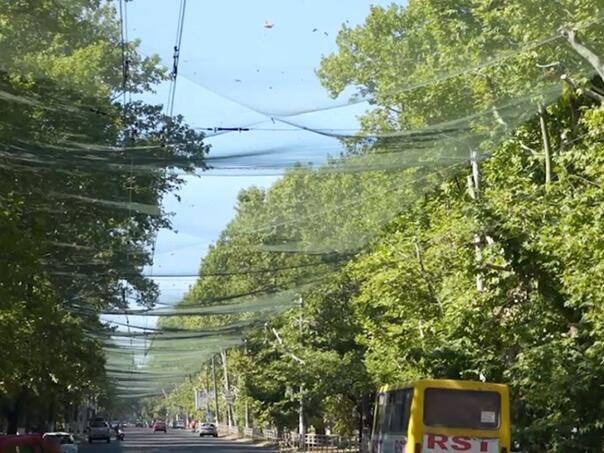
On streets covered with anti-drone nets or deep in the city’s basements, the residents of Kherson try to lead a more or less normal life under the constant threat of Russian bombing.
Shopping at the market, dance rehearsals or school classes – everyday life in this Ukrainian city, the only major urban center located almost directly on the front line, has moved underground and under protective nets, writes The Guardian.
A city that lives in shelters
In one of the basement shelters in Kherson, crisis psychologist Galina Lutsenko works with children gathered around a makeshift table. A butterfly made of plasticine hangs above them. Lutsenko herself is a victim of shelling – her house was hit in 2024, when she was wounded in the leg and stomach. Today, that basement serves as a safe place in a dangerous city, but also as a space for yoga, dance, creative workshops and gatherings of older women.
Today we got this text and video from #Kherson direction.
“Your net in action
The guys say they caught up to 30 drones in this position.”One big net with a cost of $50 stopped drones with a total cost of at least $15,000! And saved lives, too, which are priceless.
That prevent… pic.twitter.com/Jcd5P9Yr7Y
— Coast of Life (@coastoflife_od) January 25, 2026
“Children are constantly under pressure and stress. Let them be afraid to go outside after shelling,” says Lutsenko.
He adds that it is important to give children a sense of choice and control.
“It’s not just about survival, it’s about living and feeling the world around you”.
The image of the streets of Kherson makes it clear why life takes place underground. The storefronts were nailed with boards, and the facades of the buildings were scarred by shrapnel, artillery and slide bombs. Long parts of the streets, including the main approach from the river bank, are covered with anti-drone nets that form a kind of protective tunnels.
With Russian forces stationed on the other bank of the Dnieper, daily life for the 60,000 or so remaining residents, including about 5,000 children, compared to the pre-war 300,000, is under constant threat.
Kherson was captured by Russian forces at the beginning of the 2022 invasion and was the only regional center under occupation. Although the city was liberated nine months later, the attacks did not stop. On the other side of the river, Russian forces continued intense shelling, including the infamous “drone safari”, during which drones targeted civilians.
The authorities are expanding the safety net
Despite everything, life does not stop. The city’s main perinatal clinic is located within the so-called red zone – a kilometer wide strip along the banks of the Dnieper and is located in an old Soviet shelter.
Kristina Furman (23), who was hospitalized due to the risk of premature birth, says she has no plans to move.
“We live in one of the most dangerous parts of the city, but this is my home. My whole family is from here,” he points out.
The road to #Kherson goes through a net tunnel now.
: UkraineWorld
Support our team: https://t.co/WmP8G6yxzd pic.twitter.com/Ad60k93Af2
— UkraineWorld (@ukraine_world) December 16, 2025
He adds that anti-drone nets have a strong psychological effect.
“When you drive under them, you feel safer. But the truth is that they are not everywhere”.
Kherson military governor Oleksandr Prokudin confirms that most residents move only when necessary.
“This morning we had to take shelter twice because of drone sightings. We already have several wounded civilians,” he said.
He points out that Kherson has a unique and extremely difficult position.
“No other large city in Ukraine is this close to the enemy. If we didn’t have the existing protection, the city would already be a gray zone”.
The government’s plan is to expand the anti-drone network. Currently, more than 100 kilometers of protective nets have been installed, and the goal is to reach 300 kilometers by the end of the year. In parallel, a network of underground facilities – schools, clinics and public institutions – is being developed.
School in the basement
In the village of Miroljuvka, not far from Kherson, classes also take place underground. In the basement of the school, children attend biology classes, while the youngest play on the floor of an improvised kindergarten.
Almost all the streets of Kherson are covered with anti-drone nets. pic.twitter.com/wUVhSSzif6
— MilitaryNews (@front_ukrainian) November 16, 2025
“During the occupation, we had only 50 students. Now there are 120,” says school director Larisa Ribačuk.
He adds that the return of the children to the collective was challenging, because many of them did not leave the yards during the occupation.
“We have alarms five times a day, but nothing is heard in the basement. It’s easier for the children, they don’t have to run away from the classrooms,” says Ribačuk.
“The parents decided to stay. When we don’t see the drones, it feels like we’re living normally.”
(Vijesti.ba)