
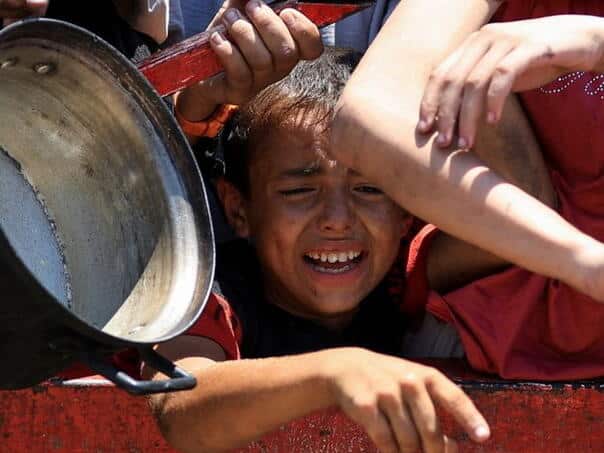
After more than two years of war, during which Israeli forces control about 60% of the territory, almost all food in Gaza must be brought in from outside.
Aid organizations that feed much of the population say the supplies they had on Saturday, when the war began, may only last a few more days.
“If the borders remain closed, World Central Kitchen will run out of food this week,” the organization’s founder, José Andrés, said in a post on social media. Guardian.
“We cook a million hot meals a day. We need food deliveries every day.”
One international food security expert said there was only a week’s supply of fresh food in Gaza.
The community bakeries that supply the most vulnerable have flour for about ten days of bread production, while supplies of humanitarian packages can last about two weeks.
Israel imposed a total siege on Gaza last spring, followed by severe restrictions on food deliveries. Together, those restrictions caused a famine last summer.
Hundreds of people were also killed trying to reach food distribution points of a new logistics organization, the Gaza Humanitarian Foundation, which operated only in areas under Israeli control.
As news of Israel’s attack on Iran spread, Palestinians, traumatized by memories of famine and periods of extreme food shortages, rushed to buy, further driving up prices.
The price of a 25-kilogram sack of flour tripled – from around 30 to between 80 and 100 shekels. Other essentials, including sugar, diapers and cooking oil, have doubled in price.
“The return of hunger to Gaza is what we fear most, even more than shelling,” said Sobhi Al-Zaaneen, a 50-year-old father of seven from northern Gaza.
He decided to buy additional supplies despite the high prices. “I’m going to the market to buy what we need before the prices go up even more.”
Many Gazans have no money to stock up after losing their homes and jobs in the war and spending their savings on survival.
“I don’t have enough money to buy and store food before prices rise further, like some others have done,” said Um Mohammed Hijazi, a mother of five. Their home was destroyed in the war, and the family was displaced five times.
“Thank God, I have a small supply of food from the aid we received from humanitarian organizations, which could be enough for a few days if the crossings remain closed.”
Some staples are harder to find than a week ago, and Hijazi says she has heard that some traders have moved goods into warehouses, hoping for further price increases.
As the occupying power in Gaza, Israel has a legal obligation to provide sufficient food for civilians. That obligation has not been diminished by the war with Iran, said Jan Egeland, head of the Norwegian Refugee Council.
“Common kitchens are already closing, and the prices of basic products have started to rise,” he said. “Even in the midst of an expanding regional war, international humanitarian law still requires Israel to allow aid to be delivered to civilians under its control.”
Israel’s agency Cogat, which controls the flow of aid and commercial goods to Gaza, said it suspended deliveries for security reasons during the war with Iran. It was announced late on Monday that the Kerem Shalom crossing would be reopened on Tuesday for the gradual entry of humanitarian aid.
Israel has kept its border crossings with Jordan and Egypt open, and the food supply chain inside the country is still functioning.
A Cogat spokesman said that there is enough food in Gaza, but did not give specifics. “Existing supplies inside Gaza are expected to last for some time,” the statement said.
Gaza shares a border with Egypt, which has been closed to humanitarian aid since Israeli forces took control of the area in May 2024. Cogat did not answer questions about why the crossing was not open for aid deliveries.
Palestinians and international humanitarian organizations have warned for months that basic necessities, including food, are in short supply despite the ceasefire. UN-backed experts said in December that nearly four out of five Palestinians in Gaza face acute food insecurity.
Bahaa Al-Amawi, secretary of the Northern Gaza Chamber of Commerce, said there is no strategic food stockpile to mitigate the effects of the border closure.
“Since the beginning of the armistice, there have been no strategic reserves, and in the current conditions we are not able to establish them,” he said.
“This means that any closure immediately causes a psychological crisis among citizens due to previous experience with hunger, but also a real economic crisis due to lack of supplies. The market reacts very quickly.”
Alaa Abu Rakba (43) supports his wife and four children by selling meat at a small kiosk set up outside the tent where they live after their home was destroyed.
His business ran out of stock practically overnight, but he immediately went out to buy staples like sugar, flour and oil.
“We learned our lesson the first time,” he said. “I would rather see war and shelling return than the crossings to be closed, because I don’t want to go through hunger again or be in a situation where I can’t provide food for my children for days.”
(Vijesti.ba)