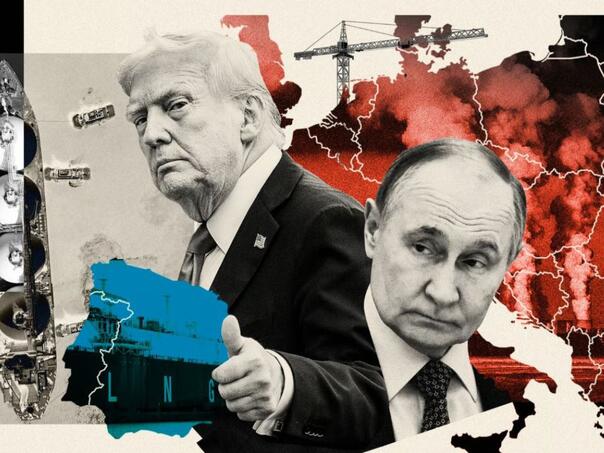
Due to the war in Ukraine and sanctions on Russian gas, European countries have become dependent on supplies of American liquefied natural gas (LNG), according to a study by the Clingendael Institute from The Hague, the Environmental Institute from Berlin and the Norwegian Institute of International Affairs, writes The Guardian.
This development carries significant risks at a time when Donald Trump has turned to “a more explicitly interest-driven, protectionist and ideologically colored approach,” the document states. The US president recently threatened to impose tariffs on trade with European allies to force their consent to the acquisition of Greenland, which is part of EU and NATO member Denmark.
Trump’s National Security Strategy document, released in November, specifically stated that the White House is pursuing American energy dominance that, “when and where necessary, allows for power projection.”
Data shows that imports of US UPP into the European Economic Area (EEA) increased by 61 percent during 2025. The EEA includes 27 member states of the European Union and Iceland, Liechtenstein and Norway.
Compared to 2019, UPP imports into the EEA increased by as much as 485 percent, and US gas now accounts for 59 percent of total UPP imports into the EU, according to December gas flow data. During 2024, the UK met 50 percent of its gas demand domestically, while 33 percent was imported from the EEA.
The rest of the needs are covered by UPP, with deliveries from the US accounting for 68 percent of total imports. For the sake of comparison, the import of gas via gas pipelines from Russia accounted for 60 percent of the total gas import in the EEA in 2019, while by 2025 that share fell to only eight percent.
Professor Kacper Szulecki from the Norwegian Institute of International Affairs said that Europe must recognize the new reality of American energy dominance under Donald Trump and watch its own gas imports with caution.
“The US National Security Strategy 2025 specifically defines energy exports as a way of projecting power,” Szulecki said.
He added that the United States tried a similar approach back in the 1980s, during Ronald Reagan’s tenure, when it sought to dissuade European partners from trading gas with the Soviet Union.
“However, there was no natural gas liquefaction technology at the time, so Europe had no alternative to Russian gas from pipelines,” he explained.
Szulecki also warned about the short-term risks of rising energy prices due to current political tensions.
“At the moment, gas stocks in the European Union are very low – the lowest in recent years, even lower than at the beginning of the war in Ukraine. If we face a cold winter and additional tensions with the US, which would lead to a rise in prices and further depletion of reserves, we could witness a serious energy crisis in the coming months,” he warned.
Although the EU is considering ending trade deals with the US in response to tariffs linked to Greenland, policymakers in Brussels admit there is currently no real alternative to US gas.
Raffaele Piria, the initiator of the report and a senior researcher at the Ecology Institute, pointed out that the UK, although it is no longer part of the EU single market, is just as exposed to risks as European countries.
“The UK is affected by the same geopolitical and economic vulnerabilities as the European Economic Area. It is physically and economically fully integrated into the European gas network and market,” Piria said.
He added that since the beginning of the invasion of Ukraine, Europe has paid a high price for relying on Russia in the energy sector, while the US was initially considered a reliable alternative.
“Historically, the idea that the US government would interfere in gas markets to put pressure on Europe was considered unthinkable. In the current geopolitical context, that assumption is no longer safe,” he warned.
The study concludes that Europe must act because “energy exports – especially gas – are increasingly functioning as a tool of strategic influence”.
In the medium and long term, the European Union should accelerate the transition to an efficient and modern energy system based on domestic renewable energy sources, according to the analysis.
(Vijesti.ba)