
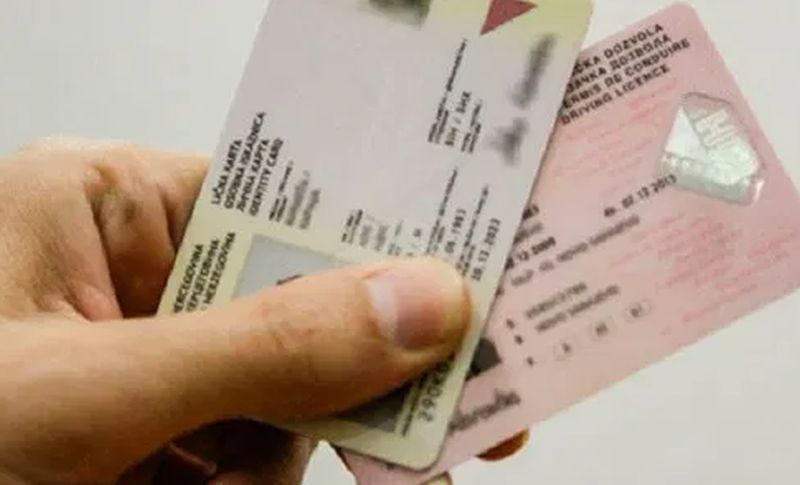
A driver’s license in BiH is valid for 10 years by default for categories A, B, BE, C, CE, D, DE, F, and subcategories A1, B1, C1, C1E, D1 and D1E.
For people over 65, validity is limited to five years.
According to the draft of the new law, the first permit for beginners could last only two years, followed by a 10-year extension.
A medical certificate is required for the extension if the permit was issued for a shorter period due to a medical condition or if the person is elderly.
But is it like that in practice? The fact is that in a period of ten years, a person can get sick and not be able to drive like before.
Wherein lies the greatest danger?
We discussed this issue with Mirzet Sarajlić, a traffic engineer and court expert in the traffic profession.
The issue of valid driver’s licenses and medical fitness to drive motor vehicles is not only an administrative issue, but a deep public health and safety issue. It affects the relationship between the individual’s right to mobility and the state’s obligation to protect the life and safety of all road users.
– According to the provisions of the Law on Basic Traffic Safety in Bosnia and Herzegovina, a driver’s license: for categories AM, A1, A2, A, B, BE, F and G is issued with a validity period of 10 years, for categories C1, C1E, C, CE, D1, D1E, D and DE the validity period is 5 years (considering the professional and increased risk of driving heavy and passenger vehicles).
The law expressly provides that a driver’s license can be issued for a shorter period of time than the above if it is established on the basis of a medical certificate – for example, in case of chronic diseases, reduced functional abilities or conditions that require periodic control.
Also, the driver is obliged to undergo an extraordinary medical examination if there are reasons to doubt his health. However, practice shows that this legal possibility is rarely used systematically and preventively – says Sarajlić.
By-laws (Regulations on drivers’ health conditions) prescribe contraindications in detail. The most important groups include:
– Neurological conditions, cardiovascular diseases, psychiatric and psychological conditions, orthopedic and motor disorders, visual and hearing impairments and others. A special problem is presented by people who use antidepressants, for whom the instructions clearly indicate that they can affect psychomotor abilities and reaction time.
Driving a vehicle under the influence of such drugs, without a doctor’s assessment, is essentially analogous to driving under the influence of alcohol. The problem here is that there is no connection with the MUP so that after these conditions, and especially after leaving the hospital, the person’s driver’s license is not temporarily revoked, and under all circumstances they are not capable of safe driving and represent a safety risk in traffic – adds Sarajlić.
Physician’s responsibility
– Doctors who issue certificates bear professional and ethical responsibility. The problem arises when: the assessment is not rigorous enough, when cognitive decline in the elderly is underestimated, when psychomotor limitations are ignored. The issue of older drivers is particularly sensitive. Age in itself must not be discriminatory, but the cumulative effect of chronic diseases, therapies and slowing of reactions requires more serious and more frequent monitoring – says Sarajlić.
The problem is that many people in our country take sedatives on their own without even seeing a doctor. There is always a grandmother, grandfather, father, or mother who has these medicines in the home pharmacy, so they are available to all members of the household.
Neither the doctors nor the police have any idea about this. But it’s not just mental states that are a problem in driving. There are also many other diseases, such as cardiovascular diseases, which should require greater and more frequent control. Of course, no one guarantees that a “healthy person” cannot suffer a heart attack while behind the wheel on the road.
Is it controlled and are there penalties?
Control is mainly reduced to: traffic controls (breathalyzer test, drug test), license validity check.
– If a driver drives a vehicle even though his driver’s license is restricted or a ban has been imposed on him, fines, protective measures and penalty points are provided.
However, the system does not function preventively, but reactively – only when a violation or an accident occurs. The ten-year validity period for most categories has administrative logic, but not medical and security logic. In ten years, a person can lose visual acuity, develop a heart disease, experience a stroke (a common occurrence), start therapy with drugs that affect psychomotor skills – emphasizes Sarajlić.
Mobility is a right, but traffic safety is a priority public good. A driver’s license must not be just an administrative document – it must be a confirmation of actual, continuous medical fitness to drive a motor vehicle.
How to solve this problem and what needs to be done
– First of all, it is necessary to establish an institutional connection between health institutions and internal affairs authorities, and to introduce mandatory check-ups after serious illnesses and operations. It is necessary to more clearly standardize the responsibility of doctors when issuing certificates and to consider shorter periods of health checks for risk groups – Mirzet Sarajlić, a court expert in the field of traffic, concludes for Faktor.


