
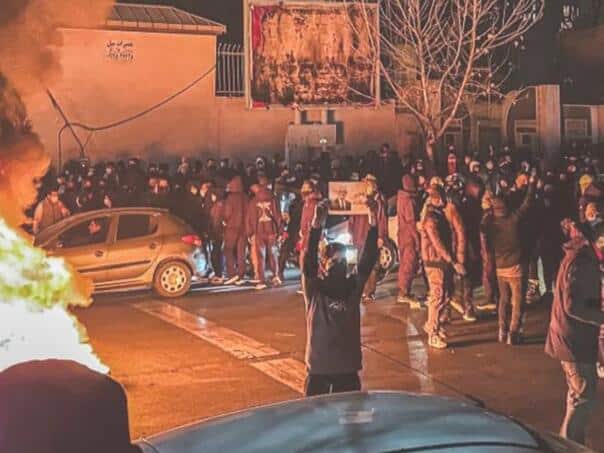
Demonstrators again defied the authorities’ deadly crackdown, and Iran’s police chief said on state television that the government’s response had been stepped up.
Doctors at two hospitals told the BBC that more than 100 bodies had been delivered over a two-day period. It is feared that the total number of dead at the level of the entire country is significantly higher. The American organization Human Rights Activist News Agency (HRANA) states that it has confirmed the death of 490 protesters and 48 members of the security forces.
According to that agency, another 10,600 people were detained during the two weeks of unrest.
The US has threatened to attack Iran over the killings of protesters, and President Donald Trump said on Saturday that the US “stands ready to help” while Iran, he said, “looks to FREEDOM”.
Trump did not specify what the US was considering. The official told the BBC’s American media partner, CBS, that Trump was aware of options for military strikes against Iran.
Other options include strengthening anti-government sources online, using cyber-weapons against Iran’s military and imposing additional sanctions, officials told the Wall Street Journal.
The Speaker of the Iranian Parliament warned that, in the event of an American attack, both Israel and American military and naval facilities in the region would become legitimate targets.
The protests began in the capital Tehran over soaring inflation and now include demands to end the clerical rule of Iran’s supreme leader, Ayatollah Ali Khamenei.
Iran’s attorney general said anyone protesting would be considered an “enemy of God” — a crime punishable by death — while Khamenei called the protesters “a bunch of vandals” who want to “please” Trump.
Staff at several hospitals told the BBC they had been overwhelmed by the wounded and dead in recent days.
BBC Persian confirmed that 70 bodies had been delivered to a hospital in the city of Rasht on Friday night, while a health worker at a hospital in Tehran told the BBC:
“About 38 people died. Many died as soon as they got to the emergency beds… direct shots to the heads of young people, to their hearts as well. Many didn’t even make it to the hospital.”
Sources inside Iran told BBC Persian that plainclothes police are targeting people who are filming protests or are alone.
The BBC and most other international media cannot report from Iran, and the Iranian government imposed an internet blackout from Thursday, making it difficult to obtain and verify information.
However, some footage has emerged, including a video showing rows of body bags in the Kahrizak area of Tehran. Pictures seen by the BBC show around 182 wrapped or covered bodies, many of them lying in the open.
Several videos confirmed as recent by BBC Verify show clashes between protesters and security forces in Mashhad, Iran’s second largest city.
Masked protesters can be seen taking cover behind dumpsters and bonfires, while a line of security forces can be seen in the distance. A vehicle that looks like a bus is engulfed in flames.
Multiple gunshots are heard, as well as the sounds of banging pots and pans.
A figure standing on a nearby pedestrian bridge appears to fire multiple shots in several directions, while several people take cover behind a fence.
In Tehran, verified video from Saturday night showed protesters taking over the streets of the Gisha district, the sound of banging dishes in Punak Square, and a crowd marching to call for the end of clerical rule in the Heravi district.
Iranian President Masoud Pezeshkiyan accused the US and Israel of the riots.
“They trained certain individuals inside the country and abroad, brought terrorists from outside the country, set fire to mosques and attacked markets and guilds in Rasht, setting fire to the bazaar,” he said without presenting any evidence.
However, footage confirmed by BBC Persian and BBC Verify shows members of the security forces shooting at gathered protesters in several areas, including Tehran, the western province of Kermanshah and the southern region of Bushehr.
Multiple confirmed videos taken last weekend in the center of the western city of Ilam also showed security forces firing towards Imam Khomeini Hospital, where a group of protesters were holding a rally.
Internet access in Iran is mostly limited to the domestic intranet, with very limited connections to the outside world. During the current wave of protests, the authorities have seriously restricted that network for the first time.
One expert told BBC Persian that shutting down the internet is more difficult than during the Women, Life, Freedom protests in 2022.
Internet researcher Alireza Manafi said the only likely way to connect to the outside world was via Starlink satellites, but warned users to be careful as such connections could be monitored by authorities.
Shah’s son tells protesters: ‘I will be with you soon’
On Sunday, Reza Pahlavi, the son of Iran’s last shah in exile who lives in the US and whose return protesters are demanding, told protesters that Trump had “watched your unspeakable courage carefully,” in a social media post.
“Your countrymen around the world shout your voice with pride,” he wrote, promising: “I know I will be with you soon.”
Pahlavi claimed that the Islamic Republic was facing a “severe shortage of mercenaries” and that “many armed and security forces have left their posts or refused orders to suppress the people.” The BBC could not confirm these claims.
He urged people to continue protesting on Sunday night, but to stay in groups or among the crowd and not to “endanger their lives”.
Amnesty International said it was analyzing “disturbing reports that security forces have stepped up their unlawful use of lethal force against protesters since Thursday.”
The protests are the most widespread since the 2022 uprising, which erupted after the death in custody of Mahsa Amini, a young Kurdish woman who was detained by the morality police for allegedly improperly wearing a hijab.
According to human rights organizations, more than 550 people were killed and 20,000 detained by security forces in the course of several months.
(Vijesti.ba)


