
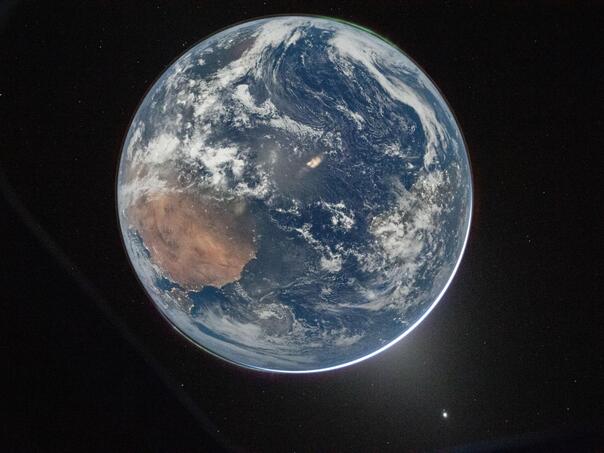
The four astronauts on the Artemis II mission, which launched from Cape Canaveral, spent the first 25 hours of their flight in orbit around the Earth before heading to the Moon.
A key phase of the mission, known as translunar injection, allowed the Orion spacecraft to leave Earth’s orbit and begin its journey to the Moon, which the crew will orbit before returning.
The crew consists of Reid Wiseman, Victor Glover, Christina Koch and Canadian astronaut Jeremy Hansen. They described the first moments of the trip as unforgettable, emphasizing the spectacular view of the Earth.
– We could see the entire planet, from pole to pole, including Africa, Europe and even the aurora borealis. We were all breathless – said Wiseman.
We see our home planet as a whole, lit up in spectacular blues and browns. A green aurora even lights up the atmosphere. That’s us, together, watching as our astronauts make their journey to the Moon. pic.twitter.com/6JkKufBgtJ
— NASA (@NASA) April 3, 2026
NASA explained that the crew will use the Moon’s gravity to return to Earth, making this mission a key test for future manned flights.
The spacecraft will travel up to 406,000 kilometers from Earth, surpassing the record set by the Apollo 13 mission. It is scheduled to fly by the Moon on Monday, which will be one of the key phases of the mission.
Although this mission does not include landing on the moon, it is an important step towards future missions, including the return of humans to the moon by 2028, and the long-term goal of sending a crew to Mars.
“I’m the space plumber, I’m proud to call myself the space plumber.”
Mission specialists like @Astro_Christina train for all roles so they can jump in wherever they’re needed. Sometimes that means fixing vital machinery, like the spacecraft toilet. pic.twitter.com/RGBWkwRgX7
— NASA (@NASA) April 3, 2026
The astronauts also emphasized the symbolism of the mission, saying that it shows how humanity can achieve great things through joint efforts, regardless of differences.
(Vijesti.ba)