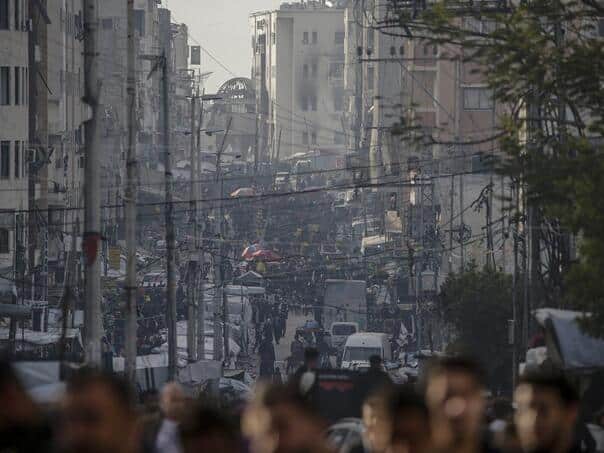
“Airstrikes have become less frequent,” says the 33-year-old from Shujaya, a settlement in the eastern part of Gaza City, in that small enclave devastated after more than two years of war between Israel and the Palestinian Islamist movement Hamas, reports HINA.
Despite the ceasefire that took effect on October 10, he says he still hears “explosions every day, as houses collapse or from artillery shelling,” adding that “warplanes and reconnaissance planes are constantly in the sky.”
The Israeli army declined to comment on the allegations when contacted by AFP.
According to him, Israel is “using the fact that the world is preoccupied with the war against Iran to increase the pressure” on the Gaza Strip, especially by closing the border crossings since Saturday.
According to civil protection data, one woman was killed near Rafah on Wednesday, while several Palestinians were wounded by Israeli fire in the center of the city.
“It’s true that Israeli bombing has decreased significantly,” admits Abdallah Al-Astal, a Palestinian from Han Yunis in the south, “but Israel is preventing the entry of food, aid and fuel.”
When the war with Iran began on Saturday with an Israeli-American military offensive, the crossings through which humanitarian aid arrived, on which Gaza depends for almost all medicine and basic necessities, were closed. The Kerem Shalom crossing, between Israel and the Gaza Strip, reopened on Tuesday.
This diversion of attention from Gaza, especially after the pro-Iranian Lebanese movement Hezbollah attacked Israel to “avenge” the death of Iran’s Supreme Leader Ali Khamenei, worries Al-Astal, who says he wants to live with dignity above all else.
“I don’t care about any country or any person in the world, be it Khamenei or anyone else. I don’t support Iran, whether it supports Gaza or not. We just want to live as human beings,” the 59-year-old told AFP.
A local Palestinian Authority source in charge of Gaza’s border crossings confirmed to AFP that “a small number of trucks” managed to enter the territory on Wednesday through Kerem Shalom.
Rafah, the other main border crossing with Egypt, remains closed. Aid trucks waiting on the Egyptian side were still allowed to pass through Rafah, according to the Egyptian Red Crescent. However, those trucks did not enter the Gaza Strip directly; they moved along the border to Kerem Shalom, where they just unloaded their cargo.
After the border crossings were closed, “we saw an immediate increase in fuel prices,” said Jonathan Crickx, a UNICEF spokesman. He added that “the prices of basic necessities, such as food and soap, have increased by 200 to 300 percent.”
According to the Office of the United Nations Special Coordinator for the Middle East Peace Process (UNSCO), 500,000 liters of fuel entered the Gaza Strip via Kerem Shalom on Tuesday, and prices have since stabilized, said Felipe Ribero, head of the Medecins Sans Frontières (MSF) mission in the Palestinian territories.
However, the situation remains difficult as storage capacity in Gaza is limited, and any supply disruption quickly leads to shortages.
“From the first day of the war with Iran, people got scared and started buying whatever they could find in the market. Basic necessities are still available, but they are starting to become scarce,” said Safia Hamuda, a 61-year-old Palestinian who currently lives in a camp for displaced people.
She claims that Israel “wants to destroy Iran and turn it into a devastated country like Gaza, unable to meet its food and other basic needs.”
According to Adnan Abu Hasna of the United Nations Relief and Works Agency for Palestine Refugees (UNRWA), the Palestinians fear that the world’s attention will shift away from them and that the international community will “relent in pressure” on Israel to allow humanitarian aid to enter.
“I think the world will forget Gaza…” sighs Mohamed Al-Hallu, a 29-year-old Palestinian living in a tent at a school in Gaza City. “And that no one will pay attention to our suffering.”
(Vijesti.ba)