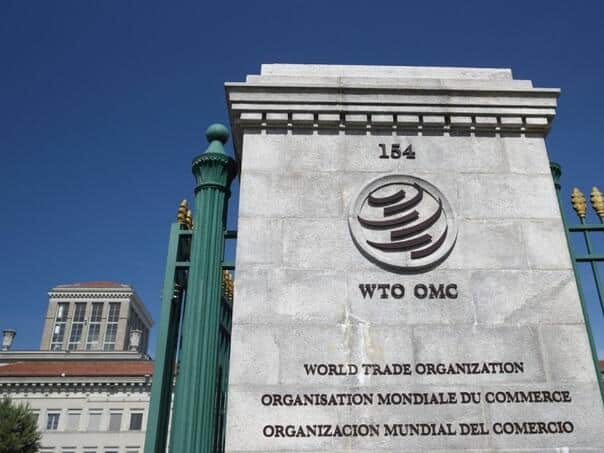
We are located on the edge of the Trade War in which Europe is the main target. The World Trade Organization (WTO) has barely passed unexant through the first term of office of US President Donald Trump.
Now, faced with the upcoming wave of “reciprocal” customs and reprisals, the world is again in front of a serious geopolitical uncertainty and a stumped multilateral trading system. Therefore, as we enter this year’s Munich Security Conference, it is time to review the institution that no longer fulfills its purpose.
Freedom and economic success are closely related. One is usually a prerequisite for another. Generally speaking, which is the economic system less free, it will be less successful. The only big exception is China, because we face the country controlled turbo-capitalism – which has been using the benefits of membership in the World Trade Organization (WTO) for years.
Under the sheath “Free Trade”, China used its membership to continue to expand its power by dishonest funds. It turned out that the WTO is not a solution, but a key part of the problem. Accelerating the weakening of really free economies, WTO encouraged the rise of unprotected and undemocratic actors. He created dependencies and became a trojan horse of unprotected trade.
WTO was founded in Marrakech in 1994. years. His establishment led to the introduction of services for services and intellectual property. Previously, international trade rules were defined by the general customs and trade agreement (GATT). The GATT agreement was created in 1947. With the support of 23 countries, while until 1994. the membership extended to 128 countries.
Gatt was created after World War II to prevent the 1920s’ customs war repetition. However, what started as an efficient and modest western cooperation, has grown into a large and non-functional organization WTO as we know, banker me. That is why now it is now a necessary conceptual review of this institution.
WTO members are obliged to respect three basic principles in international trade relations: trade without discrimination, reciprocity as the basis of negotiations and the elimination of customs and trade barriers. Member States are obliged to provide each other the same trade benefits. The principle of non-discrimination is further prescribed that the benefits and support of the approved one country must be automatically applied to all members of the organization.
However, the WTO provides special benefits to countries that are classified as “developing countries” – a category for which the organization does not provide a formal definition. Members are declared themselves as “developing countries”, which China has done when accetting the trade federation. These benefits include longer deadlines for fulfilling obligations or easier access to the market. However, the most important concession is the obligation of other WTO members to protect the interests of developing countries in the adoption of certain national or international measures – benefits that China is firmly held from the date of its accession.
In addition, China violates WTO rules for years. The list of misdemeanors is debt: Forced transfer of technology, mass, frequently unreported subsidies, and violating competition through state-owned enterprises.
In order to obtain access to the Chinese market, many foreign companies were forced to discover valuable technological information. The consequences for international businesses are measured by billions of dollars. Meanwhile, Chinese competitors in some sectors quickly caught the leading industrial innovators and have become market leaders themselves.
Almost a traumatic example – especially for Germany – is the case of photovoltaic or solar energy systems. Until 2005. This industry in China practically did not exist. However, until 2022. year, the Chinese share in all stages of production exceeded 80 percent, based on copied innovation and encouraged massive subsidies.
China is watching Europe as a supermarket. With great skill invests in top technology, often through “hidden champions” – companies that are not so publicly visible as Daimler, Volkswagen or Volvo. Chinese antitrust laws, especially the Law on Monopoly Prevention, also have extremely specific characteristics. China often punishes foreign companies because of innovation. Anyone who owns a patent and charges licensing fees can be declared a monopolist. One of the affected companies was the Qualcomm smartphone manufacturer, who had to pay a fine of nearly billion dollars due to the allegedly charging excessive licenses to Chinese competitors.
Finally, China did not even open their market as much as it is often claimed. International companies did not have full access to its financial sector until 2021. years. The lack of transparent rules makes business difficult, and no successful joint venture has been achieved in the telecommunications sector between Chinese and foreign companies. Facebook and Twitter are prohibited from 2009. years.
It is difficult to imagine that such examples could happen in the opposite direction. Chinese companies generally operate in western markets, while the People’s Republic continues to write its own rules in a way that primarily serves its power expansion. WTO rules and those who carry them out or cannot, or do not want to prevent it. His reciprocity principle is just a pious wish.
In reality, the WTO decomposes, tolerating double standards and allowing Members to play according to different rules. Instead of reciprocity, the Assymmetry government.
Carbon dioxide emissions are another factor that rose dramatically for the cinema from its WTO accession: increased by more than 200 percent. This growth far outweigh the reduction of emissions in the rest of the world. China is 2021. was responsible for almost a third of global carbon dioxide emissions – more than United States, India, Russia, Japan and Iran, which are the next five largest pollutants.
The conclusion is clear: the global climate crisis further emphasizes the need to oppose autocratic systems such as China. The real problem of climate change is not holidays in Florida or Mallorca. The problem is that we have little or no influence on the largest pollutant in the world. What the pollutant leads a completely different political agenda. And, in the end, what we contribute to the problem by moving “climate sins” we do not want in our own yard – China or some other countries.
From today’s perspective, the reception of China in WTO as full members was a fundamental error-based trade policy, not realities. As many times earlier, good intentions have led to an imbalance that has worsened over time – the damage to democratic market economies.
The main mistake was to allow access to the economically powerful, but undemocratic state, which was not able to comply with the rules of free trade due to their own system. The most absurd decision was to assign China’s country status – status that still retains that the second largest economy in the world is, with all the privileges and exceptions that this status brings. It is like you give a special privilege in the neighborhood in the neighborhood. Competition could not be more unjust or auto-destructive.
The outcome of this experiment was predictable: in the short term, the growth and economic success of all participants, but has created dependencies and unilateral advantages in the long run. The auto-destructive approach to the United States and Europe has led not only to the weakening of their relative economic power but also, ultimately, to the erosion of the entire WTO.
And when we talk about the end, the WTO came to the end of your trip. What we see today is a dysfunctional and paralyzed colossus – a pale shadow of the former organization. All this leads to an relentless conclusion: WTO should be dissolved
(Vijesti.ba)