
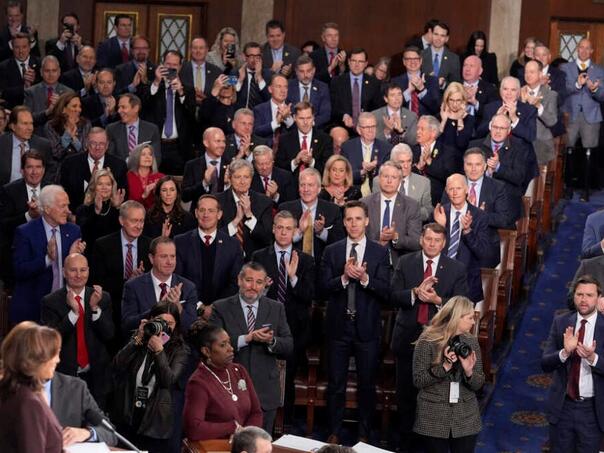
Republican leaders in the US Congress are facing growing pressure to respond to anti-Muslim rhetoric, after a series of inflammatory statements and policy proposals that have reopened the debate about Islamophobia in American politics.
The latest controversy has been sparked by statements from House Republicans, including Andy Ogles and Randy Fine, that critics say cross the line between security concerns and open hostility toward Muslims as a religious community.
Critics argue that such rhetoric has been further encouraged by US President Donald Trump, recalling restrictions on entry into the US for citizens of several Muslim-majority countries during his first term – a policy often referred to as the “Muslim ban”.
Civil rights groups and Democratic lawmakers believe the measure, along with Trump’s earlier sharing of anti-Muslim propaganda on social media, has helped normalize harsher rhetoric about Islam in American politics.
Ogles sparked the latest firestorm on Monday when he wrote on social media that “Muslims do not belong in American society,” adding that “pluralism is a lie.”
The remarks were quickly condemned by Democrats and civil rights organizations.
However, Ogles’ comments are not an isolated case.
Fine has previously written that Americans should fear Islam, and previously suggested that if he had to choose between “dogs and Muslims,” the choice would not be difficult.
In the Senate, Tommy Tuberville, who is running for governor of the state of Alabama, has issued warnings about Muslims in the United States, including a post suggesting they are “within the gates.”
This kind of rhetoric caused sharp polemics on social networks and in Congress, while Arizona congresswoman Yassamin Ansari accused Fine of “heinous racism” and asked for a statement from the Speaker of the House of Representatives, Mike Johnson.
Serious problem
So far, Republican leadership has largely avoided directly condemning the controversial statements.
Asked about Ogles’ post, Johnson said it was “different language than I would have used,” adding that concerns about the possible introduction of Islamic law in the United States were “a serious issue.”
Critics say the response reflects a broader reluctance to confront the problem, noting that a clear condemnation of religious bigotry would be a political no-brainer — but no such statement has yet come from House Republican leadership.
Meanwhile, the rhetoric seems to be escalating rather than waning.
An analysis by The Washington Post showed that since the beginning of 2025, nearly 100 Republican members of Congress have posted content about Islam or Muslims on social media – and almost all of the posts were negative.
Two-thirds of them related to topics such as radical Islam, Sharia law, extremism or terrorism.
The analysis also found that some lawmakers called for deporting Muslims or banning immigration from Islamic countries.
Among the most active was Texas congressman Chip Roy, who posted more than 100 messages mentioning Islam this year.
Mobilization of voters
Critics argue that social media activity reflects a broader political strategy within a section of the Republican Party.
Some analysts believe that anti-Muslim rhetoric is being used to mobilize voters concerned about economic problems and the ongoing US conflict with Iran.
Civil rights advocates say such rhetoric is reminiscent of messages from far-right activists outside of power, who have previously called for the deportation of Muslims or a total ban on Islamic immigration.
The escalation also spilled over into legislative proposals.
Nearly 40 Republican lawmakers, including Ogles and Fine, have proposed or supported measures to ban immigration from Muslim-majority countries.
Proponents claim that the goal of such proposals is to protect national security, while opponents warn that it blurs the line between the fight against terrorism and religious discrimination.
Several Republicans, however, expressed discomfort with the tone of the discussion.
Thom Tillis said Ogles’ comments were “nonsensical,” while Don Bacon recalled that the U.S. Constitution prohibits religious tests for public office.
(Vijesti.ba)


