
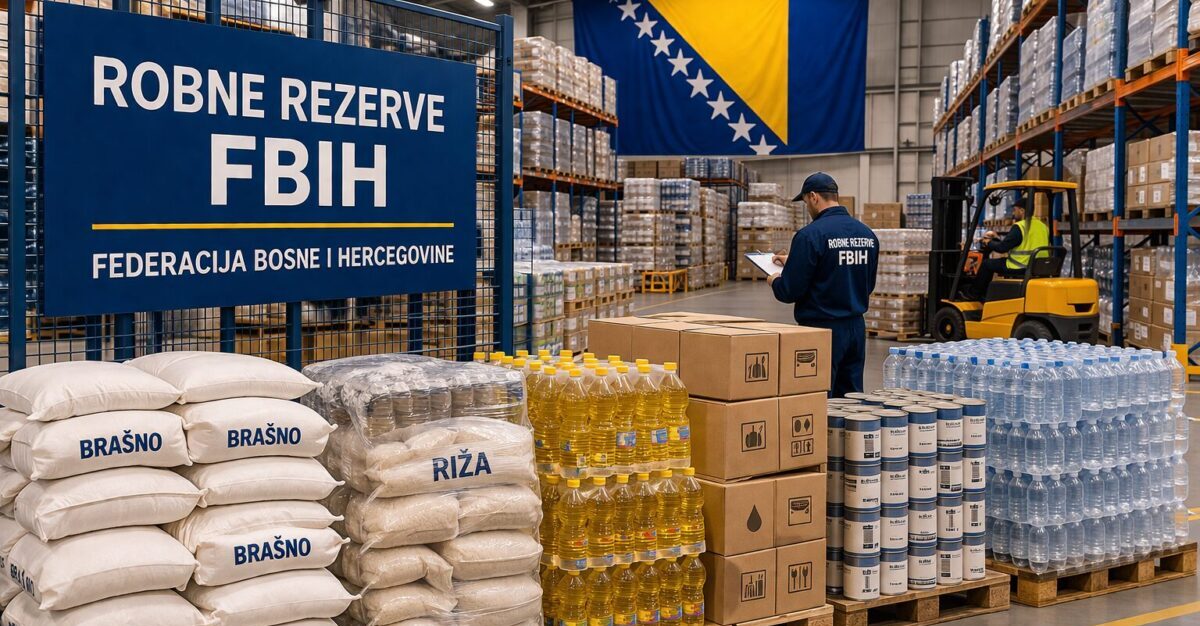
While the formation of commodity reserves in the Republic of Srpska is not in sight, the FBiH has this institution, which currently stores goods worth about 40 million KM.
Serbia has the Republic Directorate for Commodity Reserves, which, among other things, performs professional tasks related to the organization of the commodity reserve system, as well as the preservation and renewal of those reserves.
Croatia has a Directorate for Commodity Stocks, which performs tasks related to the creation, financing, use, use and renewal of strategic commodity stocks, which also includes securing storage space for their storage.
Political spears around the (outdated) system
“No one will be hungry”: Even the Prime Minister of the Republika Srpska, Savo Minic, recently confirmed that the Republika Srpska needs commodity reserves.
“I agree, they should exist, but they serve to prevent anyone from going hungry. No one in Republika Srpska is and will not be hungry. We will provide everything that is needed,” said Minic at the time.
In March, Draško Stanivuković, the mayor of Banjaluka, submitted a draft law on commodity reserves to the protocol of the Government of Republika Srpska, and Minic, a few evenings ago, when a TV debate between the two was held, stated that this system was outdated.
“Commodity reserves used to be, the old ones, for storing flour, oil, salt, sugar and so on. Now we see that it is something completely different – oil, some other derivatives,” said Minic.
Regional experiences: Serbia and Croatia fill warehouses
In Serbia, apparently, they think differently. Their Republic Directorate for Commodity Reserves announced a sale a few weeks ago to restore agricultural and food products. Upon inspection of the advertisement for sale, “Nezavisne novine” determined that it included salt (as much as 3,387,600 kg), beef cuts, pates, fattening pigs and beef…
“The public advertisement is open until the final sale of the advertised quantities of agricultural and food products”, stated the Republic Directorate for Commodity Reserves, based in Belgrade.
Croatia revealed the cards: The authorities in Croatia revealed the cards in February of this year. The State Secretary in the Croatian Ministry of Economy, Vedran Špehar, said that Croatia has grain stocks for the entire needs of the population for 60 days, as well as beds and tents to take care of up to 50,000 inhabitants.
“In addition, we have certain capacities in the MOD (Ministry of Defense of the Republic of Croatia),” said Špehar.
Voice of the profession: Abolition of reserves was the biggest mistake
Fighters for consumer protection say that commodity reserves are urgently needed in Republika Srpska as well.
“I think that the biggest mistake, in perhaps the last ten years, of those who proposed the decisions is to bring the commodity reserves to the status that they must be abolished. I am sorry that the word of the experts is not listened to here. The commodity reserves should be renewed urgently, which takes two to three years, but it is better to wait and be sure, than to have what we are waiting for now,” he told “Independent newspaper” Snežana Šešlija, president of the Association of Citizens “Tolerance against Diversity” (ToPeeR) from Doboj.
Federation of Bosnia and Herzegovina: Stocks of 40 million are only sufficient for first aid
Although, therefore, FBiH has its own commodity reserves, the situation is far from idyllic.
Tončo Bavrka, director of FBiH Commodity Reserves, told Faktor that, unlike earlier crises, such as the corona virus pandemic, FBiH’s commodity reserves are somewhat fuller now, but the quantities of food in commodity reserves and oil and oil derivatives in FBiH terminals are sufficient only for short-term interventions.
“We have approximately 40 million KM worth of goods in stock. Looking at the geopolitical situation in the world, the tendencies of price growth, it is clear that more should be allocated for commodity reserves,” said Bavrka.


