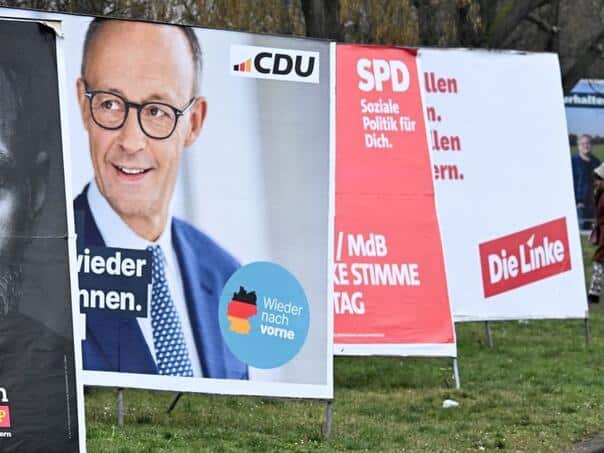
Bundestag elections on Sunday 23. February are specific not only because they are premature and due to a short winter campaign, but also because of a special political situation. A few days before voting, uncertainty is higher than ever, says the public change researcher Manfred Güllner.
“I can’t remember that it used to be this much uncertain and a tight question who can form a ruling coalition at all,” said Fors Institute for Fors for dpa.
It is possible that for the first time they will happen that for a two-central coalition without an alternative to Germany (AFD) there will be no matters of the mandate.
Relatively few votes can bring big changes in the future convocation of the Bundestag, Gilner explained.
Although Democracy (CDU / CSU) with its Candidate for Chancellor Friedrich Merz is stable in the polls with about 30 percent of support, behind them are unchanged AFD with 20 to 21 percent, Social Democrates (SPD) Chancellor of Olafa Scholac (Scholz) with 15 Up to 16 percent and green from 13 to 14 percent.
However, the situation is uncertain for three smaller parties. Left (Die Links) was at least six to seven percent in recent surveys and thus cross the census of five percent.
The Sara Vagenneht (BSW) and Liberals (FDP) federation (FDP) oscillate between four and five percent. The Bundestag with individual deputies may also include the Alliance of the Voter of Southern Skree, for which a threshold of five percent does not apply.
The results will reflect movements within the company, he explained for the DPA policy from Dresden Hans Vorländer.
In other words, if three smaller parties remain just below the threshold of five percent, in the extreme case, almost 15 percent of the voters will not have representatives in the Bundestag.
On the other hand, “If many parties enter the parliament, the formation of the government becomes difficult, so a three-member coalition could be needed,” says Forlender.
The Gilner also thinks.
“This time we cannot prepare all possible variants in advance, because small changes can have great consequences that the coalitions are possible at all,” Gilner said.
“If only Levica in parliament in parliament in parliament in the parliament, according to current surveys, would be enough for the CDU / CSU and SPD coalition,” the founder of FORS cited. However, for the black and green coalition, ie the Alliance of DemoRišćana and Liberal, would be tight.
Additional uncertainty enters the new election law, which reduces the number of deputies in the Bundestag from 736 to 630. Therefore, so-called additional and compensatory parliament sites.
Unlike previous practices, winners in electoral districts do not even receive an automatic direct term, but also the result of the party must fit into the overall distribution.
German voters vote for individual deputies and for parties.
However, a special rule remains that the party that conquers three direct mandates enters the parliament in accordance with the overall stake of the votes won.
This time maybe many hours will pass after closing polling stations before it is exactly determined who entered the Bundestag.
In one view, however, Gilner is safe. The Government of Social Democrats, Greens and Levice is excluded.
The BSW is unequivocally distinguished from the coalition with Demošišćani, SPD or green. Levica Pak is taking a campaign with the slogan “Everyone wants to rule, we want change.”
In AFD, the situation is reversed – no other party wants a coalition with that extremely right-wing party.
“This kind of political situation creates pressure on the Parties to the Democratic Center to find a deal,” Expert forlender said. Democracy must resolve problems, otherwise dissatisfaction grows.
Special is not just a situation in Germany, but also in an international context.
On the one hand, due to the crisis and wars in Ukraine, in the Middle East and the US policy, there are so many open issues that voters are rightly losing an overview of the situation. On the other hand, international partners in NATO and the EU are closely monitoring the Government of Germany.
And there are the comments of German elections from abroad. Thus, the new Vice President of America JD Vance recently indirectly criticized the refusal of the cooperation of moderate parties with AFD.
Advisor to the US President Elon Musk openly supports AFD.
And in Moscow, Foreign Minister Sergei Lavrov also sent friendly words for AFD and BSW, a party who opposes American missiles in Germany and deliveries of Ukraine’s weapons.
In the attitudes of AFD and BSW “he has a lot reasonable,” Lavrov said in mid-January.
(Vijesti.ba)