
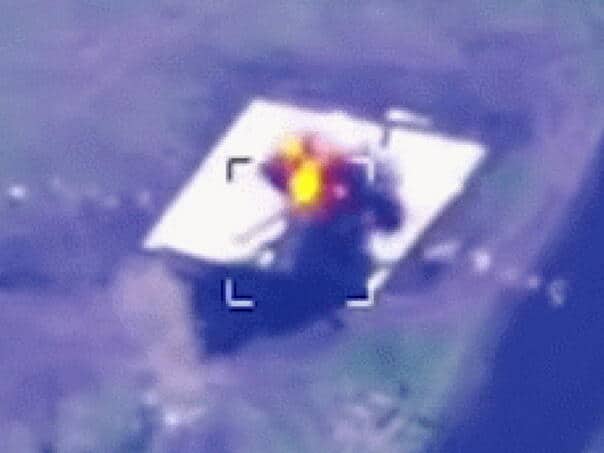
The action was the result of carefully planned cooperation between three elite units: the 429th Unmanned Systems Brigade ‘Achilles’, the 43rd Independent Aviation Brigade and the Special Operations Center ‘A’.
According to the footage, the targets were transport Mi-8 and attack Mi-28. Both aircraft were stationary at the time of the attack, almost certainly in the middle of maintenance, as evidenced by the presence of ground personnel in the immediate vicinity of the impact.
The attack was carried out in waves. After the operators confirmed visual contact and checked the coordinates, a series of kamikaze drone strikes followed. According to preliminary estimates, both helicopters were completely destroyed, writes Jutarnji list.
Video of UAS strikes by the 429th Achilles Unmanned Systems Brigade and 43rd Artillery Brigade on Russian Mi-28 and Mi-8/17 helicopters in Voronezh region, more than 150km from the front line. https://t.co/r5hgTqX9sZ pic.twitter.com/0cZTbz6r2y
— Rob Lee (@RALee85) April 29, 2026
This strike is not just a matter of material damage. Russia lost two key machines of different purposes in this attack.
The Mi-8 is the ‘workhorse’ of Russian logistics, indispensable for transporting troops, evacuating the wounded and rapid landings, while the Mi-28 is a specialized ‘armor killer’, designed to withstand heavy anti-aircraft fire and eliminate front-line tanks.
However, strategically, perhaps more painful is the loss of experienced technical personnel who happened to be at the scene of the attack. While the aircraft can be replaced, the skills of the mechanics and engineers specializing in these systems are not replaced overnight, Defense Blog claims.
The ‘Achilles’ unit of the 429th brigade confirmed its status as one of the deadliest units in the Ukrainian arsenal with this attack. Their journey from a volunteer company formed on the first day of the invasion to the level of a brigade in 2026 is followed by incredible statistics. In 2025 alone, while they were still in regimental status, they destroyed or damaged almost 20,000 targets. Today, they are the backbone of Ukraine’s Unmanned Systems Forces – a branch of the military that currently does not exist anywhere else in the world.
This attack in the Voronezh region sends a clear message to Moscow. That region, which directly borders Ukraine, has long been treated as a safe zone for crews to rest and repair equipment. That calculation is no longer valid.
Ukraine’s ability to coordinate complex strikes deep inside Russian territory, linking intelligence, special forces and drones, shows that this is no longer improvised warfare.
It is a methodical, precisely guided process that forces the Russian command to think radically about where they can safely park their aircraft in the first place, Defense Blog concludes.
(Vijesti.ba)



Chat readers
Open a chat for this news