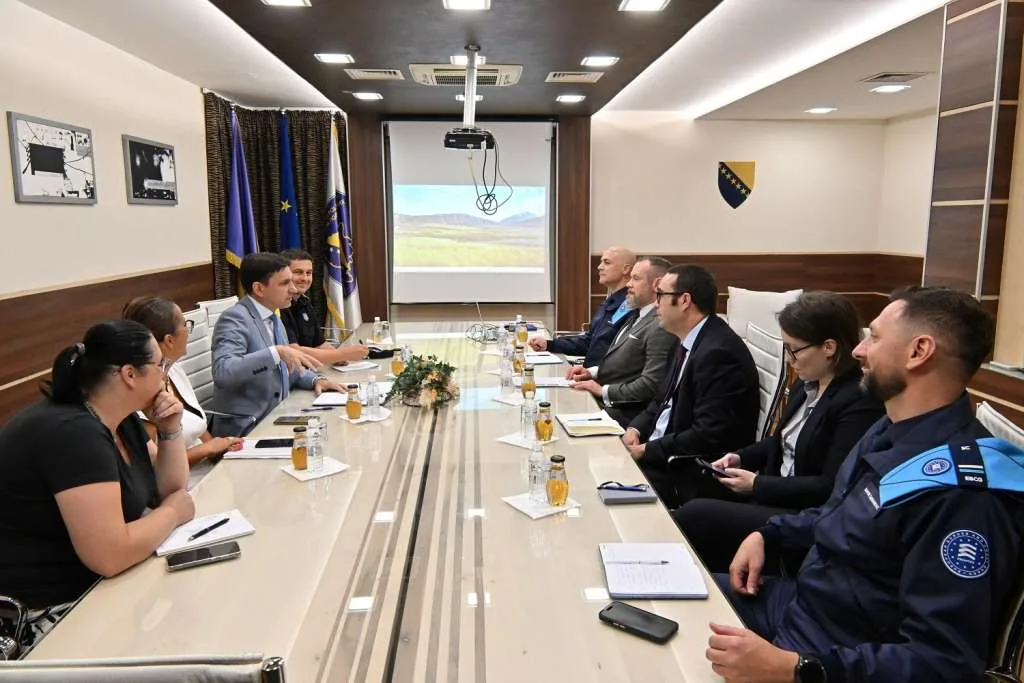
The ambassadors of the member countries of the Steering Committee of the Peace Implementation Council (UO PIC) are meeting today in Sarajevo, at the session where the official deadline for appointing a new high representative expires.
Although during the appointment of acting Louis J.Crishock on June 30, it was clearly outlined that the process of electing a new head of the OHR must be completed by July 14 at the latest, a compromise between the United States of America and the European Union has not yet been reached.
The scenario that best suits the US
This will be the third attempt to elect a high representative in Bosnia and Herzegovina after former high representative Christian Schmidt resigned under pressure from the US in May. The first attempt was on June 2 and 3, and the second on June 30, when the hope was expressed that the high representative would be appointed on July 14.
However, if there were no “reversal” at the last minute, it is more and more certain that the American diplomat Louis J. Crishock, despite the original plans, will remain in the position of acting high representative until further notice.
Although breaking deadlines in diplomatic circles is formally considered a failure, in this situation the scenario of not appointing a high representative is the most suitable for the US. Because, while the negotiations with the representatives of the EU countries are stalling, the head of the OHR remains their man, a career diplomat with full executive capacity who, in addition to the function of acting high representative, is also the supervisor for Brčko.
Through earlier decisions of the Board of Directors of the PIC, it was ensured that Crishock was not just a temporary technical executor of the OHR, but a person with full legitimacy and Bonn powers.
With this, the USA, without the need to reach difficult compromises with Brussels, retained direct control over the most important international mechanism in Bosnia and Herzegovina. For the Americans, Crishock staying in his current position is a guarantee of institutional stability, but also a clear signal of who is making the main moves on the field.
In the new negotiations, Sorensen briefly ‘surfaced’ as a compromise choice
Kaja Kallas, the EU’s high representative for foreign affairs and security policy, said that the negotiations behind closed doors ended without an agreement yesterday. At the meeting of the Council for Foreign Affairs in Brussels, she informed the ministers of the EU member states about the discussions about the OHR and sent a clear message that the European Union wants its “European candidate” at the head of the OHR in Bosnia and Herzegovina.
Given that all four names in circulation, namely the Italians Antonio Zanardi Landi and Maurizio Massari, the Frenchman Rene Trocazz and the Danish Peter Sorensen, respectively, are citizens of EU member states, it is evident that the EU reluctantly accepts the situation that Chrishock will remain in his current position until further notice, despite the fact that it was a joint decision of both the EU countries and the USA just fifteen days ago.
It is known that the USA preferred the Italian diplomat Antonio Zanardi Landi, but with the clear aim that his mandate would be strictly transitional, with a more limited role of mediator.
On the other hand, the leading European states under the term ‘European choice’ mean a diplomat who will implement the strategy of Brussels and manage the OHR in its current capacity.
There are officially four biographies on the table
While the negotiations are ongoing, four biographies are officially on the table. In addition to Landi, Italy is trying to secure support for Maurizio Massari, the former ambassador to the UN, as an alternative solution that could satisfy both sides.
Dane Peter Sorensen, the former head of the EU Delegation in Sarajevo, has emerged as a ‘pure’ European candidate, a man who knows the BiH system and political actors in the Balkans in detail. The fourth candidate is French diplomat Rene Trocazz.
The report learns that at one point in the past 15 days, the USA sent a signal that Sorensen would be acceptable to them as a future high representative, but allegedly they did not persist in that support or at least its continuity in the continuation of the negotiations.
The epilogue of today’s session of PIC ambassadors will be known in the late afternoon, it says Report.