
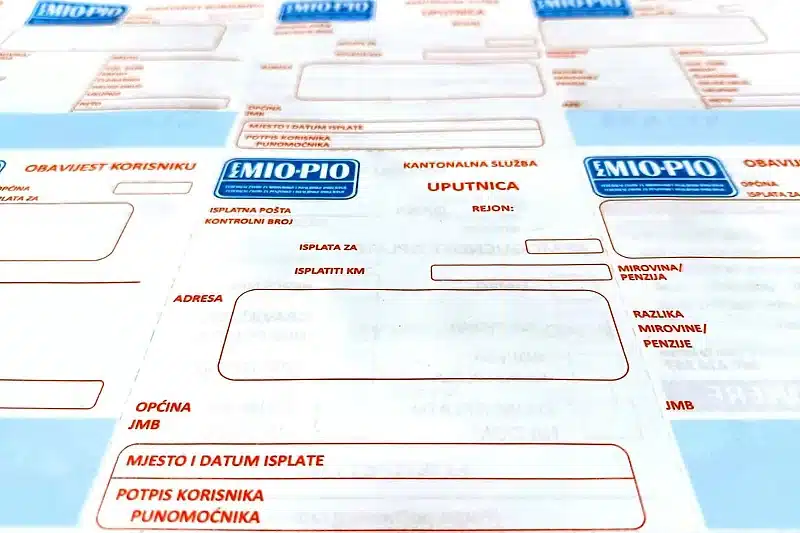
The Prime Minister of the Federation of Bosnia and Herzegovina, Nermin Nikšić, announced a new increase in pensions, which should come into effect on July 1 of this year. Speaking at the “Words, not deeds” gathering in Srebrenik, he pointed out that the total increase in pensions in the Federation this year will reach 17 percent.
He reminded that pensions have already been increased by 11.2 percent since January 1, while an additional increase of around five percent is expected from July, which will fulfill the earlier announcement about the total increase during the year, he writes. Večernji.ba.
For users who became eligible by January 1, 2026, the lowest pension is 666.76 KM, guaranteed 795.74 KM, while the highest pension is 3333.79 KM. The basis for the calculation of the lowest pension from Article 81, paragraph 2 of the Law on Amendments to the Law on MIO (Official Gazette of the Federation of Bosnia and Herzegovina, number: 6/26) for beneficiaries who exercise the right after January 1, 2026 is 724.36 KM.
Based on the above, the lowest pension is from 434.62 KM for service of less than 20 years (60% of the base) to 688.14 KM for 40 years of service and more (95% of the base), with a gradual increase in the percentage and amount with the length of the pension service. The amount of the guaranteed pension for beneficiaries who exercise the right after January 1, 2026 based on 40 or more years of insurance experience is determined in the amount of 842.44 KM.
The family pension for the insured person and the disability pension for beneficiaries who exercise the right after January 1, 2026 cannot be lower than 90% of the average pension from December 2025 adjusted in the year of exercise of the right, which amounts to 651.92 KM.
The lowest pension of beneficiaries who exercise their right according to special regulations (the Act on the Early Favorable Retirement of Veterans of the Homeland War, the Act on the Special Rights of Recipients of War Awards and Decorations and Their Family Members, and the Act on the Rights of Veterans and Their Family Members), was set in the amount of 666.76 KM by amendments to the aforementioned laws. From July 1, these amounts will be increased by about 5 percent, so the minimum pension could reach the amount of 700 KM.
Despite the growth, pensions in Bosnia and Herzegovina are among the lowest in Europe in relation to the cost of living. While retirees in Luxembourg, Italy or Spain can live comfortably on their state pensions, those in the Balkans and Eastern Europe are literally fighting for survival.
Not enough to live on
Research by Moorepay, published last month, reveals a devastating statistic: in more than half of European countries, state pensions are not even enough to cover basic living expenses. The situation in Bosnia and Herzegovina is particularly alarming. According to research data, the pension in BiH covers only 53% of basic living expenses (not including rent). This means that the average pensioner in Bosnia and Herzegovina cannot cover even basic needs, such as food and utilities, without additional help or savings. Neighboring countries are not doing much better either, although they are ahead of Bosnia and Herzegovina. In Montenegro, the pension covers 89% of costs.
In Croatia, the pension covers 82% of the costs, and in North Macedonia, the pension covers 61% of the costs. Although Serbia is not included in the short list, it follows the trend of the region, where pensions rarely reach the threshold of a dignified life without external assistance. The survey clearly shows the geographical division of Europe. In the north and west, pensions are often double the basic costs.
The absolute winner is Luxembourg, where the pension covers a staggering 225% of living expenses, leaving pensioners with a surplus of almost €16,000 a year. Italy (210%) and Finland (208%) follow.
On the other hand, at the bottom are Georgia (22%), Albania (29%) and Ukraine (29%), where the pension does not even cover a third of what a person needs for mere survival.


