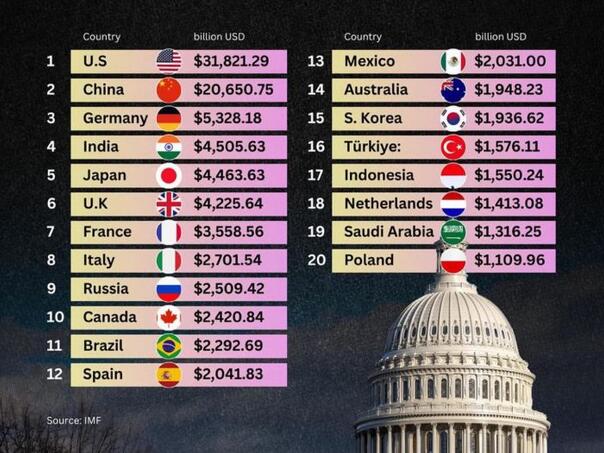
China is at $20.7 trillion, and Germany at $5.3 trillion. The difference at the top is huge. But the real story is not who wins, but who advances.
India overtook Japan to become the world’s fourth largest economy, driven by real GDP growth of 6.2%. As of 2020, India has also surpassed the GDP of the United Kingdom. The country with 1.4 billion inhabitants is growing more than three times faster than Germany. This is no longer a story of an emerging market — this is the formation of an economic superpower in the present time.
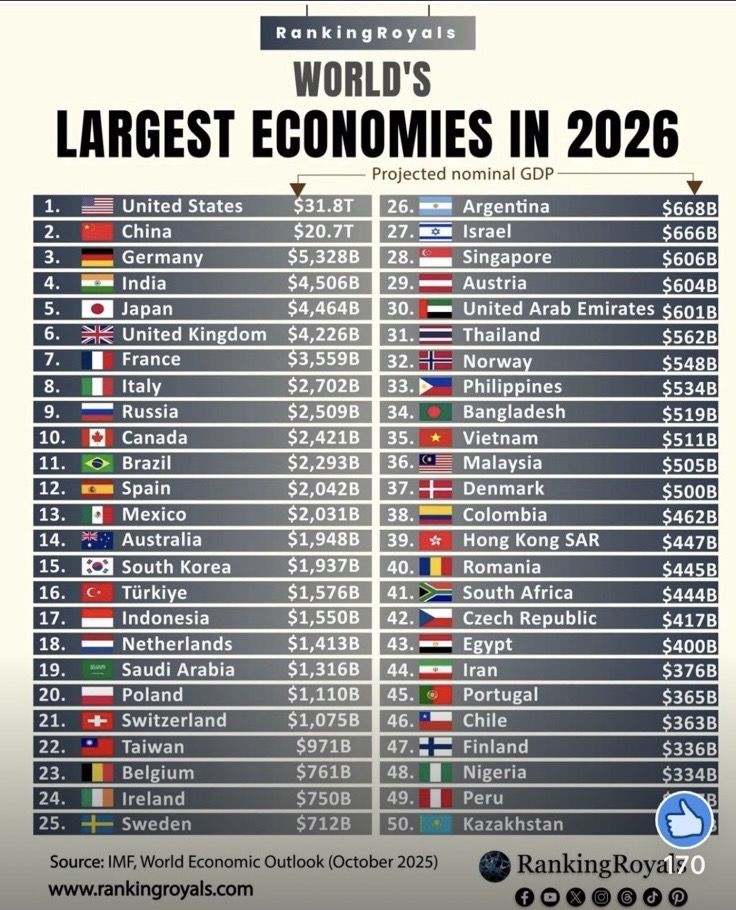
A look further down the list reveals some real surprises. Vietnam, Bangladesh and the Philippines cross the $500 billion GDP threshold. These countries are increasingly integrated into global supply chains. They are quietly taking over production capacity, trade flows and foreign investment that were previously concentrated in China.
The Middle East is writing a new chapter. Saudi Arabia is at $1.3 trillion, and the UAE is at $601 billion. Both countries are rapidly moving away from oil dependence — programs like Vision 2030 and similar national transformation agendas are already translating into real GDP growth.
China is projected to add the most to total GDP by 2030 — about $5.7 trillion. The US follows with 5.0 trillion. India stands out as the only country that is in both the top-10 lists — in terms of total GDP growth and percentage growth.
The IMF warns that the global economy has a cautious outlook in 2026 — growth is slowing due to fragmentation and rising protectionism, with significant risks such as a correction in tech stocks and weakening institutional independence. The map of economic power is being redrawn.
(Vijesti.ba)