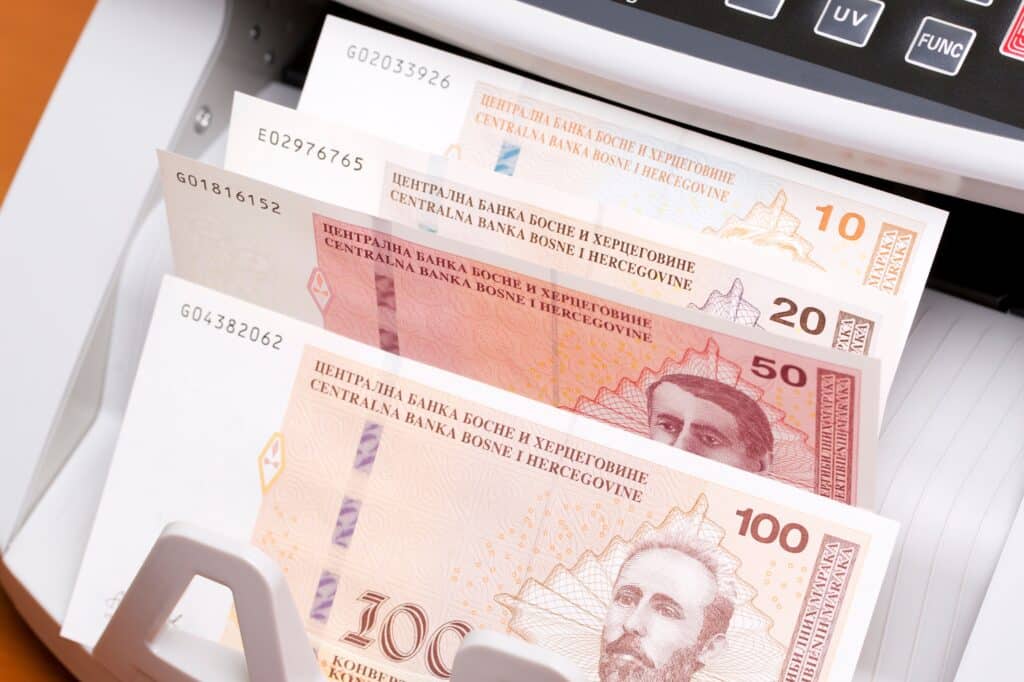
The Government of the Federation of Bosnia and Herzegovina established the Budget Proposal for 2026 at a record 8.9 billion KM, but under the pressure of major fiscal challenges and the planned increase in pensions, which significantly burdens public finances.
Total expenditures are planned at approximately 7.7 billion KM, with the largest expenditures for current transfers, pensions and debt servicing, while the Government claims that the budget is aimed at sustainable management of public finances and stabilization of social systems.
However, sources in the government indicate a deficit of more than one billion marks and a planned debt of 2.3 billion KM in order to ensure financing.
In response, SDA representative Miralem Galijašević assessed that this is not a “historical budget”, but that the budget of 8.9 billion KM does not follow real GDP growth and that debt, especially credit borrowing of more than two billion KM, will represent a huge burden for citizens and the economy, warning of the danger of populist policies before the elections and long-term negative consequences for the economy.
Galijašević told Faktor that the budget is bigger by 500 million KM, and that this is not accompanied by GDP growth, which will be 1.8, and growth in productivity, that is, economic development.
– Therefore, the assumption is that these “holes” will be filled with debt, which will be created by increasing pensions, that is, allocations for the pension fund of more than four billion KM. It is most likely that the assumption that the Federation of BiH will borrow 2.3 billion KM will come true – says Galijašević.
He points out that the FBiH Government claims that the budget is development, but it is not because it does not have a single development component.
– Infrastructural projects funded by World Bank loans have been stopped, and we see that they are trying to replace some of the infrastructure through expressways. The budget is absolutely social. It’s simple to follow logic – this is an election year and we should look to meet all categories that are on the budget and to satisfy appetites – concludes Galijašević, and adds that fiscal reform and the creation of new jobs are necessary.
Muharem Karamujić, a professor at the Faculty of Economics in Sarajevo and an expert in public finance, told Faktor that no one would have anything against the KM 8.9 billion budget if it was an investment, if the Federation was invested in and developed.
– However, this is a social budget, buying votes before the elections. He has no idea, a continuation of populism. We do not know how much the Federation of Bosnia and Herzegovina will borrow. Borrowing in order to cover the operating costs of the administration and to deal with populism is not good – emphasizes Professor Karamujić.
He claims that it cannot be done that way and that, if that money is going to be invested in development, then that’s fine.
– If we are going to borrow more than two billion KM, it is a huge debt and it must not be populism and it will cost us later. Now are the elections, if we are going to buy votes with money from loans and after that we will all suffer, because we will all have fewer and more obligations. Our services are certainly exhausting. Healthcare is at a very bad level, education too… It will all work out. We will have long-term consequences. The government must explain to us, it is there to represent us, not to work on our behalf without our knowledge. They obviously won’t do that, they are waiting for the last moment and then they will deal with populism as they have increased wages, the minimum wage, pensions and so on, for the sake of the pre-election campaign – points out Karamujić and adds that it is a bad policy and that it is not good management.
– We need clear strategies and clear policies that fulfill those strategies that are measurable and to see if this is the best way. We must have economic policies that are of a developmental nature. These are social and populist measures before the elections, and they will not bring us good – concludes Karamujić and says that someone has to pay back those debts and “they would like to buy us with our money”, he writes Factor.