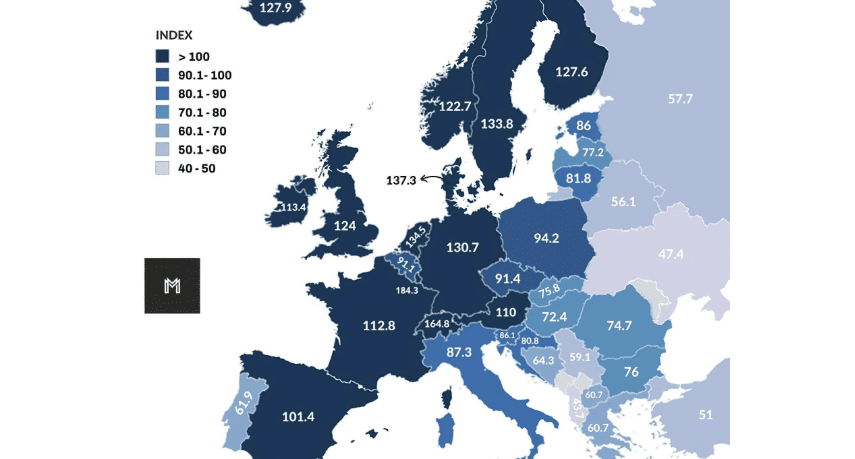
Bosnia and Herzegovina with an index of 64.3 remains at the bottom of Europe in terms of purchasing power, well below Croatia, Slovenia and the European average.
The latest data on purchasing power in Europe, shown through a map based on analyzes of purchasing power parity (PPP), again indicate pronounced differences between the countries of the continent. This analysis, processed by the Statista platform based on data from Eurostat, the OECD and the World Bank, shows in which countries salaries really enable a stable standard of living, and where they barely cover basic expenses.
According to the definitions of international economic institutions, purchasing power measures how many goods and services citizens can afford with their income, taking into account prices in the country. The differences in the indices are not only statistical in nature, they clearly reflect the difference between financial security and day-to-day balancing of expenses.
The North and small rich economies at the top
Northern European countries are still leading when it comes to this indicator. Norway, Sweden and Finland have an index above 120, while Denmark exceeds the value of 130. The high standard is also confirmed by Western European countries such as Germany and the Netherlands, where the combination of stable prices and high incomes enables relatively strong purchasing power.
However, the highest level is recorded by smaller but highly developed economies. Luxembourg, with an index of around 180, and Switzerland, with more than 160, stand out as absolute leaders. Economists attribute these results to high productivity, a stable labor market and strong institutions that allow real wages to grow despite inflationary pressures.
Western Europe facing stagnation
Although they still belong to the developed part of the continent, some western countries are recording a slowdown in the growth of purchasing power. France, with an index of around 112, and Great Britain, which reaches around 124, face the consequences of inflation, which in recent years has reduced the real value of income, especially when it comes to energy and food costs.
In southern Europe, the differences are even more pronounced. Spain is only slightly above the index of 100, while Portugal, with a value of around 60, shows how much the standard can vary even within the European Union.
The countries of Central and Eastern Europe are recording some progress, but they still do not reach the level of the more developed West. The Czech Republic and Poland are approaching the index of 100, while Romania and Bulgaria, although above 70, are still lagging behind. However, in the past decade, the differences have partially narrowed thanks to economic growth and wage increases.
The Balkans are still at the bottom of the ranking
When it comes to Southeast Europe, the data indicate a lower level of purchasing power. Slovenia, with an index of 86, and Croatia, with around 80.8, stand out as countries with a relatively better standard in the region.
Bosnia and Herzegovina records an index of 64.3, which ranks it among the lower ranked countries in Europe. Serbia (59.1), North Macedonia and Greece (about 60.7) have lower values, while Albania with an index of 43.7 takes the last place on this list. What does the position of Bosnia and Herzegovina show?
The result of Bosnia and Herzegovina indicates that the nominal growth of income does not sufficiently follow the growth of the cost of living. An index of 64.3 means that the real possibility of citizens to meet their daily needs is still significantly below the European average, and the difference is particularly visible in comparison with the more developed countries of the continent.
Such a ratio of wages and prices is most reflected in households that spend the largest part of their income on food, utilities, housing and transportation. In circumstances where basic expenses occupy the largest part of the household budget, the space for saving, investing or spending more remains very limited. In practice, this means that even minor price disturbances, especially for energy and food products, have a strong impact on the standard of the population.
The data from the map additionally show that Bosnia and Herzegovina lags behind not only the countries of Western and Northern Europe, but also a part of the region. Although it is ahead of Serbia, North Macedonia and Albania, it still remains significantly below Croatia and especially Slovenia, which have a much more favorable ratio of income and expenses. Such a schedule confirms that the economic gap within Southeast Europe is still clearly visible.
Europe of different economic realities
The analysis clearly shows that Europe continues to function as an area of great economic differences. While one part of the continent enjoys a high standard of living and stability, the other is facing limited income and rising costs, which significantly affects the daily life of citizens, writes RTV TK.