
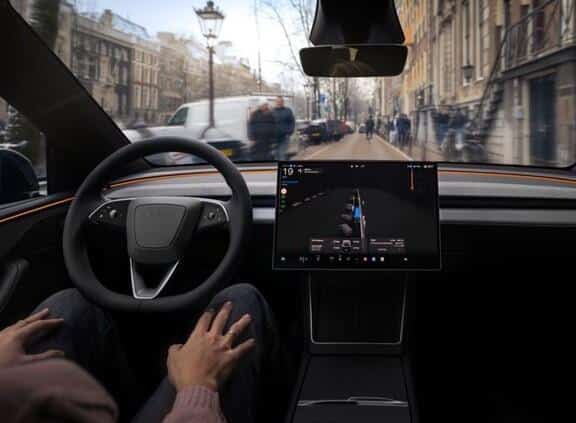
With active driver supervision, vehicles can steer almost anywhere. Tesla states that FSD learns similarly to humans – through experience – and that their vehicles collect huge amounts of driving data every day, which they use to improve the system, even in rare situations.
The system uses cameras and artificial intelligence, and data processing takes place directly in the vehicle to protect privacy. It does not rely on pre-programmed rules, but on neural networks trained on anonymous data, which make driving decisions in real time.
Although the system is constantly being improved, it still requires the driver’s constant attention and does not make the vehicle fully autonomous – the driver is responsible at all times.
According to Tesla, with FSD enabled (with monitoring), the risk of a collision per kilometer can be up to 7 times lower than with classic driving. So far, more than 14 billion kilometers have been traveled globally with this system, while tests in Europe have covered over 1.6 million kilometers.
The Netherlands is the first European country to approve the feature, and Tesla plans to expand to other countries via over-the-air software upgrades.
(Vijesti.ba)


