
Ice Brijeg, which is about twice as much as London, is stuck and should start breaking on the southwest coast of the island, writes the BBC.
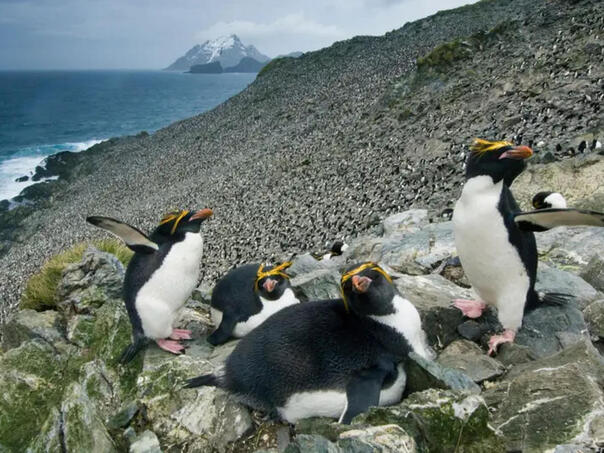
Fishermen are afraid to be forced to fight with huge pieces of ice, and that could affect some kind of penguins that feed in the area.
But scientists in Antarctica say that huge amounts of nutrients are preserved within the ice and that, how to melt, he could challenge the lifelong in the ocean.
“It’s like to throw a nutritious bomb in the middle of an empty desert,” says Professor Nadine Johnston, a scientist from the Institute of British Research Antarctica (BAS)
“If crashing, causing icebergs will probably be a danger to ships and could limit the access to the vessel to local fishing grounds, said Ecologist Mark Belchier.
Stranding is the latest craft in the nearly 40-year-old story that started when a large piece of ice broke in 1986. years.
We followed his route on satellite images since December when he finally got out of the ocean vortex where he was stuck.
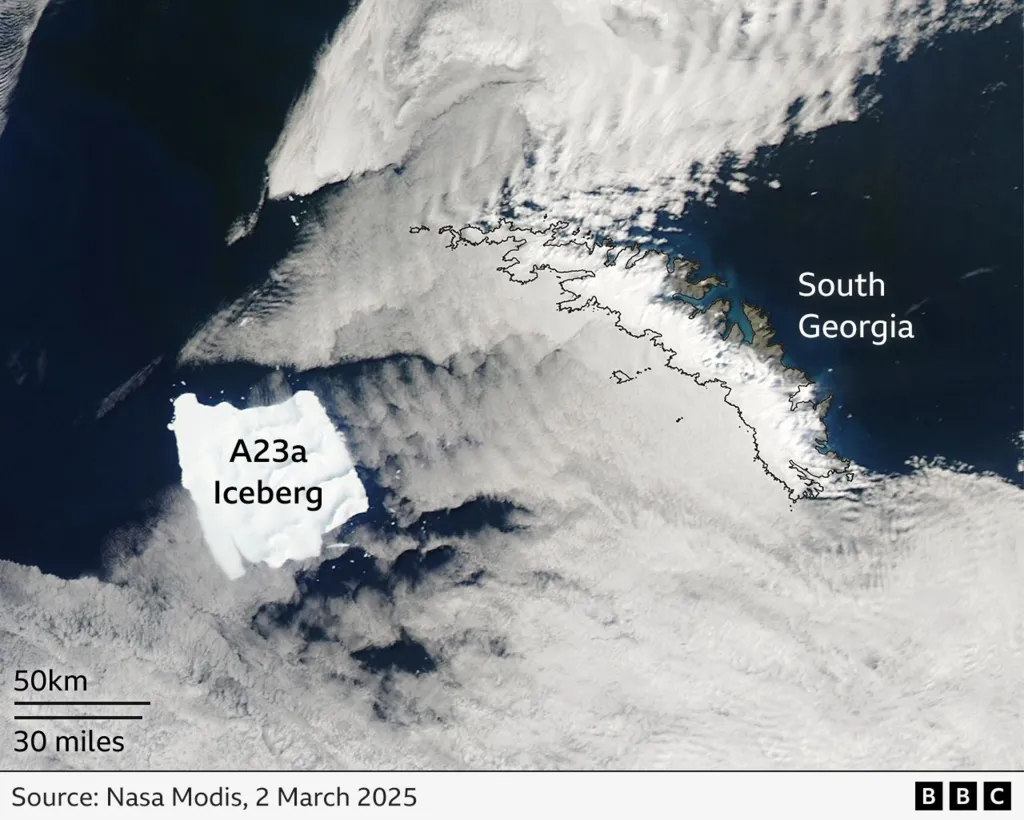
As he moved north through warmer water, he stayed intact.
A few days even seemed to revolve in one place, before he accelerated the trip in mid-February, crossing about 30 km a day.
“The future of all the icebers is the disappearance. It is very surprising to see that the A23A survived this long and that he lost only one quarter of the surface, “said Professor Huw Griffiths, speaking for the BBC News from the Polar Research Ship that is currently in Antarctica.
On Saturday, the ice colosses were 300 meters high in a land belt of about 80 kilometers from the mainland and now it seems stuck.
“It is likely to remain more or less where it is, while the pieces are not executed,” says Professor Andrew Meijers from the Antarctica Institute (BAS).
Still, the hill is significantly ripped. Once sizes of 3,900 square kilometers, it is constantly reduced due to the huge amount of water, while moving over warmer seas.
Now its size is estimated at 3,234 square kilometers.
“Instead of great, pure intact ice cubes, under the edges peek caves,” says Professor Meiers.
“If the LED is corrected salt – will fall under pressure and maybe sail somewhere on the shallower,” he adds a professor.
But where the ice touches the mainland, there are thousands of tiny creatures such as coral, seagover and sponge.
“The whole universe has been destroyed by a massive ice plate that scrapes along the seabed,” says Professor Griffits.
It is short-term catastrophic for these species, but says it is a natural part of the life cycle.
“Destroys something in one place, and in other places, nutrients,” he adds.
There were fears for larger creatures on the islands.
In 2004. Santa ice in the area called Rosovo Sea, she enhanced the propagation of penguins, leading to numerous deaths.
But experts now think that most birds and animals will avoid that destiny.
Penguins who feed on the area of the mainland where the iceberg is stuck can be affected, says Peter Fretwell from the Institute of the British Antarctica Research (BAS).
The iceberg dissolves sweet water into salt water, reducing the amount of food, including small crabs eating penguins.
Birds could move to other places in search of food, he explains, but that would put them in the competition with other creatures.
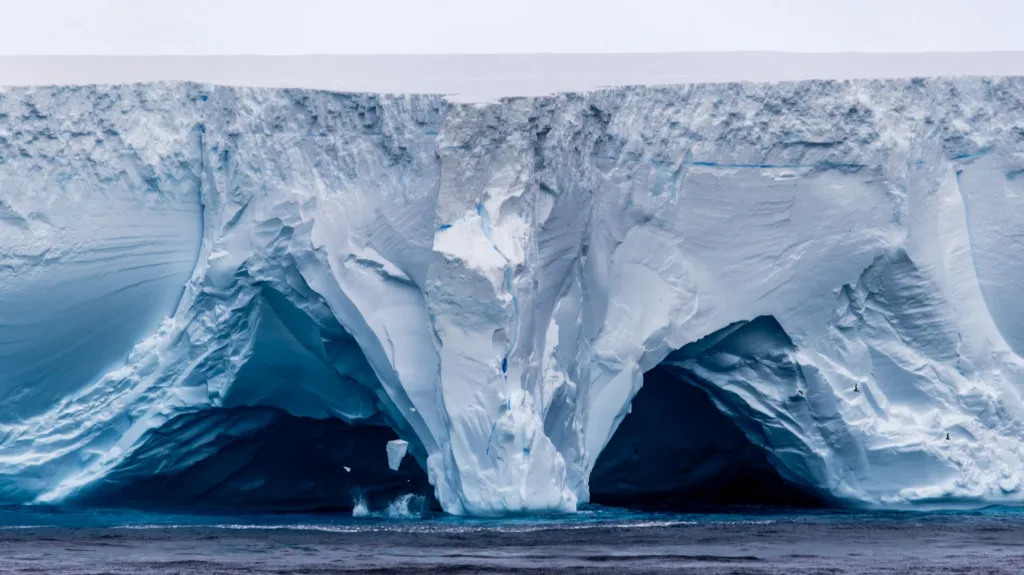
LED could block ports or disrupt the sailing when the fishing season starts in April.
“We’ll have to fight for A23A safely,” says Andrew Newman from Argos Froyanes.
Scientists currently working on Antarctica also reveal an incredible contribution that Santa ice gives life in the ocean.
Professors Grigfits and Johnston work on board and collect evidence of the flow of nutrients from ice on Antarctica across the country.
Particles and nutrients from all over the world are trapped in the ice, which is then slowly released into the ocean, explain the scientists.
“We wouldn’t have these ecosystems without ice. They are one of the most productive in the world and support a huge number of species and individual animals, and foods of the world’s largest animals like the blue whale, “says Professor Griffits.
The sign that this release of nutrients began with the appearance of the A23A will be if huge phytoplankton flowers flourish around the iceberg.
That would look like a huge green orol around ice.
The dissolution of Santi Leda is a natural process, but climate change is expected to create more and more as Antarctica warms up and becomes more unstable.
Many could be separated from the continent and melt at a faster pace, belting wildlife lives and fishing in the region.
(Vijesti.ba/bbc)


