
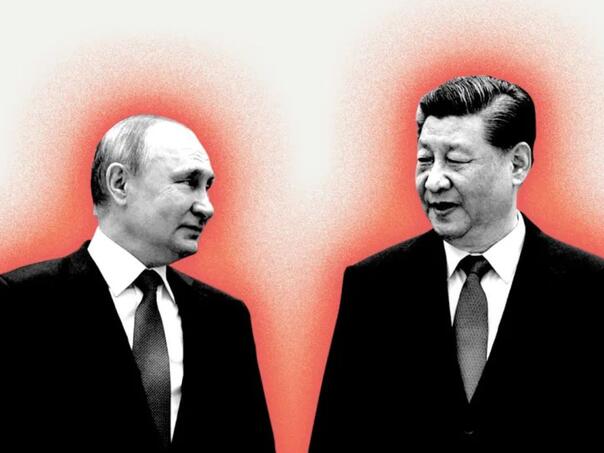
No sooner had American President Donald Trump left Beijing than Russian President Vladimir Putin arrived in the Chinese capital.
Both Russian and Chinese leaders often talk about a “partnership” between the two countries, but that relationship is no longer equal. Russia is increasingly dependent on China, while Beijing decides what and under what conditions it wants to provide Moscow.
Russia often emphasizes an “unlimited” partnership with China, a term coined shortly before the start of the war in Ukraine during one of the many meetings between Putin and Chinese President Xi Jinping. However, relations are becoming more and more one-sided, he writes Deutsche Welle.
Although the volume of bilateral trade fell slightly last year due to lower oil prices, Russian exports to China have almost doubled since February 2022, when Moscow started the war in Ukraine.
In 2024, Russia exported about $129 billion worth of goods to China, with the bulk of raw materials such as oil, coal and natural gas sold to China at significant discounts.
The Center for Energy and Clean Air Research has estimated that China has bought more than $372 billion worth of Russian fossil fuels since the start of the war. That money is crucial for Moscow because it allows it to finance the war despite Western sanctions.
On the other hand, China exported almost $116 billion worth of goods to Russia, including machinery, electronics and vehicles that replaced Western suppliers after withdrawing from the Russian market.
Although Beijing avoids directly sending arms to Russia, China supplies multi-billion dollar worth of dual-use goods, i.e. products that are used for civilian purposes but also have military applications. This keeps the Russian military industry running.
This visit to China also marks the 25th anniversary of the cooperation agreement between the two countries. However, while two and a half decades ago relations were much more balanced, today Moscow is increasingly dependent on Chinese decisions.
China is practically the only source of new technology for Russia
Western sanctions introduced from 2022, which have been further tightened over time, have cut off Russia’s access to advanced Western technology.
The United States, the European Union, Great Britain and their allies have banned the export of semiconductors, microelectronics, precision machinery and other dual-use goods critical to weapons production.
In response, Moscow turned to China, which, according to Bloomberg data, will provide about 90 percent of Russia’s technology imports under sanctions in 2025, up from 80 percent a year earlier.
The acquisition of equipment such as machines for the production of missiles and drones is much more difficult and expensive today than before the war. Russia uses complex networks of circumvention through third countries and often pays up to 90 percent more than before the sanctions were imposed.
According to Bloomberg reports, China has also provided Russia with access to intelligence data, satellite images and drones for military purposes. Chinese technology has allowed Russia to maintain and even increase production of missiles and drones, thus sustaining a war economy.
How Russia pays China
After the start of the war in Ukraine, the United States, the European Union and allies excluded major Russian banks from the SWIFT system and froze about $300 billion of the Russian central bank’s foreign exchange reserves abroad.
Thus, the global financial system, dominated by the US dollar, became a means of pressure on the Kremlin, and transactions in dollars and euros became risky or impossible.
In response, Moscow and Beijing accelerated the process of reducing dependence on the dollar and turning to national currencies. According to Russian Finance Minister Anton Siluanov, more than 99 percent of mutual trade is now settled in rubles and yuan.
This trend is further strengthened by the BRICS group, which advocates trade in national currencies and is considering the possibility of a common currency.
Such “yuanization” also creates new dependencies. Russia occasionally faces a shortage of yuan, higher borrowing costs and a weaker negotiating position vis-à-vis Beijing. China does not want to suddenly replace the dollar, but expanding the use of the yuan increases its global economic influence.
Where is the limit of Chinese influence on Russia
Analysts believe that China’s influence on Russia will grow further in the coming years. During this visit, Putin also tried to negotiate new gas pipeline projects that would increase Russia’s export revenues and China’s energy security.
Beijing, on the other hand, sees it as further strengthening the security of energy supply, especially in case of possible crises over Taiwan.
In particular, the Kremlin wants to complete the “Power of Siberia 2” gas pipeline project, which could deliver up to 50 billion cubic meters of gas per year to China via Mongolia.
However, the project has been stalled for years due to disagreements over price and technical conditions.
China has an interest in stable energy supply, but at the same time it does not want to become too dependent on one supplier and uses its negotiating position.
The meeting between Putin and Xi comes days after US President Donald Trump’s visit to Beijing, during which the US and China tried to stabilize relations after years of tensions. An improvement in relations between Washington and Beijing is not in Moscow’s favor, as it could reduce China’s willingness to engage more closely with Russia.
Beijing makes it clear to both Washington and Moscow that its own economic and strategic interests are a priority.
(Vijesti.ba)



Chat readers
Join the discussion