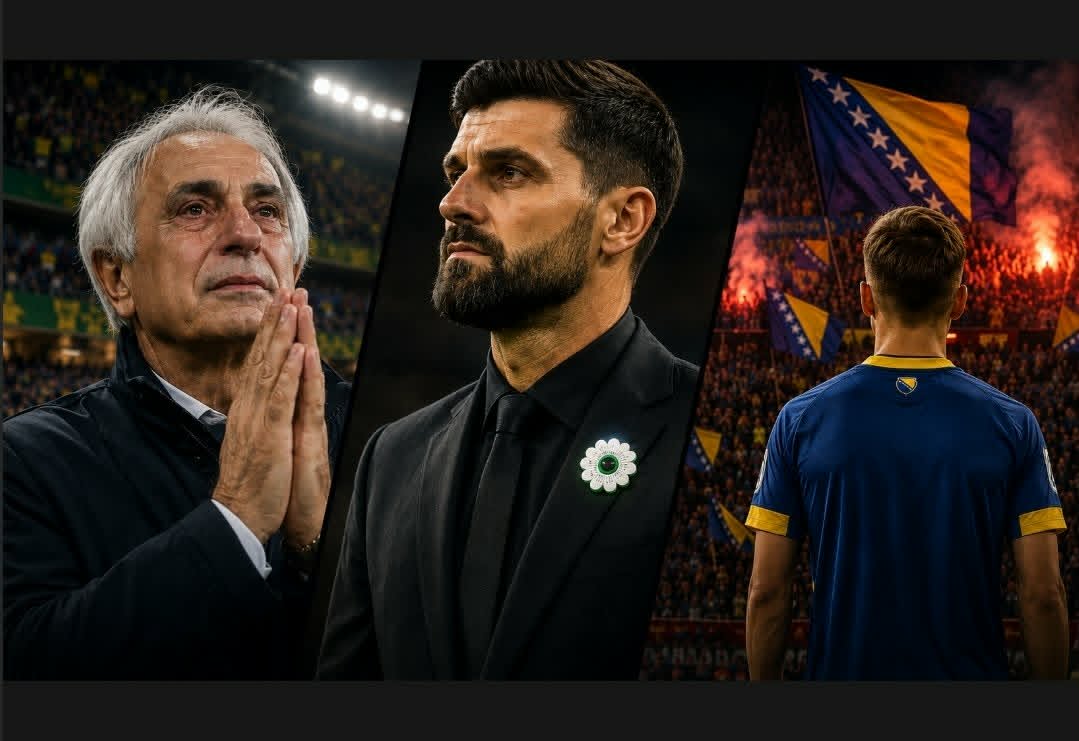
Three frames about a country that has returned from exile
Written by: Hajrudin Redžović
There are times when history does not appear in archives, but on the lapel of a jacket.
On the coach’s message.
On the face of an old man crying in the stadium of Nantes.
And then you realize: Bosnia is not playing the game again.
Bosnia proves again that it exists.
At first glance, Vahid Halilhodžić, Amar Dedić and Miron Muslić do not have the same scene.
One ends his career in France, among people who applaud him as the man who once scored goals for them and later tried to save them from relegation. Another, a boy born in Austria, with Bosnian roots that cannot be removed from the blood even with the tweezers of the European Union, receives a message from Jose Mourinho before the match with Italy. The third is Miron Muslić. Bišćanin. He passed Austria, Belgium and the English Championship. So he arrived at Schalke and brought him back to the Bundesliga. Today, he wears the Flower of Srebrenica as if it were not a symbol, but an organ.
But it’s the same story.
Just a different shot.
Vaha is a shot from an old movie.
Black and white, hard, Mostar, French, refugee. The man who left Bosnia with the war on his heels, and became an institution in France. Not because he was an exotic Balkan man with a nice story for the weekly supplement, but because he knew what big systems often forget: that character is not trained in academies. Character is carried from basements, from shelled cities, from a time when a man does not know if he will have a house tomorrow, but he knows that he will not lose his spine.
And that’s why Vaha’s tears in Nantes are more than a farewell.
These are not the tears of pensioners.
These are the tears of a man who survived his own biography.
Nantes applauded him, but not only the French club stood in that applause. There was a long, invisible column: Jablanica, Mostar, Velež, war, departure, return through other people’s stadiums, national teams he led to the World Cup, dismissals before major competitions, injustices he could not swallow because he is not one of those people who swallow stones and pretend to be rahat-lokum.
Vaha is the Bosnian version of coaching Sisyphus.
Only his stone is not a rock.
His stone is a ball.
And it always rolls uphill.
Amar Dedić is the second staff member.
New.
Fast.
European.
That frame that is recorded in high resolution, but in the background you hear the same noise of the nineties again. Born far from Bosnia, formed in the Austrian system, trained in big clubs, today with Mourinho, tomorrow who knows where. But when you have to play for Bosnia, you suddenly see that a passport is not the most profound document a person has.
And then comes Mourinho.
Special.
A man who has been through all the dressing rooms of this world, who has seen millions, egos, titles, kings, Roman emperors in football boots and London aristocrats in tracksuits. And that Mourinho, in front of Italy, does not send Dedić a tactical message about the back line.
Don’t tell him: close the left side.
Don’t tell him: watch the other goal.
Do not tell him: be calm in the possession.
He tells him what foreigners sometimes feel better than our domestic cynics: remember the victims of this country.
Play for them.
Here is the whole of Bosnia in one message from Portugal.
It’s not pathetic.
It’s pathetic when empty people pretend to be deep.
This is something else.
This is the moment when the world coach understands that the national team of Bosnia and Herzegovina is not just a team. It is a temporary state in boots. A mobile survival embassy. Eleven people who carry what ministries often don’t know how to explain, academies complicate, and politics taints as soon as it opens its mouth.
Amar Dedić then does not enter the game only as a right back.
He enters as a child of a displaced geography.
As proof that Bosnia did not remain only in Bosnia.
Bosnia went everywhere they wanted to forget it. And there she gave birth to children who will one day play for her again.
Someone thought displacement was the end.
It was not the end.
It was scouting.
The third member is Miron Muslić.
He doesn’t have to say anything.
It is enough to stand in front of the camera with the Flower of Srebrenica on his lapel.
In normal countries, the coach wears a club badge.
Here, the coach wears the memorial center on his jacket.
And it’s not a pose.
Because when Muslić says that he wears the Flower of Srebrenica because his soul asks, then PR stops there. That’s where the marketing lights go out. Only man remains there.
In Gelsenkirchen, he could have looked like another coach fixing someone else’s problem. But it didn’t. He stood in front of Europe with the Flower of Srebrenica, as a man who knows that you don’t get into the elite by removing your memory, but standing upright.
The Srebrenica flower on the lapel is not an ornament.
It’s a little white indictment.
And a little green hope.
White – for the innocent.
Green – for what is not killed.
Muslić carries it in a world that would prefer Bosnia to be nice, but not too present. To be sad, but not demanding. To be a nice story about kebabs, bridges and talented football players, but not to wear too much evidence on the lapel.
So wear it.
And let him wear.
Because if Miron doesn’t wear it, someone else will.
If the coach doesn’t wear it, the kid will.
If the child does not wear it, the photograph will.
If the photo is deleted, it will be carried by a sentence.
If the sentence is kept silent, the silence will carry him.
And Bosnian silence, once it accumulates, can be louder than a stadium.
That’s why Vaha, Amar and Miron are not three separate sports news.
It’s a trilogy.
Vaha is a past that refused to be defeated.
Amar is a bridge.
Myrrh is a sign.
And behind them, a new wave is already coming.
Esmir Bajraktarević and Kerim Alajbegović are not here to expand the story, but to confirm that the story is not over. One from the American, the other from the European football factory of Bosnian dispersion — from Leverkusen and Salzburg. Two boys, two times, one invisible umbilical cord.
Columns used to leave Bosnia.
Today, wings, midfielders, coaches, selectors and children who do not have to explain why they play for their parents’ country are returning from those columns.
Someone thought that the refugee was the end.
It was not the end.
It was a nursery school.
And that’s where everything ties in with Cardiff and Zenica.
Because what happened from Cardiff to Zenica was not just a football route.
That was the return line. I was in Cardiff. I know what it looks like inside.
Bellamy understood that better than many of us. He watched Bosnian war documentaries. And realized: this is not a team. This is a country that survived its own erasure.
From a country that was said not to exist – to a country that is going to the World Cup.
From the war documentaries that Bellamy watched – to Mourinho’s message to Amar Dedić.
From the sight in Cardiff – to the Srebrenica Flower on Muslić’s lapel.
That’s our strange representation.
It’s not always the best.
It is not always organized.
She’s not always smart.
She often puts her foot down.
But once war memory, diaspora, spite and football are combined – then something is created that great nations have a hard time understanding.
For them, football is fun.
With us, sometimes the only proof is that we did not agree to the deletion.
Therefore, it should not be surprising that Vaha cries.
That Amar listens to Mourinho as if he had sent him a war dispatch from Lisbon.
Because Miron wears the Flower of Srebrenica as if it were sewn directly to his heart.
That Esmir and Kerim look like the future, but actually come from the past that their parents survived so that they could run without fear today.
It is not an excess of emotion.
It is a lack of justice that has turned into a sport.
And that’s why, the next time someone says that ‘it’s just football’, you should answer them calmly:
It is.
Just football.
Like a passport is just a booklet.
Just like a flag is just a canvas.
Like a flower is just a flower.
Until the people they said didn’t exist come.
So make a proof out of all that.