
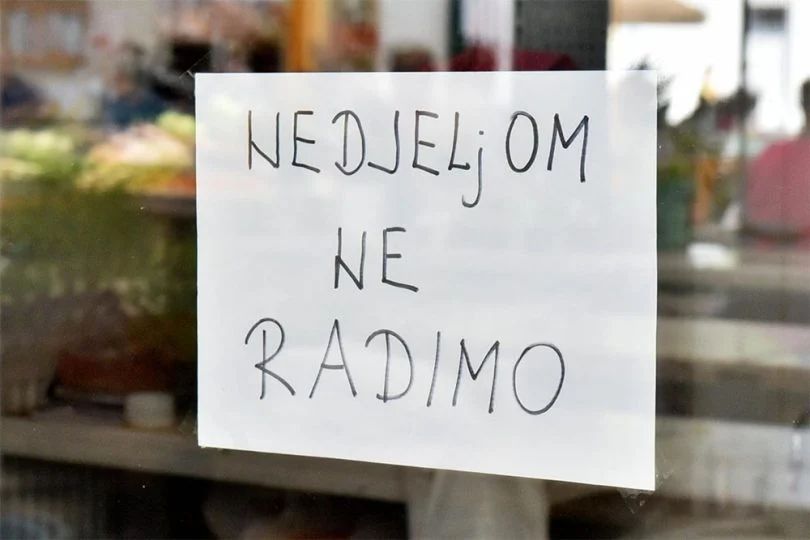
The non-working week in the Federation of Bosnia and Herzegovina caused, according to the available information, a series of negative consequences, in terms of traffic, employment levels, but also the reactions of local communities that seek exemption from this legal provision, which is why all aspects of this issue should be carefully considered in the Republic of Srpska.
This was highlighted by the Ministry of Trade and Tourism of the Republika Srpska, from which they state that the concept of a non-working Sunday is often misinterpreted by the public as a non-working day for everyone, although it only refers to trade. They indicated that before making a decision on its introduction, it is necessary to analyze the opportunities in the local community and how this measure would affect the business and life of citizens. When it comes to the non-working Sunday in the Republika Srpska, the Ministry states that the trade sector is in direct and constant connection with the needs of citizens and the economy.
“Before making decisions, it is necessary to analyze the situation and opportunities in the local community, as well as the impact that the decisions will have on business and the lives of citizens,” the Ministry points out.
They add that in connection with this topic, it is necessary to carefully analyze all the steps, paying special attention not only to the effects on the economy, but also on the satisfaction of the workers. They remind that, according to the provisions of the Law on Trade, it is prescribed that the assembly of the local self-government unit determines the working hours, the schedule of daily and weekly working hours of sales facilities, working hours on national holidays and non-working days on which the trader is obliged to do business, and working hours for markets, fairs, exhibitions and other occasional ways of conducting trade.
The Ministry notes that in the process of adopting the Law on Trade, they complied with all legally prescribed procedures, including the general public and all interested parties.
“Taking into account that all municipalities are not equally developed nor have the same developed economic areas or potential opportunities for the development of some of the economic branches, nor that the needs of residents and businessmen are equal, a provision of the Law on Trade was adopted, which gave the autonomous right to local communities to regulate the area of determining non-working days on their territory by themselves, taking into account the economic and social impacts that such a decision can have”, the Ministry states.
They also emphasize that the term non-working Sunday is often misinterpreted as non-working for all activities. The Ministry indicates that in this context, a non-working day is understood only for the trade sector, while for employees in other industries who currently also work on Sundays, it remains a working day.
“Therefore, it is particularly important to point out that the Labor Law prescribes both daily and weekly vacations, as well as that the General Collective Agreement establishes a higher price for work on Sundays and holidays,” said the Ministry.
The Ministry believes that there are legal conditions that guarantee the protection of workers’ rights and adequate remuneration for work on Sundays, but that it is certainly necessary to monitor the implementation and compliance of these regulations in practice through the competent authorities, writes Acts.


