
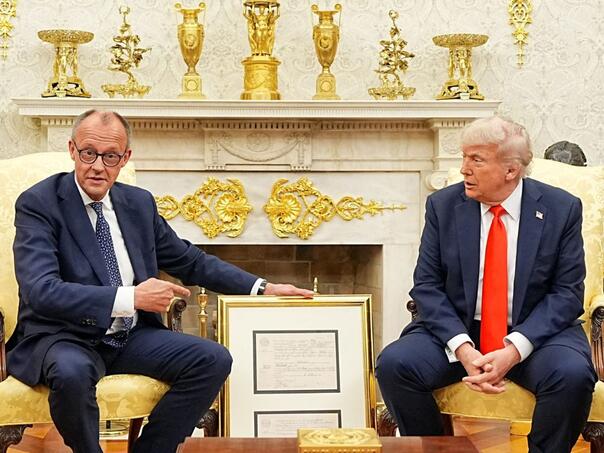
As recently as last week, German Chancellor Friedrich Merz was “on the same page” with US President Donald Trump regarding the goals of the war against Iran.
Now he no longer sounds so enthusiastic, writes POLITICO.
Europe’s most powerful leader in the early days of the conflict decided to stand firmly with Washington, while other European leaders such as Spanish Prime Minister Pedro Sánchez and French President Emmanuel Macron condemned the US-Israeli strikes as illegal.
But Merz must now make an abrupt U-turn as the economic and security impact of the war on the European Union’s largest economy becomes increasingly clear, and he publicly expresses fears that Trump has no exit strategy to end the fighting in the Persian Gulf.
On Friday, during his visit to Norway, he took the most critical tone so far. He said the war raises “big questions” about security and added:
“It has a huge impact on our energy costs and has the potential to cause mass migration.”
That’s a big difference from his visit to Washington last week. Then, during the meeting with Trump in the Oval Office, he expressed his support for the goals of the war set by the American president. He even laughed when Trump boasted about the extent of the damage that US airstrikes had done to Iran and declared that Berlin was fully aligned with Washington in the need to remove the “dictatorship” in Tehran.
But the chancellor is no longer in a mood to laugh because the consequences of the war — which is entering its third week — are increasingly threatening numerous German and European interests. His political isolation among key European allies and growing pressure from his coalition partner, the Social Democratic Party (SPD), have prompted him to take a tougher stance on the war in recent days.
Merz increasingly fears that the war in Iran will further deepen his country’s serious economic problems — especially as Germany’s already weakened industrial sector will suffer a further blow from soaring energy prices.
He also fears that the conflict could set back European efforts to end the Russian-Ukrainian war and trigger a new refugee crisis, just as he is trying to prevent the far-right and anti-immigration Alternative for Germany (AfD) party from becoming the most popular political force in the country.
Merz on Friday condemned the Trump administration’s decision to ease oil sanctions on Russia to lower global oil prices, warning that it could refill the Kremlin’s war coffers and allow Moscow to resume its invasion of Ukraine. He called that move “wrong”.
“We want to ensure that Russia does not use the war in Iran to weaken Ukraine,” Merz added.
“Infinity War”
Merz has been sending mixed messages about Iran since the start of the US-Israeli attacks. The day after the first attack, he expressed doubt that the operation would succeed in overthrowing the regime in Tehran and warned of the danger of an “Iraqi scenario”. However, he said that Germany is not in a position to “teach lessons” to the allies and that he supports their goal of regime change.
Those conflicting messages even caused confusion in the Iranian government.
“We don’t know what Germany’s real position is,” Iran’s ambassador to Germany, Majid Nili Ahmadabadi, told POLITICO. “We are hearing different voices from within the government itself.”
But Merz on Wednesday took a somewhat harsher tone towards the US-Israeli attacks. Standing in Berlin alongside Czech Prime Minister Andrej Babis, he expressed concern that the US and Israel have no plan to end the conflict.
“We have no interest in endless war,” he said at the time.
That shift is partly the result of growing pressure from within the EU and within his own coalition government, where SPD lawmakers have increasingly openly criticized Merz’s Christian Democratic Union (CDU) for being too accommodating to Trump and attacking Iran.
“The CDU position is losing more and more support,” said René Repasi, a member of the SPD in the European Parliament.
Repasi added that the criticism of the US-Israeli attacks by the President of the European Council António Costa shows how isolated Berlin is. “He knows that the majority of member states are with him,” Repasi said.
This week, even Italian Prime Minister Giorgia Meloni — otherwise a frequent Trump ally — joined European leaders in condemning the attacks on Iran as a violation of international law.
Merz didn’t go that far — and probably won’t. But SPD politicians in Berlin argue that his harsher tone in recent days is at least partly the result of pressure they have exerted.
“There were several discussions in the coalition in which we insisted very strongly that we must clearly reject this war,” Adis Ahmetović, the SPD’s leading representative for foreign policy, told Deutschlandfunk radio.
Fear of economic consequences and refugees
Merza also raises concerns about the economic risks of a protracted war, particularly as Germany’s energy-intensive industry — which was already struggling before the conflict began — is particularly vulnerable to rising costs.
“The outlook for economic growth is likely to deteriorate further,” wrote one of Germany’s leading economists, Veronika Grimm, in a commentary for the Handelsblatt newspaper. “For Germany, this means that hopes for a return to economic growth are diminishing again.”
It is also expected that Germany will be among the EU countries that will feel the consequences the most if the escalation of the war in the Middle East causes a new refugee crisis.
According to a study by the Berlin-based Rockwool Foundation, Germany would be the most common destination for Iranians fleeing the war — 28 percent of respondents cited it as the most likely destination, largely because the country already has a large community of Iranian refugees.
Those challenges come as Merz’s conservatives face a series of provincial elections, in which growing concerns about the economy and war abroad play a role — and help bolster the far right.
Given the growing risks, Merz said on Friday that he would work on a plan to end the war through talks with the G7 countries and Israel.
“Germany is not a party to this war and we do not want to become one,” Merz said.
“In this sense, all our efforts are aimed at ending the war.”
(Vijesti.ba)


