
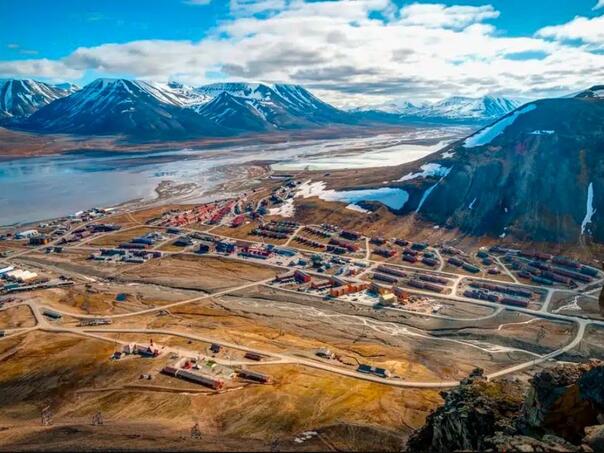
Nestled in the middle of the arctic tundra, between glaciers and under polar skies, Longyearbyen lies almost exactly halfway between the North Pole and Russia’s Kola Peninsula, home to the main headquarters of Putin’s nuclear fleet.
In Longyearbyen, where the ground is permanently frozen, houses and apartment blocks for more than 2,000 residents are built on stilts, writes Der Spiegel.
During the season, cruise ships disembark waves of curious tourists daily who stock up on local Arctic specialties – like reindeer prosciutto, smoked seal and whale steak served with onion compote.
For many years, the Norwegian slogan for the North was: “High North, Low Tension”. This expressed the hope that relations with Russia in the Arctic would remain calm despite geopolitical tensions. But that idea seems to have come to an end.
The Norwegian government plans to significantly increase the military budget – in the future, it will allocate 5 percent of GDP for defense, which is more than double compared to previous amounts.
This decision was made due to the increasing strategic importance of the Svalbard archipelago, which enables surveillance of key maritime routes between the Barents Sea and the North Atlantic.
The archipelago also plays a key role in the future exploitation of large, as yet undiscovered oil and gas reserves.
Back in 2020, Vladimir Putin recognized the growing importance of the Arctic and introduced a development plan for the region above the Arctic Circle.
Soon after, he ordered the reorganization of Russia’s Northern Fleet, which is now an independent military district with a powerful nuclear arsenal.
That fleet, stationed in the Barents Sea, forms the core of Russia’s naval power.
According to an internationally legally binding agreement, which was ratified, among others, by the Soviet Union, Svalbard has belonged to Norway since 1925 as a demilitarized zone.
At least on paper, that archipelago in the Arctic therefore belongs to NATO territory, reminds Der Spiegel.
But since Russia invaded Ukraine in 2022, there is growing concern that Svalbard could become a new crisis hotspot.
Not only because of its strategic position within the operational area of the Russian nuclear submarine fleet, but also because Svalbard, in addition to about 3,000 polar bears, is also home to a significant number of Russians.
On the Arctic archipelago of Svalbard, under Norwegian sovereignty, there are also several Russian strongholds that still operate today under the auspices of the state-owned mining concern “Arktikugol”.
This company, based in Moscow, was founded in 1931 to manage Soviet coal mining interests in Svalbard – a role it still retains today, albeit in a changed context.
(Vijesti.ba)


