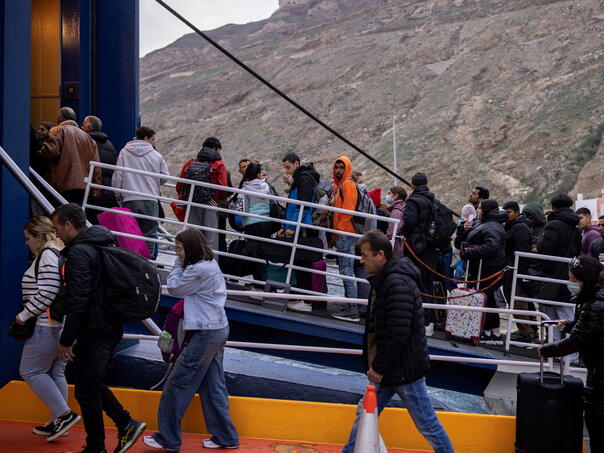
More than 11,000 people left the island due to successive earthquakes, and the authorities began taking additional security measures due to the possibility of stronger earthquakes, index.hr.
The island hit “roy earthquake”
Recall, the Greek government declared a state of emergency on the island of Santorini, which earthquakes affect several times a day, sometimes in intervals of just a few minutes.
“Roy earthquake” feels on other nearby Aegean islands. It all started at the end of January a series of very weak earthquakes (weaker than magnitude 3), which were barely noticeable. But in the early February, the seismic activity increased, earthquakes became stronger and more frequent.
Thousands of earthquakes in two weeks
In the last two weeks, several thousand earthquakes were recorded, of which as much as 30 a day had a magnitude higher than 4.0. Most of them happened at a depth of less than 10 kilometers, which means that people on the islands felt quite strong.
Stronger earthquakes caused rocks of rocks on the coastal cliffs and minor damage to buildings. The strongest earthquake so far, Magnitude 5.1, hit Region 6. February. He was also felt in Athens, on the Crapa and in parts of Turkey for more than 240 kilometers.
Santorini, otherwise one of the most visited tourist destinations in the world, is almost empty. In the last seven days, the island left about 11,000 people, including tourists and the local population. Many fear that seismic activity could be an introduction to volcanic eruption.
How does the “swarm earthquake” form and what follows?
Greece is one of the seismically the most active regions in Europe, so frequent earthquakes are not unusual.
The current seismic activity is located near Andros, an uninhabited island about 30 kilometers northeast of Santorini. This area is located within the Hellenic subduction zone port, where the African tectonic board is slowly underlined below the Eurasian board (or, specifically, the Aegean microplates).
The Santorini-Amorgos Earthquake Swarm Just Keeps Going. It has now produced over 1,000 Individual events since it began on January 27. pic.twitter.com/kqwxej0vbb
– Nahel Belgherze (@wxnb_) February 5, 2025
There are numerous tectonic cracks in that region – fuss – where earthquakes often occur.
Santorini is Volcanian Caldera, created over the last 180,000 years, and the last eruption occurred in the 1950s. Earthquakes may be associated with volcanic activity, ie the movement of the magma below the surface.
However, the current seismic activity is not located under Santorini, and local experts have not yet observed the signs that these earthquakes could be an introduction to a new eruption. They seem to be associated with tectonic fault between Santorini and the island of Amorgos.
History of powerful earthquakes
This is not the first time that earthquakes hit that area. In 1956. A strong earthquake of Magnitude 7.8 caused destructive Tsunami. Just a few hours later, a subsequent earthquake of magnitude 7.2 was followed. More than 53 people were killed at the time, and hundreds were injured in the shake series, subsequent strikes and Tsunami.
Σαντορίνη: μεγάλη κατολίσθηση στην κόκκινη παραλία τουρίστες έβΓαζαν selfies στο χείλος του γκρεμού
https://t.co/llvgbyjebh# σεισμος # Σαντορινη # σεισμός # Σαντορίνης pic.twitter.com/h5np5jwxeq– In.gr/news (@in_gr) February 4, 2025
Earthquakes arise when stress in the Earth’s bury suddenly release, causing shooting along the fault and release energy in the form of seismic waves. Usually a strong earthquake (the main stroke) monitors a number of smaller subsequent earthquakes that gradually weaken. This is a typical main earthquake-subsequent shocking form.
Instead of dominant earthquake – swarm
But some earthquake series behave differently. Instead of a dominant earthquake, many earthquakes occur similar to the volume during the day, week or even months. Such sequences are known as “swarm earthquakes”.
Emergency Crews Sprang Into Action Monday as a “Quake Swarm” Hit Santorini, Sparking Fears of a Major Earthquake.
Schools Were Closed, Safety Measures Extended to Nearby Aegean Islands After Over 200 Underse Quakes, Many Exceeding 4.5 Magnitude.
pic.twitter.com/k5jwiagzmn– (@nerdy_addict) February 3, 2025
The 1956 earthquake. He was a classic example of the main stroke with subsequent shivers. However, the current array of earthquakes in Santorini – with thousands of earthquakes between Magnitude 4.0 and 5.0 – suggests that this is “swarm earthquake”.
“Roy earthquake” is often associated with the movement of fluid through the Earth’s crust, which makes it less dramatic from the sudden shooting of a large fault. Seizmologists carefully analyze the difference between the main earthquake and subsequent strikes and “swarm of earthquakes” because it helps them understand the causes and possible consequences of these phenomena.
Can the even stronger earthquake follow?
The correct outcome of the current seismic activity in Santorini cannot be predicted. Global statistics show that only about 5% earthquakes precedes a stronger earthquake.
However, there is still a possibility that stronger and potentially developed earthquake could guess that area in the near future. Although “shake swarms” are usually associated with lower magnitudes, they can last for days, weeks or even months. They often calm down, then intensify again, which further disturbs the population.
(Vijesti.ba)