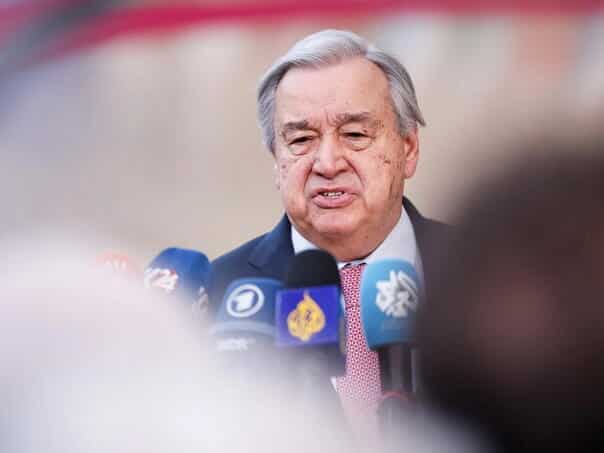
He stated that during almost a decade at the head of the UN, he witnessed the challenges that our world is facing again and again, such as climate crises, deepening poverty, violent conflicts and narrowing of the space for civil engagement.
– In the same way, I witnessed numerous solutions that come to life in practice, and all of them had the same common denominator – women. Below I list eight steps, derived from my personal experience and inspired by the activities of the UN system and civil society movements around the world, to improve women’s rights and achieve concrete results – said Guterres.
The first step according to him is to bridge the disparity in power because gender equality is a matter of power.
– Nevertheless, institutions dominated by men continue to shape our world. A rising tide of authoritarianism is deepening these inequalities, rolling back hard-won protections from fair labor practices to reproductive rights, and entrenching racial and gender biases that hold women back. Gender equality improves societies. With an equal distribution of power, freedoms are expanded – said Guterres.
He added that it is necessary to make parity a priority since women are severely underrepresented in government and management structures around the world.
– In the United Nations, we established gender parity as a priority, starting from the top management, and in such a way that we expanded the search for qualified candidates, instead of lowering the standards. As a result, the UN is stronger, with an improved working culture and more inclusive decision-making. The lesson is clear – when institutions choose equality, the results are inevitable – said Guterres.
As the third step, he mentioned investing in investments with the highest return, and investing in women brings extremely high returns.
– Every dollar invested in girls’ education brings almost a three-fold return, while investments in maternal health and family planning generate more than eight-fold benefits. Policies to support families, such as childcare and elder care, strengthen communities and activate additional growth. Together, these steps lay the foundations for overcoming gender disparities, which can increase national income by up to 20 percent – Guterres emphasized.
The fourth step would be to ensure women have a seat at the table in the peace talks.
– Peace agreements last longer when women participate in negotiations and their implementation. Yet there are too many conflicts, including Gaza, Ukraine and Sudan, where women are largely excluded from the process, even though they bear the brunt of the war. In a time of growing instability, inclusion is not only symbolic but a shortcut to stabilizing our divided world – Guterres believes.
He underlined that it is necessary to end legal discrimination, since all over the world women have only 64 percent of the legal rights enjoyed by men.
– There are too many places in the world where women cannot own property, work freely or ask for a divorce. Even where protection exists, women face greater obstacles in accessing legal aid and courts. Every country must commit to the abolition of discriminatory laws and to the consistent implementation of rights in practice – said Guterres.
The sixth step is zero tolerance for gender-based violence and zero excuses.
– Violence against women is a global crisis, rooted in inequality and maintained by silence. Every woman and girl has the right to live without fear. However, gender-based violence, including sexual exploitation and abuse, remains a serious violation of trust and humanity. We must oppose him everywhere, with zero tolerance, full responsibility and unwavering support for the surviving victims – said Guterres.
It also considers it necessary to remove bias from the digital code.
– Bearing in mind that only every fourth person employed in the technological sector is a woman, bias is built into the systems that shape everyday life. At the same time, misogyny is exploding on the Internet. Tech companies and governments must act together to build safe and inclusive digital spaces, and the world must do more to remove barriers for girls in science and technology, Guterres added.
As the eighth step, he recommended including a gender perspective in climate plans.
– Climate change has a gender dimension. In food crises, women are often the last to eat and are exposed to greater dangers in emergency situations. Girls are exposed to a greater risk of underage marriages in circumstances of disrupted existence. But women are also leaders in climate solutions; they are the ones who adopt green laws, start global movements and lead changes on the ground – said Guterres.
He concluded that a sustainable planet requires gender-sensitive climate policies, including equal access to green jobs, better protection in crises and full participation in environmental decision-making.
– All over the world, I have witnessed the concrete application of the mentioned eight solutions, both in war zones and in recovery processes, in legislative bodies and classrooms, organizations and communities. If leaders take gender equality seriously and immediately commit to these steps, we will change the world, for women and girls, but also for all of us – said Guterres, the UN said.
(Vijesti.ba / FENA)