
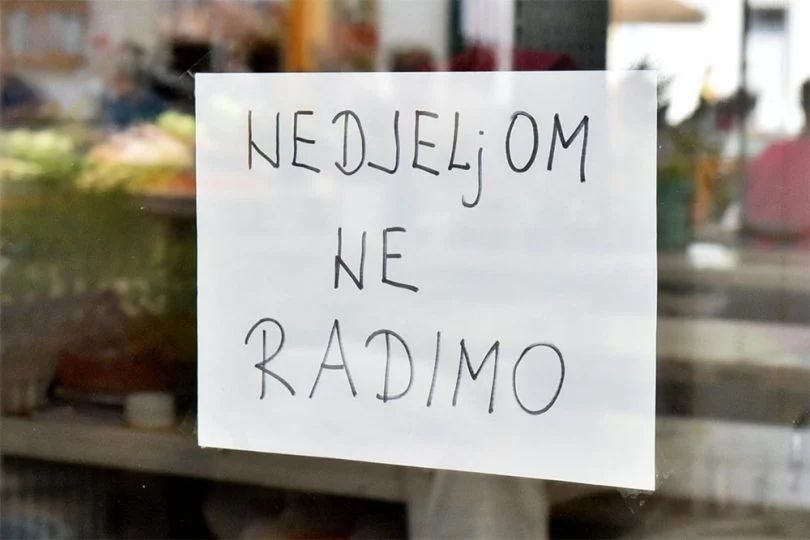
The last letter of the informal group of disenfranchised traders in Zavidovići, those who respect this decision, sent to the Cantonal Inspection, and because of colleagues who still work on Sundays, even issue fiscal invoices, shows how illogical and flawed the non-working Sunday in the Federation of Bosnia and Herzegovina is.
The decision on the non-working week had several points of view from the beginning. While some thought that it was a positive thing that the workers in the shops would rest at least one day a week, even though legally they have two days to do so, others still thought that the only day of the week when they can do shopping is being canceled, so many of them now shop in Republika Srpska.
The last example from Zavidović shows how largely illogical the decision on the non-working week was. Namely, the group of traders pointed out in their letter that they respect the decision on the non-working Sunday, but that there are those who do not do so and deliberately open shops on Sundays, sell goods, issue invoices, and for all that they receive a fine in the amount of 500 KM.
Big profit, so even fines are not a problem
Their turnover on Sundays, according to the disenfranchised traders, is up to 30,000 KM per day, so a fine of 500 KM or 250 KM if paid within seven days is actually miserable. It would be miserable and much higher in terms of traffic.
We were told by the ZDK Cantonal Inspection that for violating the working hours of sales facilities, a fine of 500 to 1,500 KM is provided for natural persons, and legal entities that do not comply with working hours on Sundays are fined from 2,000 to 15,000 KM.
In Zavidovići, this decision is knowingly violated by natural persons, who have been issued several misdemeanor orders in the past months, and more rigorous measures should be issued by the competent courts. How could they not knowingly violate when paying a fine is more economical than not working on Sundays.
Federal Department of Commerce: There are no flaws in the law
The Federal Ministry of Trade told Klix.ba that there are no “loopholes in the law” when it comes to non-working Sundays, that the legal solutions are clearly defined, but that individual cases have been recorded in which natural persons carry out trade activities without proper registration and permission (that they are registered as drugstores) and thus circumvent the regulations.
“Such behavior is not legal and does not represent a deficiency of the law, but rather a conscious violation of it. The inspection authorities act in accordance with the applicable regulations and continuously carry out controls in the field”, we were told by the Federal Ministry of Trade.
Otherwise, fines for violating the regulations range from 500 to 30,000 KM, depending on the offense and whether it is a natural or legal person.
The Law on Internal Trade precisely defines what is considered illegal business and fines for violators are clearly prescribed, so fines of 1,000 to 1,500 KM are provided for natural persons who carry out commercial activities without a license, while for traders – legal entities, they range from 3,000 to 30,000 KM, depending on the severity of the offense and the circumstances of the case.
In addition, the working hours of sales facilities are regulated, fines from 500 to 1,500 KM for natural persons, or from 2,000 to 15,000 KM for legal entities that do not comply with working hours, especially on Sundays, where in addition to fines, a protective measure of banning commercial activities for a period of up to six months can be imposed (passed by the Court).
“The Federal Ministry of Trade clearly states that it will insist on consistent application of the law, equal treatment of all market participants and protection of workers’ rights, and that any attempt to circumvent regulations will be sanctioned in accordance with the law,” they added.
In the end, they said that changes to Article 18 of the Law on Internal Trade were proposed to allow small traders to work on Sundays, but only family members and owners, and that these changes were sent to the FBiH Government for consideration.
Exemptions from the non-working Sunday for: florists, bakeries, souvenir shops, traditional and old craft facilities are also established by law.
“Drag stores cannot have a sales area of more than 50 square meters, purchases are made in the classic way and cannot take place over the counter. Opening a drag store implies additional employment of workers in order to comply with the provisions of the Labor Law, according to which workers work 40 hours a week,” the Federal Ministry of Trade concluded.
Disenfranchised merchants in Zavidovići said that they expect help in solving this problem and hope that everyone will fight together for business in accordance with the law and contribute to creating a better business environment in FBiH and preventing the displacement of the population, writes Klix.
Read more:
- THE WAVE IS SPREADING: Another BiH the municipality introduces municipal taxes for betting shops
- Let’s help little Aylin: A six-year-old girl is fighting a hard fight for her health


