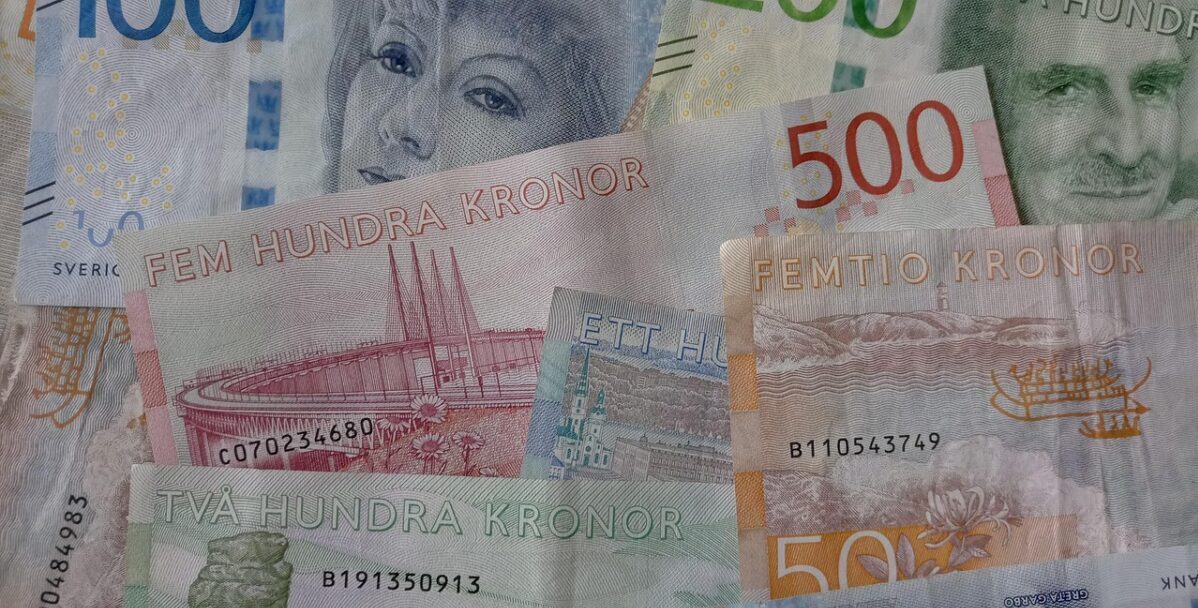
Citizens of Bosnia and Herzegovina who come from Scandinavian countries face the problem of not being able to exchange Swedish, Norwegian and Danish kroner in domestic banks and exchange offices.
Although these are official currencies of stable European economies, their conversion in BiH is currently not possible, which has caused numerous questions from the public.
Regarding the impossibility of converting the mentioned currencies, the Radiosarajevo.ba portal contacted the Central Bank of Bosnia and Herzegovina (CBBH) seeking an answer to this question. As we were informed by this institution, commercial banks make the decision whether to trade in a foreign currency independently:
“Answers to the questions are not within the competence of the Central Bank. Commercial banks in Bosnia and Herzegovina are free, in accordance with their business policy and the ability to exchange currency on the foreign exchange market, to decide whether to trade with a foreign currency. The legal provisions of the Central Bank of Bosnia and Herzegovina oblige commercial banks and other authorized financial institutions in Bosnia and Herzegovina to, upon request and without restrictions, sell and buy the convertible mark for the euro,” explained the CBBH.
Then we turned to commercial banks, which informed us that they had suspended the conversion of these currencies as early as 2023, and the reason lies in the specificity of Scandinavian payment transactions:
“Scandinavian countries have almost completely switched to cashless payments, which is why their currencies are rarely used in cash today even in their home countries. Banks no longer process them or return them to international circulation,” we were told.
Regarding this issue, we also contacted the exchange offices, which confirmed to us that they do not convert these currencies due to the business decision of the bank whose authorized exchanger they are:
“In accordance with current regulations and the business policy of the bank on whose account we perform foreign exchange operations, the purchase and sale of foreign currencies is carried out exclusively for currencies that are on the bank’s valid exchange rate list. Currently, certain currencies, such as: Swedish krona, Danish krona, and Norwegian kroner, are exempt from redemption. Specifically, in our case, the reason for suspending the purchase of the above-mentioned currencies is not a ban by the regulator, but a business decision of the bank for which we are an authorized exchanger. We hereby inform the public that in all our branches, it is possible to purchase and sell the currency CHF (Swiss francs) for all paper notes of this currency that are valid and in circulation”, explained the Exchange Exchange Exclusive Change.
We also checked the possibilities of exchanging crowns in the countries of the region, and determined that the conversion is currently not possible in Croatia, Serbia or Montenegro either, since banks and authorized exchange offices in those countries do not buy these currencies.
When it comes to the countries of the European Union, the situation is identical, with the fact that the decision to stop buying cash from Scandinavia came into force a little later, in July 2024.
Let us remind you that Sweden is considered one of the most cashless economies in Europe. In many parts of the country, only about two percent of transactions are made in cash, while the rest is realized by cards and digital payments. This means that the physical demand for krona outside of Sweden is not great, which banks often cite as a reason for the reduced interest in buying the currency.
Although cash is used in most places, Denmark is a highly digital society. Many shops, cafes and restaurants are now cashless, accepting only credit cards or mobile payments such as MobilePay or Apple Pay. It should also be borne in mind that some kiosks and supermarkets stop accepting cash after 8 pm, while according to research by the Norwegian Central Bank, only three percent of consumers in Norway use cash for their payments.
Those coming to Bosnia and Herzegovina from Scandinavian countries are recommended to use payment cards or to exchange kroner for euro or another internationally accepted currency in the country from which they are traveling. This approach ensures smooth execution of financial transactions upon arrival in Bosnia and Herzegovina.
For the citizens of Bosnia and Herzegovina who have a certain amount of crowns, there are only a few options left: to spend them during their next stay in one of the Scandinavian countries or, if they know a person who will soon travel to that part of Europe, ask them to convert them in local financial institutions on their behalf, he writes. Radio Sarajevo.