
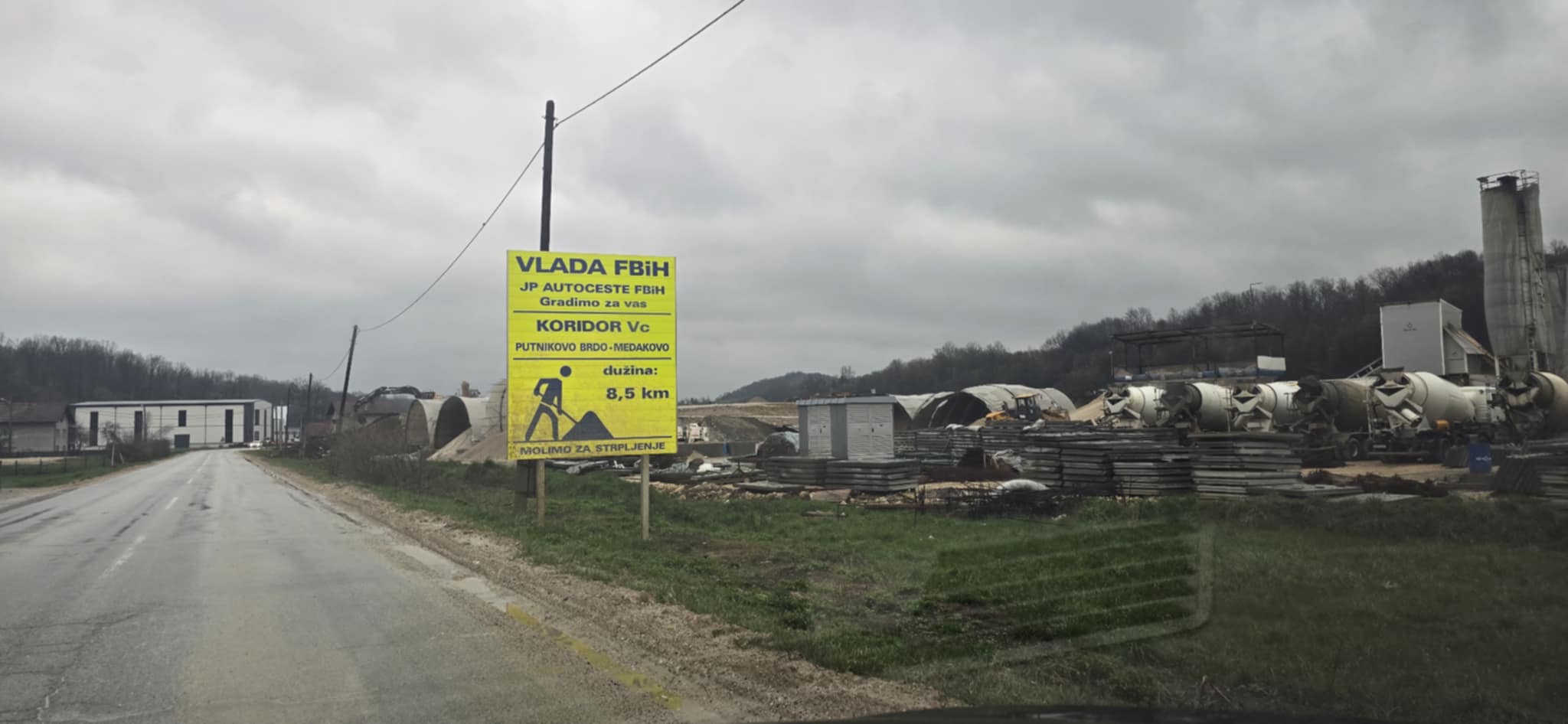
The construction of Corridor 5C has been presented as a key infrastructure project of Bosnia and Herzegovina for years. And while the authorities announce the opening of new sections already this year, the total costs are rising, and the completion date is still not clear.
In the meantime, countries like Poland implement similar projects faster and at lower costs, which additionally raises the question of the effectiveness of domestic implementation.
Although two decades have passed since planning, the Corridor Vc highway has not yet connected the north and south of the country. However, JP Autocesta of the Federation of BiH announces progress, with a plan to open almost 40 kilometers of new sections by the end of the construction season.
These are the sections of Putnikovo Brdo 2 Tunnel – Medakovo with a length of 7.2 kilometers, Medakovo – Ozimica with a total of 21.6 kilometers, then the remaining part of Nemila – Vranduk of two kilometers, the section of Vranduk – Ponirak 4.8 kilometers long, Ponirak – Vraca, i.e. the Zenica tunnel of 3.4 kilometers, and the part of the Zenica Tunnel – Donja Gračanica, the so-called northern section with a length of 0.65 kilometers.
According to announcements, most of these sections, including Medakovo – Ozimica, Nemila – Vranduk, Vranduk – Ponirak and the Zenica – Donja Gračanica Tunnel, should be open by the end of the current construction season. The section Putnikovo Brdo 2 – Medakovo is expected after a technical inspection, while Ponirak – Vraca will be put into traffic only after connecting with the section Zenica north – Nemila.
Corridor 5C was conceived as a key traffic artery that should better connect Bosnia and Herzegovina with the rest of Europe. However, its implementation turned into a slow, expensive and fragmented process, characterized by long-term tenders, problems with expropriation, complex procedures for issuing permits, and political obstructions between the entities.
Traffic expert Mirzet Sarajlić points out that the problems are multi-layered.
“It’s a complex story, in any case, both factors are involved, the topography of the terrain and ineffective project management. We should have let a large contractor make an integral solution, but we didn’t do that, we split up the corridor and now we have numerous lots.”
Precisely because of this approach, it is clear that the construction will take much longer than the original plans, while the price is continuously increasing. According to the official data of the FBiH Government and the FBiH Highway, more than 2.5 billion convertible marks have been invested in the project so far, although less than half of the total project has been realized.
Economist Admir Čavalić warns that the final price could be many times higher.
“Very likely it goes to 6 to 7 billion KM, maybe even 8, due to delays, inflation and the fact that we do not use the effects of economies of scale, but divide everything into small lots, which ends up costing taxpayers.”
Unlike Bosnia and Herzegovina, the example of Via Carpatia in Poland shows a different model. It is a project about 580 kilometers long that has been intensively built since 2014, where about 200 kilometers have already been completed, while an additional 342 kilometers are under construction. A similar, more efficient approach is also visible in neighboring Montenegro, he writes BHRT.
Sarajlić points out that the key is in the organization of the project.
“The most plastic example is Montenegro, which is smaller than Bosnia and Herzegovina, and has entrusted the construction to a global corporation, and the work is progressing much faster.”
It is important to emphasize that the construction of Corridor 5C is mostly financed by borrowing, primarily from the European Bank for Reconstruction and Development and the European Investment Bank, but also from other international creditors. The debt already reaches billions, and with the continuation of the works it will grow even more.
Once the project is completed, the key question will not only be when citizens will drive on this highway, but also who and how will repay the debts incurred during its construction.


