
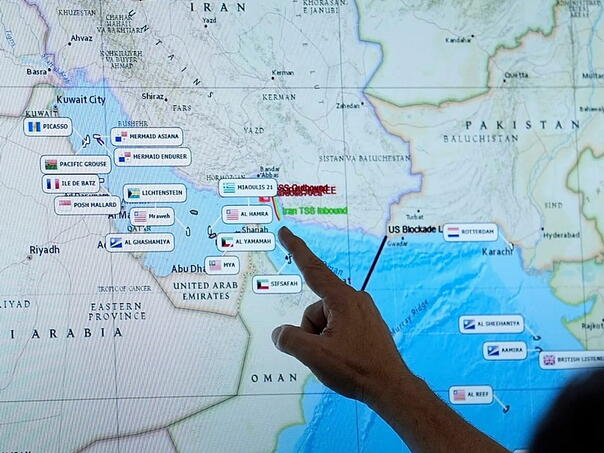
According to the proposal, Israeli vessels would be permanently barred from passage, while ships from the US and its allies would have to pay war reparations, Iranian state media reported.
The proposal comes two months after the start of the war between Iran and the US-Israel, which closed the vital waterway, cutting off 20 percent of the world’s oil and gas supply. The strait was closed after Iran began retaliatory attacks on its Arab neighbors in the Persian Gulf.
The United States has also imposed a naval blockade of Iranian ports since April 13 to prevent Tehran from using the strait as a means of pressure or a source of income.
Under the 12-point plan being considered by parliament, other ships would have to get permission from Iran before passing through Hormuz, said first deputy speaker of parliament Ali Nikzad. He added that the measure would be adopted in accordance with international law and the rights of Iran’s neighbors, but insisted that Tehran would not return the strait to its pre-war status.
“We will not give up our rights in the Strait of Hormuz, and the traffic of vessels through the Strait of Hormuz will not be like before the third imposed war,” he said. Nikzad compared the importance of the new Iranian control over Hormuz with the nationalization of the oil industry in 1951, reports Index.hr.
Mohammadreza Rezaei, chairman of the parliament’s Construction Committee, added that all ships requesting passage would have to use the name “Persian Gulf”.
According to the plan, 30 percent of the collected revenues would be used to strengthen the military infrastructure, while 70 percent would go to economic development and public good.
“Managing the Strait of Hormuz is more important than acquiring nuclear weapons,” Rezaei said. While Tehran hopes to recoup some of the heavy war damage with the new levy system, Washington has warned that companies and governments that agree to pay Iranian fees could face sanctions.
Let us remind you that earlier today Iran made a new proposal for the end of the war. Under the new proposal, Iran would open the Strait of Hormuz to navigation and end the US blockade of Iran, while leaving negotiations on Iran’s nuclear program for a later stage, a senior Iranian official said. Trump rejected the proposal.
Speaking on condition of anonymity, a senior Iranian official said Tehran believes its latest proposal, which calls for a delay in the nuclear talks, is a significant move aimed at making it easier to reach a deal.
Under that proposal, the war would end with guarantees that Israel and the United States would not attack Iran again. Iran would open the Strait of Hormuz to international shipping, while the United States would lift the blockade of Iranian ports.
Future negotiations would then be conducted on limits on Iran’s nuclear program in exchange for the gradual lifting of sanctions. At the same time, Iran demands that Washington recognize its right to enrich uranium for peacetime purposes, even if it would temporarily agree to suspend such activities.
“Within this framework, the negotiations on the more complex nuclear issue have been moved to the final stage, in order to create a more favorable atmosphere,” the official said.
On Friday, Trump said he was “not happy” with Iran’s latest proposal, without specifying exactly which elements he opposed. “They’re asking for things I can’t agree to,” he told reporters at the White House.
Washington has repeatedly said it will not end the war without a deal to prevent Iran from ever obtaining a nuclear weapon, which was the main goal Trump stated when he launched the strikes in February amid nuclear talks. Iran, on the other hand, claims that its nuclear program is exclusively for peacetime.
Back in 2018, Trump withdrew the US from the nuclear deal that the Barack Obama administration reached with Iran in 2015. With that agreement, Iran agreed to reduce its uranium stockpile by 98 percent and limit its enrichment level to 3.67 percent, which is below the level needed to build a nuclear weapon. An enrichment between 0.7 and 5 percent is usually sufficient for the operation of nuclear power plants, while uranium enriched to about 90 percent is used for nuclear weapons.
Reuters and other news agencies have already reported last week that Tehran is proposing to reopen the strait before resolving the nuclear issues. The official confirmed that that timeline has now been detailed in the official proposal, which was submitted to the United States through an intermediary.
(Vijesti.ba)



Chat readers
Open a chat for this news