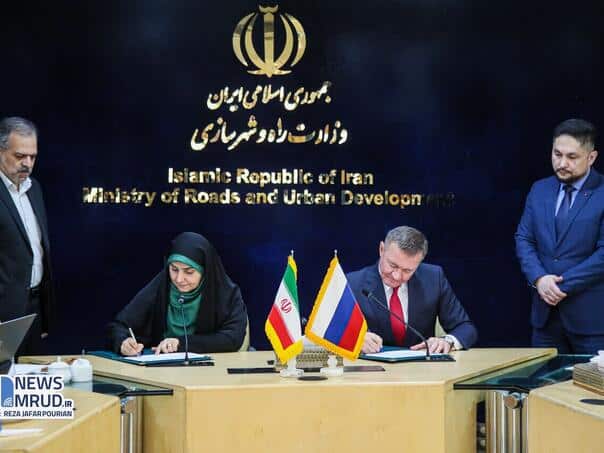
Iran and Russia signed a plan of transport and transit cooperation for 2025. year, with the Appendix for Engineering Studies on the RSHT-Astar Railway Project. The agreement was signed by the Iranian Transport Minister and Urban Development of Farzaneh Sadgh and Russian Transport Minister Roman Vladimirovich Starovoyt.
According to the Ministry of Transport and Urban Development Iran, a two-sided meeting was held on Tuesday at the headquarters of the Ministry in Tehran. The meeting was attended by high Iranian officials, including Saeed Rasoulia, Deputy Minister of Transportation and Acting Head of Luke and Maritime Navigation; Jabaralija Zakerije, Chief of Iranian railway company; Houshanga Bazwanda, head of the company for the development of transport infrastructure; and Amina Tarafo, Chief of the Center for International Affairs of the Ministry.
Minister Sadgh welcomed the Russian delegation, emphasizing the importance of regular meetings for the improvement of bilateral cooperation. She pointed out that continuous talks will help both countries achieve the goals for the completion of the International North-Southern Transport Corridor (INSTC).
Sadgh also pointed out the current third Caspian economic forum, hosted by Iran, with the participation of Russia, calling it a key event to strengthen economic, trade and transport links between the two countries and other countries in the Caspian region.
The Iranian minister expressed hope that the final contract for the Railway Railway Railway, Rasht-Astar will be signed by the end of the current Iranian year (at the end of March), after finalizing the volume of the project and costs. She emphasized that the acquisition of land for a rapid stripe and will be completed within a year.
Sadgh welcomed the approval of the Russian President Vladimir Putin for Engineering Studies on the railway to the railway before finalizing the schedule for the acquisition of land, calling it a positive step towards the project acceleration.
It also pointed out the upcoming trilateral meeting between Iran, Russia and Azerbaijan, on which three countries will define the levels of cooperation for the Western Branch of INSTC in the western part of the Caspian Sea. In addition, she emphasized the importance of focus on the eastern branch of Corridor, identifying transit costs for both routes and resolving bottlenecks.
Sadgh emphasized the potential for the Russian burden to reach Pakistan through Iran, repeating Tehran’s commitment to the maximum utilization of his transit capacities. It also called for simplification of visa truck drivers, increasing the use of the Caspian Sea for freight and passenger transport, including increasing airport frequency, new routes, airports and exchange experiences in the airplane maintenance.
Russia is proposing the Caspian consortium
In response, the Russian transport Minister Starovoyt supported Iran proposals and proposed the establishment of a Caspian transport consortium. The Minister Sadgh greeted this idea, emphasizing that Iran and Russia should be leaders in the implementation of this initiative.
She concluded that the close cooperation of Iran and Russia, which were continuously supported by both countries, benefits for their people.
Iran and Russia are planning a comprehensive plan for the Caspian naval corridor
Also on the margins of the Caspian Economic Forum, Dmitry Azarov, the Deputy Transportation of Russia, the Iranian Deputy Minister of Transportation and Maritime Navigation, to discuss the enlargement of the combined transit through the Caspian Sea and Facilitation of Container’s Transport . They also discussed the plans to start a cruiser between Iranian port Anzala and Russian port Astrahan.
Azarov stated that Moscow is ready to solve logistical challenges in Caspian maritime transport, including alignment of the vessel layout and accelerating the processing of quarish and sensitive burdens. He emphasized that Russia improves the infrastructure of Makhachkal to improve the docking and operations with the cargo, and expressed interest in achieving a comprehensive agreement on maritime and harbor cooperation with Iran.
Tehran’s readiness for the Summit of Maritime Cooperation
Rasouli, on the other hand, said Iran seeks to improve maritime and shipping cooperation with Russia through a joint action plan. He emphasized that Iran strives for the simultaneous development of railway-arched and road-arched connection.
Emphasizing the need for a comprehensive Plan for the Caspian Corridor, Rasouli called on the harmonization of port tariffs, facilitating multimodal transit through the Caspian route and improving the container transit between Iranian and Russian ports. He announced that Iran was willing to hold the Summit of Maritime Cooperation with Russia to finalize the common maritime plan.
128% of the growth of marine transit Iran
Jalil Eslami, Deputy Chief of the Iranian organization for ports and maritime navigation, revealed that the Maritime Transit through Iranian ports increased by 128 percent in the last year, with Kazakhstan and Turkmenistan most of the burden.
However, Eslami mentioned that there are still problems with Iranian shipping in Russian ports, including inefficiency in the schedule, lack of adequate port services such as pilotage and strict inspection. He called for improving the conditions for handling hazardous and quursive goods.
Eslami also announced that Iran is ready to launch a circular and passenger shipping service with Russian ports, inviting Russia to assign the appropriate cruiser for this line.
He also emphasized the long-term six-year delay in the finalization of maritime security agreements for search and rescue operations and inspections between the two countries, inviting the quick solution to this issue.
(Vijesti.ba)