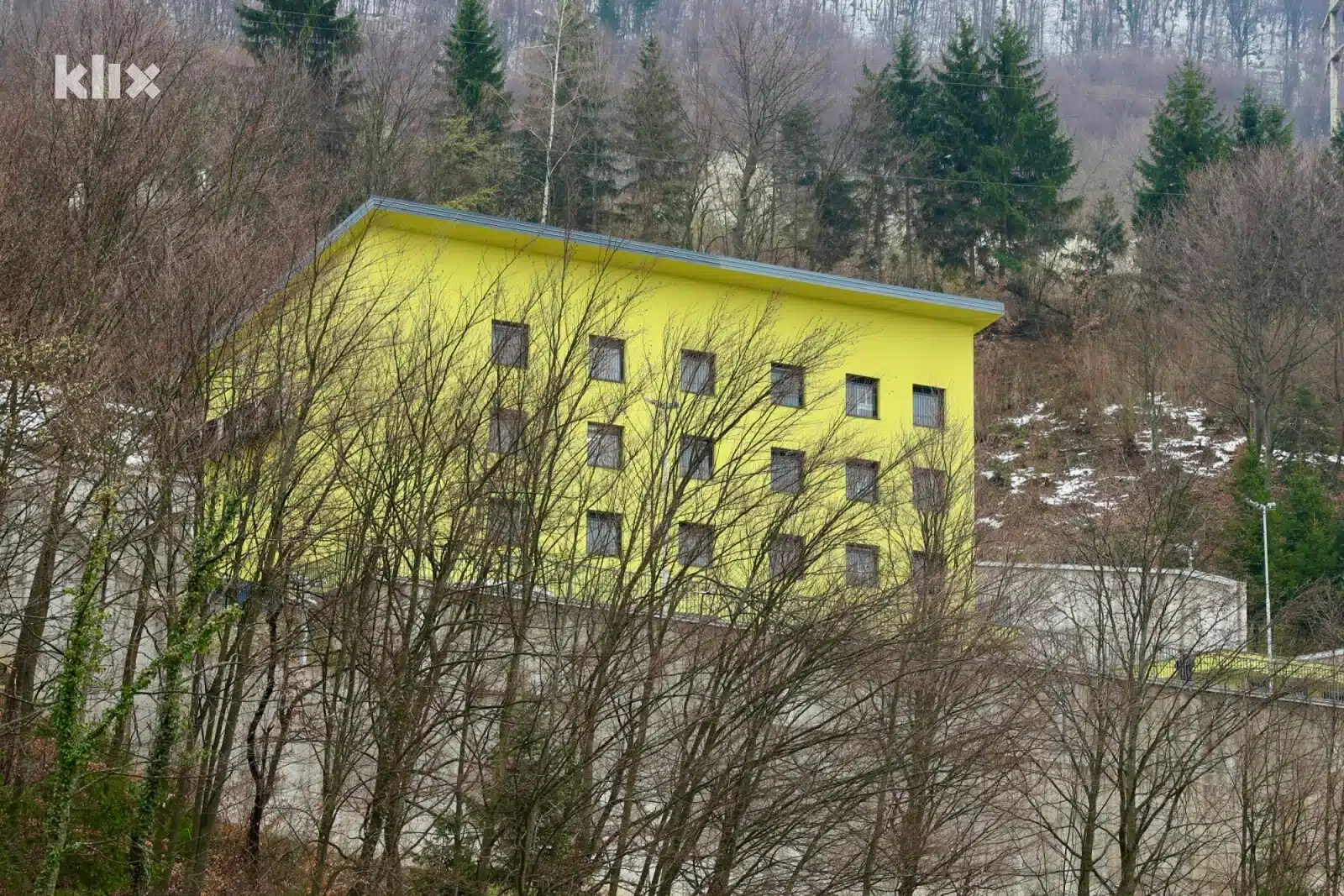
The opening of the expanded unit of the Correctional Prison (KPZ) on Igman represents one of the most significant infrastructure projects within the reform of the prison system in Bosnia and Herzegovina (BiH).
The new premises come at a time when institutions are facing long-standing problems of overcrowding. Officials point out that this facility will contribute not only to the relief of existing capacities, but also to the improvement of the resocialization process.
Convicted persons reside in facility A, and as of March 30, 31 convicts were registered. They spend their time in different ways – they have a daily activity room where they play board games or watch TV. We noticed that there is a TV in the prison cells, and in addition, the convicts spend their time engaged in agricultural, culinary or maintenance work, all within the prison complex.
Convicts also have access to a masjid, that is, a room for performing religious activities.
Special attention was paid to security measures, and only complex B and the administrative building are “covered” with 140 cameras, and the building itself is surrounded by a wall that is more than five meters high in certain parts.
When it comes to complex B, it was opened at the beginning of this year, and has the capacity to receive 55 detainees.
However, the central part is complex C, which will be able to accommodate 300 detainees. We visited every part of this complex – from the detention units, the kitchen, the medical block, all the way to the outdoor activities.
On the occasion of the opening of the new unit on Igman, we spoke with the director of the Sarajevo Penitentiary, Munib Isaković, who took us through Complex A, where convicted persons reside, Complex B, where detainees reside, as well as Complex C, which is also intended for detention.
During the tour, Isaković told us that this prison will receive modern equipped detention units and that the tender for underfloor heating, which was rejected because the bidder offered a price higher than the requested price, remains to be realized.
“Until now, we had a problem when executing the detention measure because the detainees were referred for the execution of the detention measure in Zenica, that will no longer be the case and these capacities will be sufficient. When I was appointed in 2023, the detention system was devastated. We managed to create the conditions for the execution of the detention measure by building these units,” Isaković said.
When it comes to convicted and detained persons, a frequent topic in the public is the process of their resocialization and rehabilitation, and we visited the Treatment Sector where there is an expert team of employees who help convicted persons to return to “normal life” after serving their prison sentence.
As they explained to us, in addition to talking with a psychologist, work therapy is also available where people often discover that they have talents they didn’t know about before.
Professionals work with prisoners exclusively during their stay in prison, after which they are connected with the competent center for social work in order to enable them to find a job when they leave prison. That it is a difficult task is also shown by the fact that there are more and more people who are returnees in the commission of criminal acts.
Given that expanded prison facilities require an increased number of staff, Isaković explains that it will be necessary to systematize in order to be able to respond adequately to the tasks set.
Currently, a competition has been announced for the admission of nine new employees, but that number is not enough.
Two more projects are planned. The first one refers to the connection of the KPZ to the city water supply, where cooperation with the Municipality of Ilidža was achieved. The second project relates to the construction of a security wall, and planning documentation is being prepared.
“Except for this wall, every complex and building is protected by walls, and some of them are more than five meters high,” Isaković explained to us.
In response to our question about the crimes for which convicts are in prison, Isaković told us that it is most often the abuse of narcotics and he pointed out the worrying trend of an increased number of convicts for domestic violence.
For the realization of this project, more than 20 million KM was invested, of which 11.7 million KM was invested from the budget of the Federation of Bosnia and Herzegovina, while the European Union provided funds in the amount of nine million KM, it says. Klix.