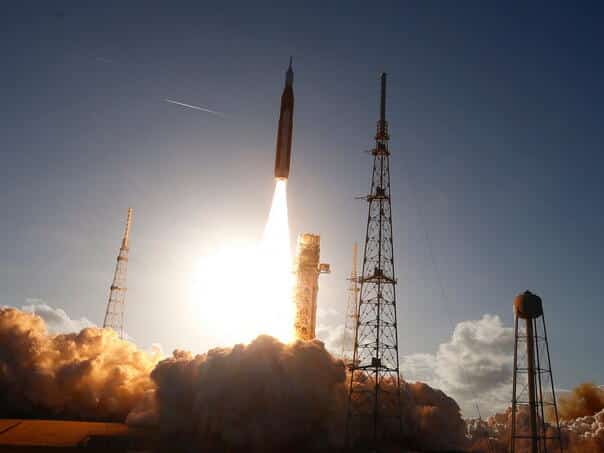
A Space Launch System (SLS) rocket carrying an Orion capsule lifted off from the Kennedy Space Center in Florida, carrying a crew of three NASA astronauts and one Canadian: Reid Wiseman, Victor Glover, Christina Koch and Jeremy Hansen.
Mission Commander Reid Wiseman soon reported to control: ‘Beautiful view. We have a beautiful moonrise.’
The hatch is now closed.
The Artemis II astronauts are now strapped into their seats and ready for launch. pic.twitter.com/NWSjgklep9
— NASA (@NASA) April 1, 2026
The astronauts crossed the Karmann line, the boundary between the Earth’s atmosphere and outer space. They are now in orbit around the Earth. It is a historic mission because for the first time a woman (Koch), an African-American (Glover) and a Canadian (Hansen, astronaut of the Canadian Space Agency) are flying around the moon.
The weather conditions were ideal. During the final preparations for the launch of the Artemis II mission, technical problems arose, but they were successfully resolved.
We’re going around the Moon. Come watch with us. Artemis II’s four-astronaut crew is lifting off from @NASAKennedy on an approximately 10-day mission that will bring us closer to living on the Moon and Mars. The launch window opens at 6:24pm ET (2224 UTC). https://t.co/X27QJejNDt
— NASA (@NASA) April 1, 2026
The media previously reported problems with the Space Launch System’s flight abort system, a key safety mechanism that can destroy the rocket in the event of a trajectory deviation to prevent damage to Earth. The problem was identified during testing just before launch, and engineers solved it at the ground systems level, using some of the equipment from the Space Shuttle program.
An unusually high temperature was also recorded on one battery of the same system. After additional checks, NASA determined that it was an instrumentation error, not an actual malfunction, and that the problem would not affect the safety of the mission. Despite the initial difficulties and prolonged delay in the final phase of the countdown, all key systems were verified, and the launch was finally approved and carried out according to plan, reports tportal.hr.
The orange-and-white SLS rocket is 98 meters tall, about 10 meters shorter than the Apollo-era Saturn V rocket.
The mission is expected to last approximately 10 days and will mark the first manned flight of Artemis. The mission will allow astronauts to test Orion in real-space conditions, including manual control and maneuvering in orbit, as well as conducting a series of scientific and engineering experiments.
Artemis II represents the first human flight as part of the Artemis program, which was launched in 2017 with the goal of establishing a long-term human presence on the Moon and preparing for future missions to Mars. The program succeeds the Apollo missions, the last of which, Apollo 17, ended in December 1972, leaving a gap of more than half a century in human missions to the Moon.
During the mission, the astronauts will orbit the Moon without landing, fly over its far side and collect data that will help in the planning of Artemis IV in 2028, the first manned mission to land on the lunar surface pole – a place where no member of the human species has been before. The return to Earth is planned along a ‘free return path’, using the Moon’s gravity to return without additional propulsion, and the end of the mission is expected after ten days in the Pacific Ocean.
NASA had originally planned to launch Artemis II in early February, but the flight was postponed to March, but during the test, a number of technical problems arose, such as those with the helium supply, which caused the rocket system to be temporarily returned to the assembly building.
Artemis is a legacy of initiatives launched in the early 2000s to continue American spaceflight. These efforts survived multiple presidential terms until current President Donald Trump officially established the program during his first term in the White House.
Unlike the Apollo program, the American space program in which man set foot on the moon for the first time in 1969, this time NASA also cooperates with private industry and other countries, especially European ones. This refers to SpaceX and Blue Origin, competing companies founded by billionaires Elon Musk and Jeff Bezos, which are in charge of developing lunar modules.
(Vijesti.ba)