
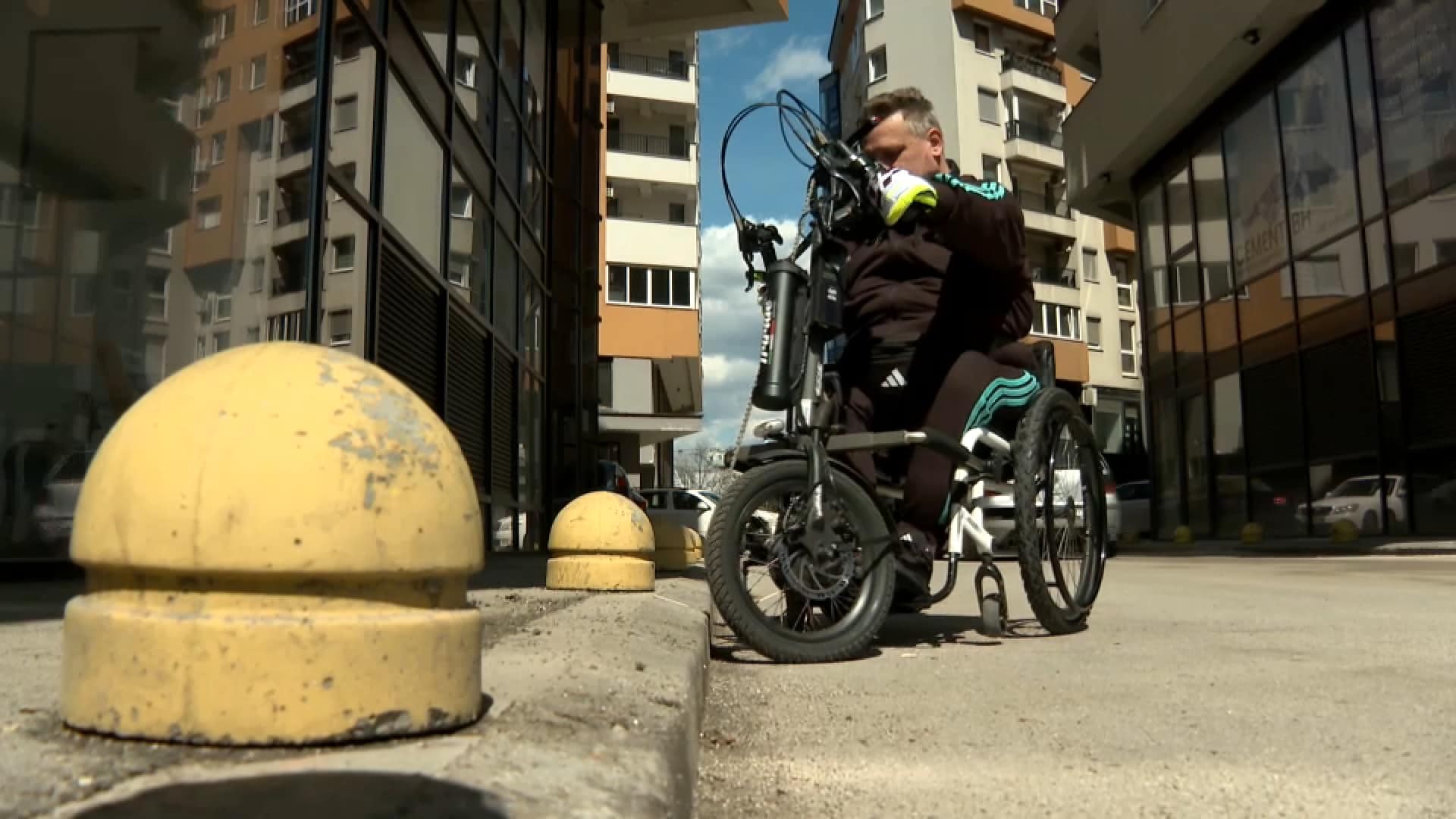
While most of us walk without thinking, for many BH are streets, a training ground full of obstacles. The question of the accessibility of BiH. cities concern the whole society, not just individuals. Although laws exist, the everyday barriers faced by people with disabilities remain invisible to the public eye.
Mirza Alihodžić from Sarajevo never finished college – not because he didn’t want to, but because it was unavailable to him. Stairs at the entrances, high sidewalks and faulty elevators are not trifles for him, but everyday obstacles. He was wounded when he was a child, in 1995, and has been using a wheelchair ever since.
“Since I played basketball in a wheelchair for a long time, I would have finished DIF, so I would have been involved in coaching, because I have a love for that sport,” says Mirza, but adds that, due to the inaccessibility of state institutions, he was not able to finish college.
Today, he points out, the obstacles are the same and continue to limit his movement, education and daily life.
Accessibility of public facilities is still not the standard, but the exception. While some institutions have ramps and elevators, many are still inaccessible, so even the simplest going to the institutions becomes a challenge. Going to the doctor is also a problem – in the Ilidža Health Center, he says, the elevator has not been working for a long time, and the sidewalks are also an obstacle.
“We have problems with architectural barriers, where it is difficult for us to move with a wheelchair in general. I can with a bicycle, but it is very difficult with a wheelchair. I contacted the mayor of the Municipality of Ilidža, he gave me a recommendation to contact the local community, but they turned a deaf ear,” Mirza tells us.
For a long time now, Sarajevo has not been a city where people move, but pass through. This kind of situation for people with disabilities often means stopping and finding another, safer way. But it is not only their problem, but the problem of all of us.
Senija Okić, professor of history and member of the Association of the Blind in Sarajevo Canton, who moves with the help of a white cane, is of the opinion that we should work on raising citizens’ awareness and improving traffic culture. He says there are numerous obstacles, from illegally parked vehicles to scooters and bicycles.
“They are quiet, hard to spot, especially in noisy streets, and they often use the very part of the pedestrian zone where I walk – the markers I follow,” says Senija.
The life of blind people has been made much easier by the development of applications for blind people, which makes it easier for them to move around and increase their independence.
Through the Adaptive traffic management project in Sarajevo Canton, 163 traffic light intersections were modernized, with the installation of LED systems, pedestrian buttons and sound signaling.
The sound signal is now integrated into the traffic light lanterns, thus reducing the possibility of damage and vandalism, which was often the case before.
Movement for blind people is facilitated by the sound announcement of stations in new city transport vehicles.
“It increases driving comfort, driving is more pleasant, we are more relaxed, we hear the announcement and know where we need to get out,” Senija points out.
Such improvements are also necessary in other areas and in other BiH. cities. But still, according to our interlocutors, the very act of leaving the house of a person with a disability, due to all the obstacles, is true courage. N1 BiH.


